Gary Rivlin - Broke, USA
Здесь есть возможность читать онлайн «Gary Rivlin - Broke, USA» весь текст электронной книги совершенно бесплатно (целиком полную версию без сокращений). В некоторых случаях можно слушать аудио, скачать через торрент в формате fb2 и присутствует краткое содержание. Город: New York, Год выпуска: 2010, ISBN: 2010, Издательство: HarperCollins Publishers Inc., Жанр: Старинная литература, на английском языке. Описание произведения, (предисловие) а так же отзывы посетителей доступны на портале библиотеки ЛибКат.
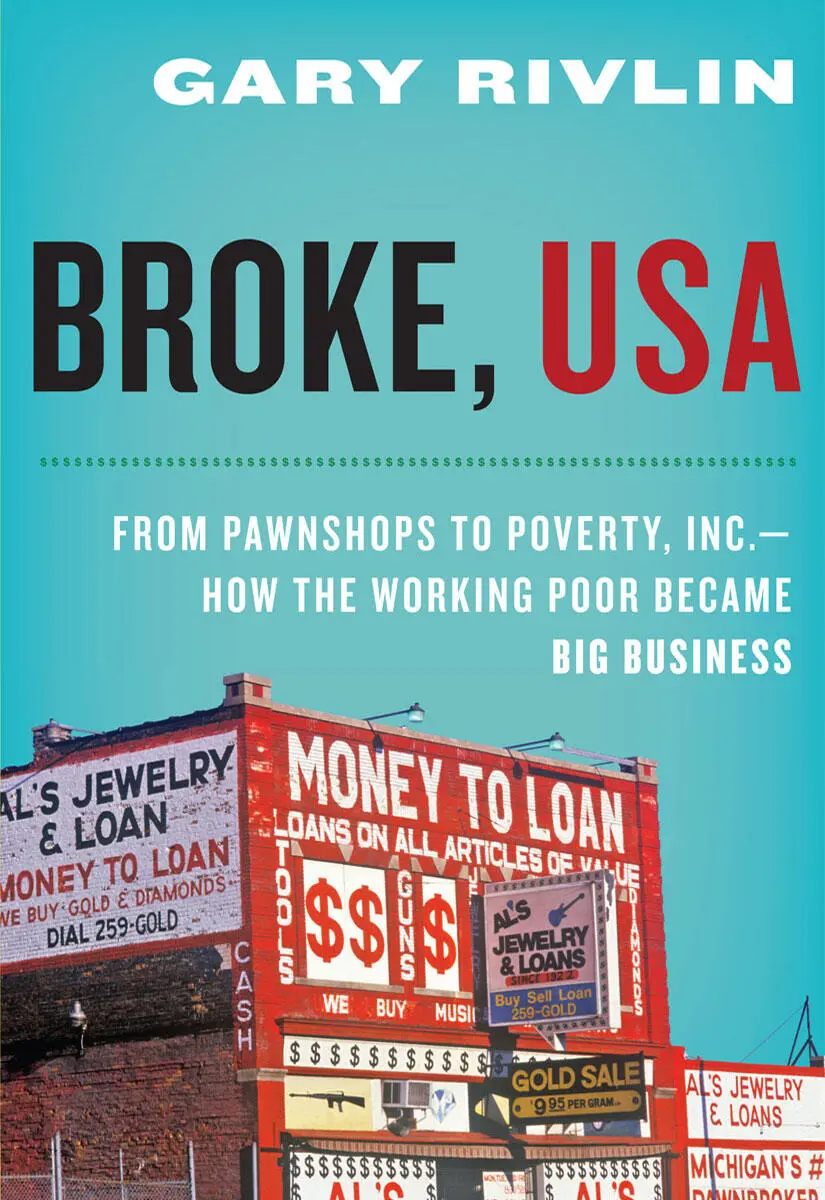
- Название:Broke, USA
- Автор:
- Издательство:HarperCollins Publishers Inc.
- Жанр:
- Год:2010
- Город:New York
- ISBN:978-0-06-199794-5
- Рейтинг книги:3 / 5. Голосов: 1
-
Избранное:Добавить в избранное
- Отзывы:
-
Ваша оценка:
Broke, USA: краткое содержание, описание и аннотация
Предлагаем к чтению аннотацию, описание, краткое содержание или предисловие (зависит от того, что написал сам автор книги «Broke, USA»). Если вы не нашли необходимую информацию о книге — напишите в комментариях, мы постараемся отыскать её.
Broke, USA — читать онлайн бесплатно полную книгу (весь текст) целиком
Ниже представлен текст книги, разбитый по страницам. Система сохранения места последней прочитанной страницы, позволяет с удобством читать онлайн бесплатно книгу «Broke, USA», без необходимости каждый раз заново искать на чём Вы остановились. Поставьте закладку, и сможете в любой момент перейти на страницу, на которой закончили чтение.
Интервал:
Закладка:
Jones wouldn’t have to look far to find his first big competitor. It was a local man named Steve McKenzie, who was a few years ahead of Jones in high school. McKenzie, who everyone called Toby, had grown up poor in a family whose woes were serious enough to draw the attention of the local authorities. He cut a high profile in town even as a teenager, when, to help support his family, he took a job delivering newspapers in a smashed-up Volvo he had bought for $150. A social worker named Joe Kirkpatrick used to look in on the family and especially McKenzie’s younger brother, who had a penchant for getting into scrapes. Kirkpatrick had a theory that people in public housing have no dreams unless they invent a different dream every week. McKenzie was different. “Toby was rough around the edges,” Kirkpatrick said, but likable and also a hard worker. Kirkpatrick made sure to keep an eye out for McKenzie because he struck him as one kid whose dreams seemed attainable.
Jones and McKenzie first met in the late 1970s, when both were still in their twenties and McKenzie was looking to rent space for a new business he had recently gotten into called rent-to-own. “You know how stores rent TVs to people?” McKenzie said in explaining the business to Jones. “I’m going to rent them everything. Living room sets. Bedroom sets. TVs. Everything.”
“Nobody’s going to rent their bed,” a skeptical Jones responded.
“Man, you don’t know. You just don’t know.” But even if Jones doubted the business, he recognized McKenzie as his kind of businessman. Buy a television in a store, Jones remembered him explaining, and you might pay a 20 or 30 percent markup over the proprietor’s price. But rent out that same TV by the week and you make several times what you paid for it.
Competition was inevitable in a business that lucrative, and down the interstate, just south of Cleveland, a rival had seemingly opened directly across the street from one of McKenzie’s stores. The warring between them seemed particularly fierce, with banners that said things like “Don’t be ripped off across the street!” Joe Kirkpatrick remembers expressing his sympathies to McKenzie when they ran into one another in town.
“He looks at me with this big ol’ grin on his face,” Kirkpatrick remembered, “and he says, ‘Joe, I own ’em both. The type of person who goes to a store like mine, they get all pissed off because you repossess, they get back at you by crossing the street. I’m just givin’ ’em a place to go!’”
McKenzie’s rent-to-own empire was up to eighty stores when he hired a CPA named Jerry Robinson to put his books in shape for an initial public offering, or IPO. Robinson worked in what he describes as “the bare-knuckles side of banking,” lending money to businesses like McKenzie’s while working for a subsidiary of Transamerica, the San Francisco insurance giant, called Transamerica Commercial Finance, which specialized in businesses catering to the subprime market. Robinson, who had grown up poor, thought he had found his meal ticket when McKenzie asked him to join him in Cleveland. “There was the potential to make a lot of money doing this,” Robinson said of rent-to-own. “There were millions of people without a checking account and without any kind of credit who needed some way of financing these small transactions.” The only hitch, he discovered, but only once he had moved to Tennessee, was his new boss. Robinson’s eyes began to open during a trip the two made to Chicago to meet with a banker Robinson knew there. The banker made a seemingly reasonable recommendation when he suggested that McKenzie consider slowing down his expansion plans, at least until he got some of his numbers in order. “Toby says to the guy, ‘You’re a fucking order taker; you’re lucky I don’t beat the shit out of you right here,’” Robinson said. Maybe more frightening was the question McKenzie asked him after the meeting: “How do you think it went?”
“I worked for Toby for two years, four months, nine days…,” Robinson said.
In the end, though, the problem wasn’t McKenzie but bad timing. Robinson still remembers the exact day in September 1993 that he and McKenzie were staying in a hotel outside Nashville to meet with people from J. C. Bradford & Company, the middle-market investment banking firm they were hoping would take the company public. Robinson was reasonably certain Bradford would green light the offering, until he took a glance at that morning’s Wall Street Journal . “Left hand column, above the fold”—a page-one article casting the industry as one ripe for reform if not legal sanctions. With Jones, McKenzie had used the example of a television set; the Journal focused on the Sanyo VCR that would cost $289.98 if a customer bought it at a retail outlet—or $1,003.56 over eighteen months if it were purchased through weekly installments at Rent-A-Center, the industry’s leading company. That worked out to an annual rate of 220 percent. More damning was the new term the Journal taught its readers: the “couch payment.” That was when the repo man accepts sex in lieu of a payment. Of the twenty-eight former Rent-A-Center managers interviewed for the article, six admitted that couch payments had occurred in their territory. The banker passed on the deal.
At that point, McKenzie was making $3–4 million a year in profits. He would have grown faster if they had raised $15 million in an IPO, but he had plenty of cash to plow back into the business. Yet once his boss had been denied the glamour of a public offering, Robinson saw that McKenzie’s interest in the rent-to-own business was fading. That’s when he asked Robinson to take a closer look at what Allan Jones was up to.
Robinson had already flirted with payday back when he was with Transamerica. On the lookout for entrepreneurs seeking to strike it rich operating on the fringes of the economy, Robinson and his colleagues had flown to Kansas City to talk with the people at QC Holdings, a check-cashing company experimenting with payday loans. They liked the idea of charging a 20 percent fee, of course, but Robinson couldn’t understand the logic of offering loans to people with nothing in the way of collateral except their word that they would pay back a loan on payday. “We told them that was the dumbest thing we ever heard and flew home,” Robinson said.
Robinson’s mind began to change after he spent a few hours doing reconnaissance work outside one of Allan Jones’s Check Into Cash stores. He was still nervous even when they opened their first payday lending store. They handed out $10,000 in forty-eight hours and he wondered if he and McKenzie weren’t “the two stupidest people on the planet.” An ad of theirs would run on the radio station and he would watch the phones light up—but were they simply reaching a whole new set of people who might be happy to take their money but less eager to pay it back? McKenzie, however, harbored no doubts. He sold his rent-to-own chain for $15 million and, like Jones, hired people to scour the country looking for fresh business locations. For the two local Cleveland boys, the race was on.
Jones and I were heading up the hill to his home when we passed through a new development of pricey homes and high hedges on the northern edge of town where some of Cleveland’s wealthiest residents live. Many of the homes have been built in a style a writer for Harper’s would memorably describe as “Plantation Revival: columned white monstrosities like something out of Gone with the Wind .” Jones pointed out one such monstrosity in the making, a half-built multistory brick edifice. That was to be Toby McKenzie’s new place, Jones said. There was more than a hint of satisfaction in Jones’s choice of tenses. McKenzie had declared bankruptcy a few weeks before I showed up in Cleveland, and the speculation around town was that his home would never be finished. Jones argued that McKenzie’s financial woes demonstrate that payday isn’t as lucrative as its critics think but in reality it only proved that the business didn’t render you so rich that you’re inoculated against bad financial decisions. The immediate source of McKenzie’s problems, the local media had reported, was the many millions he had committed to real estate deals and especially his investment in a high-end golf development that was an early casualty of the global credit crunch.
Читать дальшеИнтервал:
Закладка:
Похожие книги на «Broke, USA»
Представляем Вашему вниманию похожие книги на «Broke, USA» списком для выбора. Мы отобрали схожую по названию и смыслу литературу в надежде предоставить читателям больше вариантов отыскать новые, интересные, ещё непрочитанные произведения.







Обсуждение, отзывы о книге «Broke, USA» и просто собственные мнения читателей. Оставьте ваши комментарии, напишите, что Вы думаете о произведении, его смысле или главных героях. Укажите что конкретно понравилось, а что нет, и почему Вы так считаете.