Gary Rivlin - Broke, USA
Здесь есть возможность читать онлайн «Gary Rivlin - Broke, USA» весь текст электронной книги совершенно бесплатно (целиком полную версию без сокращений). В некоторых случаях можно слушать аудио, скачать через торрент в формате fb2 и присутствует краткое содержание. Город: New York, Год выпуска: 2010, ISBN: 2010, Издательство: HarperCollins Publishers Inc., Жанр: Старинная литература, на английском языке. Описание произведения, (предисловие) а так же отзывы посетителей доступны на портале библиотеки ЛибКат.
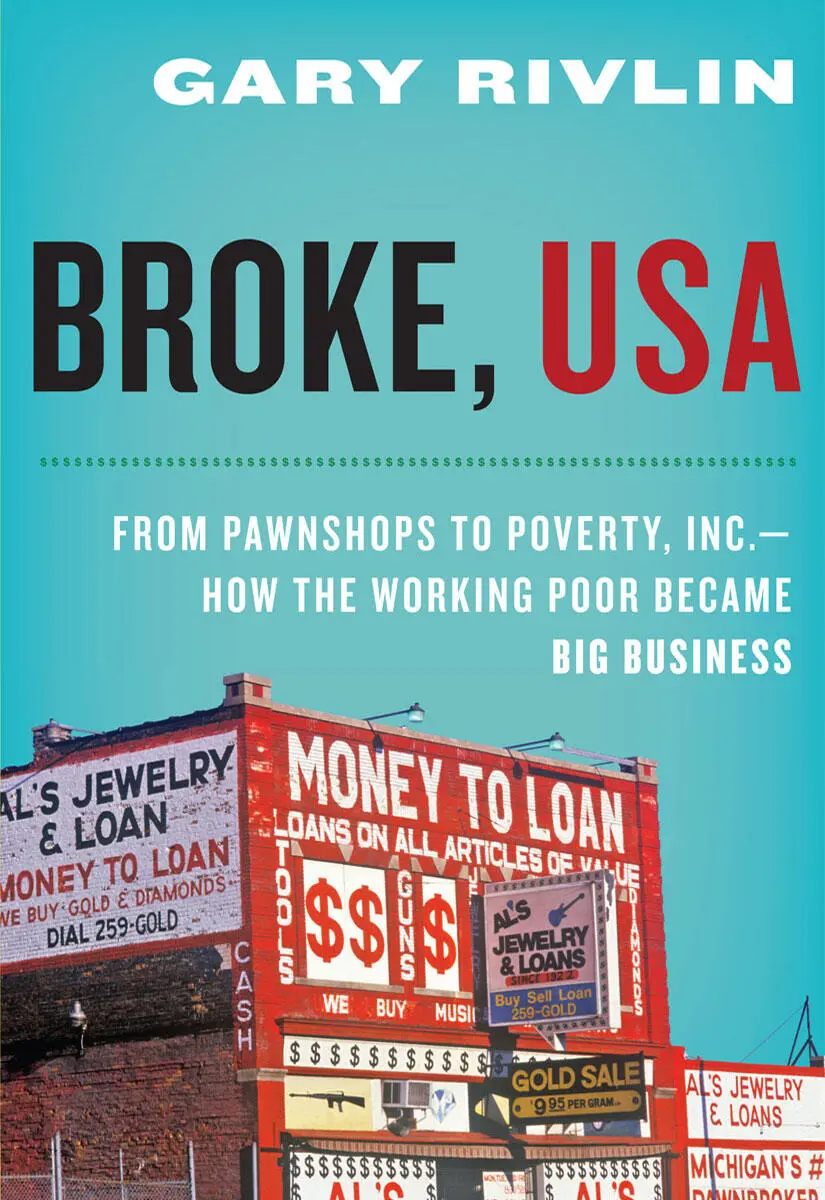
- Название:Broke, USA
- Автор:
- Издательство:HarperCollins Publishers Inc.
- Жанр:
- Год:2010
- Город:New York
- ISBN:978-0-06-199794-5
- Рейтинг книги:3 / 5. Голосов: 1
-
Избранное:Добавить в избранное
- Отзывы:
-
Ваша оценка:
Broke, USA: краткое содержание, описание и аннотация
Предлагаем к чтению аннотацию, описание, краткое содержание или предисловие (зависит от того, что написал сам автор книги «Broke, USA»). Если вы не нашли необходимую информацию о книге — напишите в комментариях, мы постараемся отыскать её.
Broke, USA — читать онлайн бесплатно полную книгу (весь текст) целиком
Ниже представлен текст книги, разбитый по страницам. Система сохранения места последней прочитанной страницы, позволяет с удобством читать онлайн бесплатно книгу «Broke, USA», без необходимости каждый раз заново искать на чём Вы остановились. Поставьте закладку, и сможете в любой момент перейти на страницу, на которой закончили чтение.
Интервал:
Закладка:
The loan shark, who has been a chat-in-the-street friend of McKenzie since both were young men, reached the opposite conclusion as Jones. McKenzie’s mistake, he said, is that he got out of a proven market. “You can make more money off the rich but it carries a much bigger risk,” he said. In contrast, there’s what he calls the “poor people’s economy.” “The thing about the poor people’s economy,” he said, “is that basically it’s recession-proof. You’re always going to have people who need $100 or $200 real quick.”
For many, jumping into the payday business would seem barely more plausible than joining Tony Soprano’s crew. Yet for people like Jared Davis, a twenty-six-year-old rich kid from Cincinnati casting about for something to do, the lowly cash advance business proved the opportunity he had been waiting for. One year after Allan Jones opened his first store, a friend told Davis about the store his sister was running in Louisville, Kentucky, and Davis, who was working for his father, Allen Davis, the CEO and president of Provident Bank, Cincinnati’s second largest, went down for a look. The place had a distinctly backroom feel to it but Davis saw potential. “Loaning people small amounts of money against their next paycheck?” Davis said. “I liked the business. I liked it a lot.” His father agreed to stake him money so he could open a store just across the river from Cincinnati, in Covington, Kentucky. He chose the name Check ’n Go.
Davis ran that first store for a few months to get a feeling for the customer and to design a system before hiring a manager and taking to the road. “I was thinking twelve, thirteen, maybe fourteen stores,” Davis said. That was before he met Jones and McKenzie in Puerto Rico at his first meeting of the National Check Cashers Association and realized payday lending was bigger than Kentucky. David Davis, his older brother, had recently joined the business, which meant they had the advantage of each other’s labor—and a father with deep pockets. “After Puerto Rico, we decided to go big,” Davis said.
With each new state Davis would buy a map and book that listed its cities by population. He figured he visited just about every city in Kentucky with at least twenty thousand people before he aimed his Jeep Cherokee toward Indiana and repeated the same routine. “My job was to find the stores,” Davis said. “Once I was ready to open one, I would hand the keys over and David would run it.”
“I’m not very disciplined,” Davis confessed. “I’m not the kind to make eight or nine A.M. meetings. But basically after we built out Kentucky and heard Indiana was available, I started driving and didn’t stop.”
The more ambitious payday companies had lawyers researching the usury laws of every state. Illinois! Illinois had no cap on the rates a lender could charge. Wisconsin! Oregon! New Mexico! And when they worked their way through this scattering of available states, they explored new frontiers with the help of the lobbyists they put on retainer. “It was necessary to explain to governors and to legislators, ‘Here’s what we do and here’s why it’s necessary,’” Jared Davis said. A usury cap that prevented a working stiff from borrowing a few hundred dollars till payday, they argued, was the worst kind of government paternalism. And to reinforce that point of view, these entrepreneurs with a newfound interest in policy debates gave generously to the political campaigns of the right state legislators. “We were very successful in educating them about the usefulness of our product and getting laws passed,” Davis said.
Jones parked his truck on a side street a few minutes from the front entrance to his home, which he has given the name “Creekridge.” He seemed ready to tell me something meaningful but he only wanted to share with me his vision of a home that would last a thousand years. “I never wanted to live in some subdivision house,” Jones told me. “What I was looking for was a big piece of real estate that would let me build a really big house.” He paid $1 million for the first two hundred acres and at least $3 million for the next 450 acres. He shaved off the top of the hill and paid for two lakes to be built on the property. He imagined himself fishing with his sons, and his sons fishing with their friends, so he paid a woman $7,000 to drain her lake so he could take her bass. For his kids he had built a regulation-sized football field complete with lights, bleachers, and a fieldhouse and also a three-story tree house. The property is so sprawling that there are little wooden signs pointing visitors in the right direction: “beach,” “stadium,” “stables,” “greenhouse.” The property also has an aviary, where he raises birds.
The house itself is modeled on the Biltmore, the stunning 250-room, French Renaissance–style vacation home that George Vanderbilt built for himself during the Gilded Age in the North Carolina mountains. Like the famous Vanderbilt estate, Jones’s home is built from stone and stucco and stands several stories high. It has a slate blue roof and a copper dome that had to be flown to the property by helicopter and installed by a crane operator.
“Everyone was laughing when I started buying property up here,” Jones told me as we stood in the marble entranceway to his home, a high-ceilinged room with a sweeping staircase. He felt vindicated, he continued, when in recent years Cleveland’s moneyed set started building in the new development down the hill, where Toby McKenzie had been constructing his home. “That’s where I’m a visionary,” he said. “Now everyone wants to be in this part of town.” He invited them to see his home shortly after it was built. “They saw the estate that I was capable of building,” he said and, as he imagines it at least, “no one is laughing at me anymore.”
They were certainly chuckling back in March 1996, though, when the big news in town was Jimmy Logan’s revenge. Tennessee might not have expressly outlawed these high-rate short-term loans but state law didn’t permit them, either, and Logan filed a class-action suit on behalf of several clients challenging their legality. At that point, Jones, in addition to the several dozen Check Into Cash outlets he had in Tennessee, was operating stores in Kentucky, Indiana, Illinois, and Wisconsin. His pretax profits for the year would exceed $2.3 million. Yet he faced a formidable foe in Logan, an ambitious lawyer with a nose for notoriety who was starting to appear on lists of Tennessee’s top attorneys. Jones opened forty-five stores in 1995, but he would open just seventeen in 1996. “Here’s this lawyer everyone is telling me is so powerful,” Jones said, “telling me he’s going to put me out of business. I was scared.”
Jones saw the suit as an act of revenge. When we met in Cleveland, however, Logan would claim he sued Jones and several other big payday chains as a matter of principle. He felt they were operating in violation of the state’s usury and consumer protection laws and he was intent on seeing them stop making these “loans that were destroying lives.” Jones, the former wrestler, wanted to “drive Logan into the ground,” he said, to “prove to him that I wasn’t as dumb as he thought.” But after months of distractions, Jones agreed to a $2.2 million settlement that included a $600,000 payout to Logan and the lawyers he had enlisted to work with him. That was on top of the $500,000 Jones had already squandered fighting the claim and the untold sum he then had to spend convincing the Tennessee legislature to explicitly legalize payday lending, which it did in 1997. “They hired a Noah’s Ark of lobbyists,” a state senator told a reporter for the Associated Press. “They hired a black lobbyist to get the black votes. If we’d have had a transsexual, they would have hired a transsexual lobbyist.” Campaign finance records show that Jones and his family donated more than $29,000 to local officials in Tennessee in the months leading up to the vote.
Читать дальшеИнтервал:
Закладка:
Похожие книги на «Broke, USA»
Представляем Вашему вниманию похожие книги на «Broke, USA» списком для выбора. Мы отобрали схожую по названию и смыслу литературу в надежде предоставить читателям больше вариантов отыскать новые, интересные, ещё непрочитанные произведения.









Обсуждение, отзывы о книге «Broke, USA» и просто собственные мнения читателей. Оставьте ваши комментарии, напишите, что Вы думаете о произведении, его смысле или главных героях. Укажите что конкретно понравилось, а что нет, и почему Вы так считаете.