Jack Whyte - The Lance Thrower
Здесь есть возможность читать онлайн «Jack Whyte - The Lance Thrower» весь текст электронной книги совершенно бесплатно (целиком полную версию без сокращений). В некоторых случаях можно слушать аудио, скачать через торрент в формате fb2 и присутствует краткое содержание. Жанр: Старинная литература, на английском языке. Описание произведения, (предисловие) а так же отзывы посетителей доступны на портале библиотеки ЛибКат.
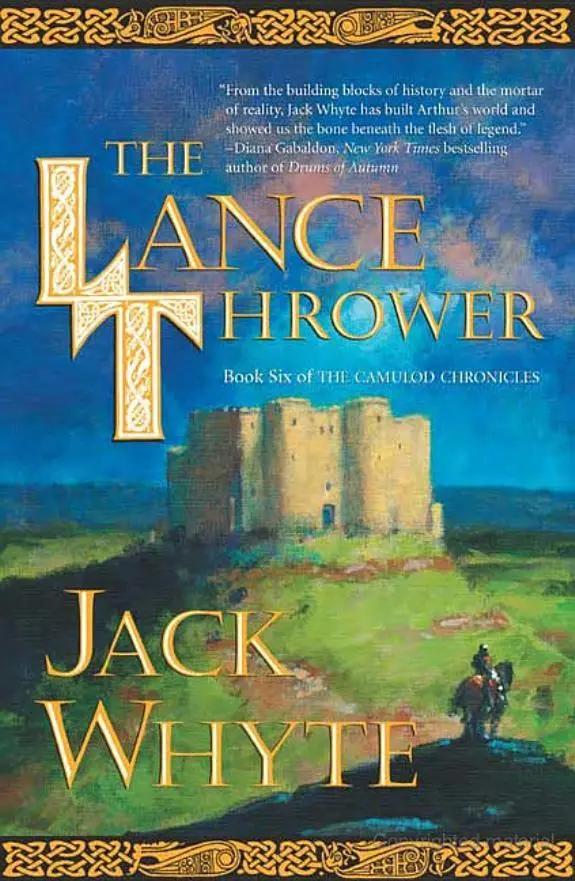
- Название:The Lance Thrower
- Автор:
- Жанр:
- Год:неизвестен
- ISBN:нет данных
- Рейтинг книги:5 / 5. Голосов: 1
-
Избранное:Добавить в избранное
- Отзывы:
-
Ваша оценка:
The Lance Thrower: краткое содержание, описание и аннотация
Предлагаем к чтению аннотацию, описание, краткое содержание или предисловие (зависит от того, что написал сам автор книги «The Lance Thrower»). Если вы не нашли необходимую информацию о книге — напишите в комментариях, мы постараемся отыскать её.
Clothar is a young man of promise. He has been sent from the wreckage of Gaul to one of the few schools remaining, where logic and rhetoric are taught along with battle techniques that will allow him to survive in the cruel new world where the veneer of civilization is held together by barbarism. He is sent by his mentor on a journey to aid another young man: Arthur Pendragon. He is a man who wants to replace barbarism with law, and keep those who work only for destruction at bay. He is seen, as the last great hope for all that is good.
Clothar is drawn to this man, and together they build a dream too perfect to last--and, with a special woman, they share a love that will nearly destroy them all...
The name of Clothar may be unknown to modern readers, for tales change in the telling through centuries. But any reader will surely know this heroic young man as well as they know the man who became his king. Hundreds of years later, chronicles call Clothar, the Lance Thrower, by a much more common name.
That of Lancelot.
The Lance Thrower — читать онлайн бесплатно полную книгу (весь текст) целиком
Ниже представлен текст книги, разбитый по страницам. Система сохранения места последней прочитанной страницы, позволяет с удобством читать онлайн бесплатно книгу «The Lance Thrower», без необходимости каждый раз заново искать на чём Вы остановились. Поставьте закладку, и сможете в любой момент перейти на страницу, на которой закончили чтение.
Интервал:
Закладка:
“You think me unfit,” I said, stricken, feeling my throat swell up to choke my words.
“What?” His face betrayed utter confusion, and even in the pain of his rejection of me I was aware that I had never seen Bishop Germanus so completely at a loss for either words or understanding. And then all at once his face cleared and he was on his feet, gazing down at me. “Unfit?” he said. “What is this about unfit? In all the things I have ever thought about you, Clothar, son of Childebertus, the word unfit has never entered my mind. There is nothing—you hear me, lad?— nothing for which I would consider you unfit. Look at me.”
He reached out and grasped me by the upper arms, holding me tightly, almost painfully, and forcing me to meet his eyes. When I did eventually look at him, I saw his look soften, and he shook his head, making a soft sound that might have been one of regret.
“As God is my witness,” he said, “there are few things easier to do in life than to cause pain and grief unwittingly simply by being human.” He drew himself erect and heaved a great, deep sigh, expelling it forcefully so that his shoulders slumped again with the release of it.
“Clothar, Clothar, Clothar, what can I tell you? The last thing I ever expected to hear from you was the very thing you just said to me. It had never occurred to me that you might want to join the Church. And you misread my reaction. Misread it completely. Certainly, I was shocked, but it had nothing whatsoever to do with your fitness to do or to become whatever you decide to do or to become. It had everything to do, on the other hand, with me and with what I had planned for you, and with what I had decided was to be your role in life, for the next few years, at least.”
For the next quarter of an hour, Bishop Germanus led me on a tour of the main residence of the school, where the teachers and lay brethren and others lived and worked. He took me into every room where people were working and praying, and pointed mutely to whatever the people there were doing, bidding me tacitly to pay attention to what I was being shown. I obeyed, but grew more and more confused as we went from room to room in silence until at length we returned to his dayroom and he crossed to the window, where he stood gazing out into the early-morning bustle of the square enclosure inside the main gates. I stood patiently, waiting for him to speak again.
“Come over here.”
I crossed to where he stood and followed his pointing finger to where two of the brethren were manhandling a cart loaded with straw through the main gates.
“They are working for the glory of God,” he said, and glanced at me sidewise. “Do you take my point?”
“No, Father …”
“Hmm. What do you think I was showing you in that little tour we took?”
I made no attempt to hide my mystification. “I don’t know, Father.”
“Work, Clothar,” he said. “I was showing you work, in the kitchens and the laundry rooms, in the classrooms and the library, and in the stables and the granaries. Work. All of it dedicated to the greater glory of God, and all of it performed by kindly, dedicated souls who are doing their best to fulfill the talents, skills, and abilities given to them by that same God.” He stopped again, interpreting my continuing confusion correctly.
“The point I must make here, Clothar, will sound uncharitable and perhaps unkind, but it is most certainly valid and accurate. The people performing all those tasks, doing all that work, are, for the most part, incapable of doing anything better or more demanding. To greater or lesser degrees, in the words of Holy Scripture, they are all hewers of wood and drawers of water. Were they capable of doing greater things, performing larger tasks, they would be about them already. But there are some tasks that require men of singular and outstanding abilities”—he looked directly into my eyes—“and there are some men born to achieve and to carry out singular and outstanding tasks.”
He turned away from the window and went to his worktable, eyeing the pile of documents awaiting his attention and talking over his shoulder to me as I followed him. “I believe, Clothar, that it would be a waste of your time and your God-gifted abilities were you to shut yourself away from the world now and immure yourself as a mere cleric. You might turn out to be a divinely gifted cleric, but not at this stage of your life. Look at me. I am supposed to be a fine bishop, according to my superiors, but as a bishop I am nonetheless very much the man whose life I lived for all those years before I was drawn to the Church.” He glanced sideways at me. “Do you know how I came to be a bishop?”
“Not really, Father.”
“Hmm. Would you like to hear the tale? It is not long in the telling.” I nodded, and he continued. “Well, as you know, I had been in the armies for many years, serving Honorius, who was both my Emperor and my friend, and when the war I had been fighting on his behalf came to an end, he permitted me to return here to Auxerre, which had always been my family’s home. Now, as it happened, the bishop in Auxerre when I came home was an elderly and much revered cleric and teacher named Amator. I remembered him well, for he had been my teacher when I was a boy, before I left to study the law in Rome, and he and I had locked horns on several occasions even then, for I was no one’s idea of a perfect student.” The bishop smiled to himself.
“Anyway, when I came home as the conquering hero of the wars, Bishop Amator was … unimpressed … that is as good a description as any, I suppose, and shortly afterward I discovered that he held what I considered at that time to be peculiar ideas about certain things, the foremost among which was hunting. Amator could not accept the idea that animals might be hunted for the sheer pleasure of the hunt. He had come to believe, somehow, that animals had souls just like people; souls of a different order, certainly, but souls nonetheless, and he felt it was a flouting of God’s love to hunt them and kill them without pressing need.
“Well, that set the two of us directly upon a collision course, for I had always been a hunter, loving the thrill of the chase and the challenge of the hunt itself. When I came home from the wars, I hunted on my own lands as I always had, relishing the wealth of game that had proliferated since I left, decades earlier. Bishop Amator, may God rest his soul, was incensed, and he condemned me publicly for setting a bad example to my people. And I am sad to report that, in my pride, I ignored him completely and kept on hunting, caring nothing for his disapproval.”
Germanus pursed his lips. “But then everything changed, almost overnight. Bishop Amator had a dream in which God appeared to him and told him he was going to die very soon, and that he must quickly prepare me , the biggest thorn in his side, to succeed him as Bishop of Auxerre.” He looked at me keenly. “Do you ever have dreams, Clothar?”
“Yes, Father, I do.”
“And do you remember them clearly, once you wake up?”
Did I? I had to think about that for several moments before shaking my head slowly and with more than a little doubt. “Sometimes I think I do, just after I awaken, but then when I try to remember exactly what I dreamed, it all breaks apart and most of what I can recall makes no sense at all.”
The bishop nodded, a half smile tugging at his lips. “That’s the way it is with most people. Dreams seldom make sense in the light of day.
“But the dream Bishop Amator had was different. He recalled it in perfect detail when he awoke, and that made him think very seriously about what it meant. He prayed for guidance for days before he finally accepted that the guidance had already been delivered in his dream, and then, having accepted that, he had to act quickly, for he believed that he would die soon but did not know when.
Читать дальшеИнтервал:
Закладка:
Похожие книги на «The Lance Thrower»
Представляем Вашему вниманию похожие книги на «The Lance Thrower» списком для выбора. Мы отобрали схожую по названию и смыслу литературу в надежде предоставить читателям больше вариантов отыскать новые, интересные, ещё непрочитанные произведения.








Обсуждение, отзывы о книге «The Lance Thrower» и просто собственные мнения читателей. Оставьте ваши комментарии, напишите, что Вы думаете о произведении, его смысле или главных героях. Укажите что конкретно понравилось, а что нет, и почему Вы так считаете.