Jack Whyte - The Lance Thrower
Здесь есть возможность читать онлайн «Jack Whyte - The Lance Thrower» весь текст электронной книги совершенно бесплатно (целиком полную версию без сокращений). В некоторых случаях можно слушать аудио, скачать через торрент в формате fb2 и присутствует краткое содержание. Жанр: Старинная литература, на английском языке. Описание произведения, (предисловие) а так же отзывы посетителей доступны на портале библиотеки ЛибКат.
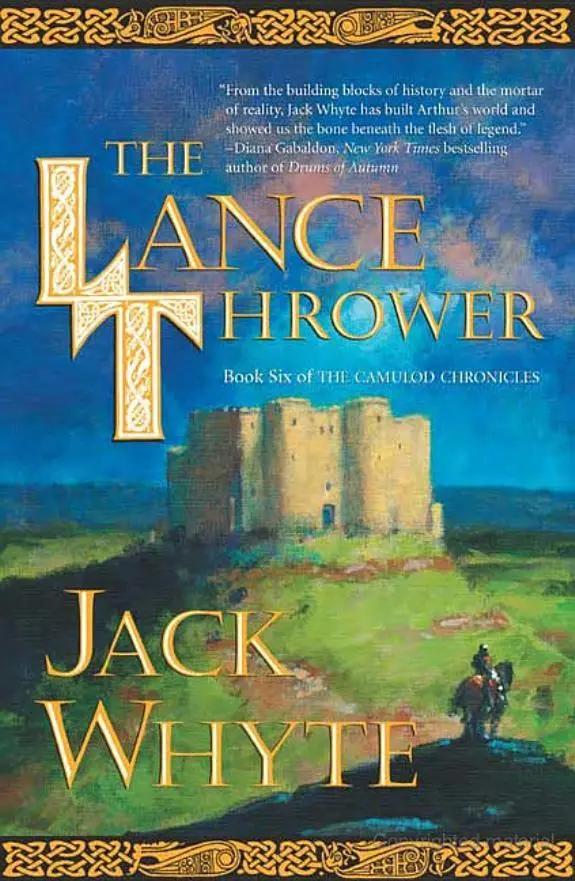
- Название:The Lance Thrower
- Автор:
- Жанр:
- Год:неизвестен
- ISBN:нет данных
- Рейтинг книги:5 / 5. Голосов: 1
-
Избранное:Добавить в избранное
- Отзывы:
-
Ваша оценка:
The Lance Thrower: краткое содержание, описание и аннотация
Предлагаем к чтению аннотацию, описание, краткое содержание или предисловие (зависит от того, что написал сам автор книги «The Lance Thrower»). Если вы не нашли необходимую информацию о книге — напишите в комментариях, мы постараемся отыскать её.
Clothar is a young man of promise. He has been sent from the wreckage of Gaul to one of the few schools remaining, where logic and rhetoric are taught along with battle techniques that will allow him to survive in the cruel new world where the veneer of civilization is held together by barbarism. He is sent by his mentor on a journey to aid another young man: Arthur Pendragon. He is a man who wants to replace barbarism with law, and keep those who work only for destruction at bay. He is seen, as the last great hope for all that is good.
Clothar is drawn to this man, and together they build a dream too perfect to last--and, with a special woman, they share a love that will nearly destroy them all...
The name of Clothar may be unknown to modern readers, for tales change in the telling through centuries. But any reader will surely know this heroic young man as well as they know the man who became his king. Hundreds of years later, chronicles call Clothar, the Lance Thrower, by a much more common name.
That of Lancelot.
The Lance Thrower — читать онлайн бесплатно полную книгу (весь текст) целиком
Ниже представлен текст книги, разбитый по страницам. Система сохранения места последней прочитанной страницы, позволяет с удобством читать онлайн бесплатно книгу «The Lance Thrower», без необходимости каждый раз заново искать на чём Вы остановились. Поставьте закладку, и сможете в любой момент перейти на страницу, на которой закончили чтение.
Интервал:
Закладка:
I nodded, albeit unwillingly, and mulled over his words for a while before looking at him again. “What should I do, then?”
He shrugged. “Decide on nothing until you’ve met with Germanus. He’ll know what you should do and he’ll have no difficulty explaining it to you. Leave word with Brach that you’ll send word to him with one of Germanus’s priests about your future plans. You’re almost seventeen, Clothar, not forty-seven, so you should have plenty of time to plan correctly and plan carefully. No need to go charging off to meet your destiny before you catch your breath.”
And so it was that I bade farewell to my family and friends easily and in good faith, and once again set out to travel north to the ancient town of Auxerre and the Bishop’s School that waited there.
BOOK THREE
HOLY MEN AND SORCERERS

VII
BISHOP GERMANUS
 AS WE APPROACHED the walls of the bishop’s town of Auxerre, Ursus remarked on how peaceful it was, but I could hear the ingrained skepticism in his voice even as he said the words. One of the first lessons a mercenary ever learns, he had told me long before, is that outward semblances of peacefulness hold no guarantees of harmony or tranquility. An arrow can strike you just as dead, just as quickly, from an idyllic setting of calm as it can amid the seething anthill of a battlefield.
It was an afternoon in the middle of an autumn that had not yet stopped being summer, and the trees in central Gaul had barely begun to yellow. We were riding slowly, enjoying the heat of the late-afternoon sunshine and feeling no great need to cause ourselves discomfort by hurrying unduly. Ahead of us the western and southern walls of the town that was our destination crested the shoulders of a high hill and met on the summit, their junction fortified by the defensive thrust of a square guard tower. Ursus reined his horse in tightly.
“You know,” he said, sounding intensely frustrated, “that tower is about as useless as nipples on a bull.” He glared over at me as if expecting me to argue with him. “I mean, if I’ve ever seen a more stupid, witless place to build a defensive tower, I don’t know where it was. Who would ever mount an attack up there, I ask you? No matter what side you attack from, you would have to carry every bit of gear, every ladder, every heavy weapon up there with you, and once you’re up there, you’d still be looking up at the tower, inviting them to throw things down at you.”
I was grinning at him, knowing he was nowhere close to being as angry as he was pretending to be. “That’s true,” I said. “But then, if they hadn’t built that tower up there, there would be nothing to prevent an enemy from climbing up the hill and scaling those walls, perhaps even while another attack was happening lower down. That would—”
“Shsst!” He held up his palm to silence me. “Listen. What’s that?”
I had heard something, too. I cocked my head to the south, listening intently, and heard it again—the distant but unmistakable clack and clatter of wooden training swords. “Someone’s fighting, over there.”
Ursus had already spurred his mount and I followed him, angling down the slight slope and to his right in order to catch up with him, and together, knee to knee, we rounded the base of the hillside and galloped into a shallow valley. I realized immediately what was going on and waved Ursus down as I reined my horse in gently, slowing him to a canter.
“It’s my old teacher,” I told Ursus. “Tiberias Cato. That’s him, up there on the hillock, supervising sword training. On days like this he often brings his classes out here, away from the school and from the town. I used to love it when he brought us here. It always felt as though we had escaped for the afternoon.”
As we drew nearer to where Cato stood on the summit of his tiny knoll, I counted twelve boys gathered around him, all of them now listening intently to what he was saying and ignoring our approach completely, which was purely unnatural. The sight of it made me smile, remembering that even on those few occasions when whatever Cato had to say was boring, you never dared to show that you were less than enthralled by what he was telling you, and you never, ever looked away in search of diversion … not if you wished your life to continue being bearable.
But then, when we were perhaps a hundred paces distant, Cato himself turned his head to peer at us, then turned back to his class and continued speaking. Moments later, the boys all came to attention and saluted, then in unison began to walk back toward the town gates, traveling in pairs and walking unhurriedly and with dignity as befitted representatives of Bishop Germanus and his associates. Tiberias Cato watched us pull our horses to a halt in front of him.
“Clothar,” he said. “You finally return. Be welcome.” His eyes moved to Ursus, sweeping him from head to toe. “And you are?”
“Magister,” I interposed, “this is my friend Ursus, which is a shortened form of Ursus the Bear-killer. Ursus, this is the teacher of whom you have heard me speak so often, Magister Tiberias Cato.”
Ursus nodded graciously to Cato. “Master Cato,” he murmured, “I feel as though I know you well already, simply from what I have learned of your teachings.”
“My thanks to you, Master Ursus, for your courtesy.” Cato threw me a sidewise glance, on the point of making some biting comment, I was sure, but he held it back and invited us to dismount and walk with him. As I slid to the ground, I saw how his eyes flicked to the hilt of the sheathed spatha by my side. I brought myself to attention and unclipped the sword from the ring at my belt, and held it out to him, wordlessly. He took it from me with both hands, the fingers of his right hand fitting around the hilt with the ease of long usage, then drew the blade halfway from its sheath, bringing it up close to his eyes to inspect the edge. Finally he pushed the blade home and looked at me.
“I thought this had been lost long since, with Phillipus Lorco … and you, too, for a long time. How came you by it?”
Quickly I told him of the trap that had been sprung on us, describing how I had seen my friend Lorco die, and went on to relate how I had later found Lorco’s horse with the spatha still hanging from its saddle. “So now it is my pleasure to return it to you, Magister.”
His eyes widened and he thrust the weapon back into my hands. “Return nothing. The sword is yours.” He tilted his head slightly to one side, appraising me carefully. “You have aged, boy. You have grown up and changed—for the better, I hope. Does the prospect of fighting and warfare still excite you as it used to?”
I saw no benefit in lying to him, and I shook my head gently. “No, Magister,” I said quietly. “That admiration and the yearning for such things wither quickly when men begin to die around you. I have no urge in me now to fight or go to war again, nor do I think I ever will have such a need again. But if war comes to me”—I shrugged my shoulders—“why then I’ll face it and I’ll deal with it. My thanks to you, Magister, on that score, even although they are belated.”
He blinked, but never removed his gaze from mine. “What do you mean?”
I smiled. “I have lived through a short but brutal war since last I saw you, Magister Cato, and it was not the Burgundian invasion everyone here was so perturbed about. Our war was fought in Benwick, after the death of my uncle Ban, the King there. I remember you warning us years ago to beware of becoming involved in civil war, where brother fights brother and everyone is hurt. Well, ours was a civil war over a kingship, waged between brothers, and several times during it I escaped with both my life and my hide intact purely through relying on the many lessons I had learned from you. And for that, for those, I thank you now.”
Читать дальшеИнтервал:
Закладка:
Похожие книги на «The Lance Thrower»
Представляем Вашему вниманию похожие книги на «The Lance Thrower» списком для выбора. Мы отобрали схожую по названию и смыслу литературу в надежде предоставить читателям больше вариантов отыскать новые, интересные, ещё непрочитанные произведения.







Обсуждение, отзывы о книге «The Lance Thrower» и просто собственные мнения читателей. Оставьте ваши комментарии, напишите, что Вы думаете о произведении, его смысле или главных героях. Укажите что конкретно понравилось, а что нет, и почему Вы так считаете.