Jack Whyte - The Lance Thrower
Здесь есть возможность читать онлайн «Jack Whyte - The Lance Thrower» весь текст электронной книги совершенно бесплатно (целиком полную версию без сокращений). В некоторых случаях можно слушать аудио, скачать через торрент в формате fb2 и присутствует краткое содержание. Жанр: Старинная литература, на английском языке. Описание произведения, (предисловие) а так же отзывы посетителей доступны на портале библиотеки ЛибКат.
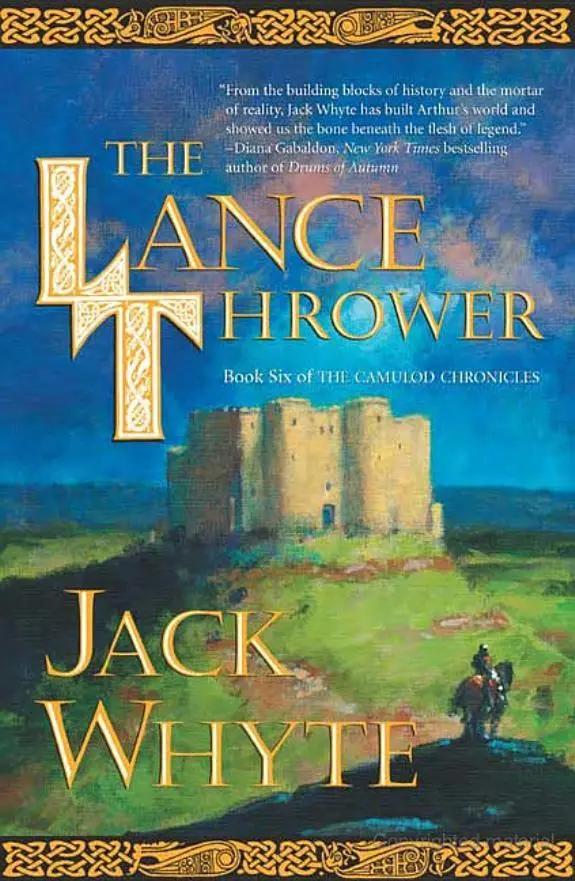
- Название:The Lance Thrower
- Автор:
- Жанр:
- Год:неизвестен
- ISBN:нет данных
- Рейтинг книги:5 / 5. Голосов: 1
-
Избранное:Добавить в избранное
- Отзывы:
-
Ваша оценка:
The Lance Thrower: краткое содержание, описание и аннотация
Предлагаем к чтению аннотацию, описание, краткое содержание или предисловие (зависит от того, что написал сам автор книги «The Lance Thrower»). Если вы не нашли необходимую информацию о книге — напишите в комментариях, мы постараемся отыскать её.
Clothar is a young man of promise. He has been sent from the wreckage of Gaul to one of the few schools remaining, where logic and rhetoric are taught along with battle techniques that will allow him to survive in the cruel new world where the veneer of civilization is held together by barbarism. He is sent by his mentor on a journey to aid another young man: Arthur Pendragon. He is a man who wants to replace barbarism with law, and keep those who work only for destruction at bay. He is seen, as the last great hope for all that is good.
Clothar is drawn to this man, and together they build a dream too perfect to last--and, with a special woman, they share a love that will nearly destroy them all...
The name of Clothar may be unknown to modern readers, for tales change in the telling through centuries. But any reader will surely know this heroic young man as well as they know the man who became his king. Hundreds of years later, chronicles call Clothar, the Lance Thrower, by a much more common name.
That of Lancelot.
The Lance Thrower — читать онлайн бесплатно полную книгу (весь текст) целиком
Ниже представлен текст книги, разбитый по страницам. Система сохранения места последней прочитанной страницы, позволяет с удобством читать онлайн бесплатно книгу «The Lance Thrower», без необходимости каждый раз заново искать на чём Вы остановились. Поставьте закладку, и сможете в любой момент перейти на страницу, на которой закончили чтение.
Интервал:
Закладка:
“Then you shall have water. Come inside.”
As we entered, the bishop’s arm around my shoulders, the officious cleric passed us on his way out, his eyes wide now and his mouth hanging open. Germanus stopped the fellow, then extended his palm for the sword the cleric still clutched. The young priest handed the spatha over, his face paler than before, and Germanus passed it to me without comment. I clipped it into place on the ring in my belt and winked at the cleric, who started in surprise and scuttled away.
We dined together that night, as Germanus wished. The meal was delicious, a simple affair of a roasted hare, served with lightly boiled turnips and some kind of kale, both of them drenched in fresh-churned butter, and fresh-baked unleavened bread that had been liberally salted in the preparation. I eschewed the wine and drank water, but Germanus drank his lightly watered wine with great relish.
Throughout the meal we spoke only of pleasant things, most of them family related. As usual, however, I ended up saying much more than I had intended to, and by the time we finished eating, the good bishop had drained me dry of every last vestige of information I could supply about my lost love, the beautiful Rosalyn. I do not know how I ever came to mention her in the first place, but I do know that I sat down to dine expecting to be asked about such things and determined to say nothing that might lead toward her. I had absolutely no intention of revealing anything about her, or the pain she had caused me. But I had reckoned, of course, without the bishop’s gentle, irresistible persuasiveness. It may have been something I said, or equally likely failed to say, that alerted him. I may have hesitated at the wrong point in response to a question. Who can tell? Whatever it was that I did or said, or did not do or say, Germanus was onto the scent like a hound on the trail of a fox, and all my resolve melted like snow in a warm wind. I told him all about Rosalyn and how she had left me, brushing aside the fact that she had had no choice but to leave when her family did. I should have known, however, that I would find little sympathy for my bruised feelings from my confessor.
I knew that many of the religious brethren had begun decades earlier to distrust and avoid women, increasingly regarding them as vessels of sin; temptations made flesh in order to seduce men away from God. Father Germanus would have none of that, however, and for the simplest and most lucid of reasons: God, he believed and taught, is omnipotent and omniscient and therefore incapable of creating anything less than perfect. He had created woman to be man’s helpmeet and companion, equal in most things and unparalleled in one all-important respect: the continuity of mankind itself is the prime responsibility of woman; man’s participation in the process is at best incidental and all too frequently accidental. Without God’s gift of woman to share his world, man could not even exist. How then, Germanus asked, could any thinking person allege that women were creatures of evil? The mere suggestion was blasphemous and impious, since it implied that God Himself, the Creator, must be less than perfect. This was a perennial concern for Germanus, inspired by what he perceived to be a collective human weakness—the tendency, amounting almost to a willingness, to demean and offend the Deity by indulging in casual, unthinking blasphemy.
He wanted me to understand the special nature of women, and he was determined that I should treat all women, regardless of birth and position, with courtesy, respect, and consideration of their God-given dignity.
He himself had been married for years, he told me, to a wonderful woman who had brought him great happiness simply by sharing his life wholeheartedly, and although she had died while still very young and they had never known the pleasure of parenthood, he yet thought of her, years after her death, as the greatest blessing a bountiful God had bestowed on him. Without the benisons of her friendship and her physical love, he said, he could never have advanced to be the man he had become. She it was, Germanus said, who had awakened in him the confidence and self-assuredness to throw himself completely into any new endeavor he was moved to undertake, and to do so with complete conviction that he could achieve whatever he wished to achieve.
Someday, Germanus assured me, I would find a woman created and designed by God Himself purely to be my helpmeet and my soul mate. I might not meet her soon, he warned, and I might meet others in the meantime whom I liked, admired, and even enjoyed, but when I found the one God had made for me, I would know it beyond dispute. As for the others I might meet in the interim, he told me, I should remember that every human being born had a mate somewhere and so I should treat all women with the respect and dignity I would expect to be shown by others to my spouse.
My difficulties with Rosalyn seemed to amuse and intrigue the bishop: he was highly curious about how I could be so bold and daring in combat yet so utterly craven when it came to speaking to a young woman. Looking back on it later, it seemed to me that his interest sprang simply from the fact that I had been vulnerable enough to love, and to love so hopelessly and inadequately.
Much as I appreciated the bishop’s amused concern with my amorous misadventures, I was no closer, after our long meal, to knowing what work he had in mind for me, and the mounting frustration of being ignorant about what role I had to play reminded me of a conversation I had had with him more than a year before, when I had approached him after a long period of soul-searching, prayer, and meditation.
I had sought him out directly after matins, and he had stopped immediately upon seeing me waiting for him by the side of the path in the predawn dimness. His face had creased in curiosity and concern plainly caused by what he perceived in the very way I was standing, and he had broken away from his brethren to come directly to me.
“Clothar, what ails you?”
“Nothing, Father,” I answered. “I merely wished to speak with you, to ask you something.”
“It must be important, I can see that from your face.” He looked up to where his secretary Ludovic stood waiting for him, and waved the man away gently. “Come,” he said to me. “Walk with me and tell me what is troubling you.”
In truth, nothing was troubling me at that time. My intent was merely to solicit his blessing upon what I had decided, only the previous night and after months of thinking about it, to do with my life. Bishop Germanus was my hero, and for good reason: his life had been heroic in every respect. He had excelled in every task to which he had set himself and had never known mediocrity or compromise. Living in the school he had created and in the atmosphere that surrounded him, seeing how even the most mundane details of his everyday life inspired and uplifted his companions and his brethren, I had come to admire him so much that I could think of no better way to honor him than by trying to be like him in every respect, voluntarily following in his footsteps and dedicating my life to the glory and service of God by undertaking the triple oath, as he himself had, of poverty, chastity, and obedience. And so, with those thoughts in my mind and content to remain silent while I ordered my galloping ideas, I walked beside him through the gathering dawn as he led me back to his dayroom, where he seated himself across from me, folded his hands in his lap, and waited for me to say what I had to say.
I cleared my throat. “I have been thinking, Father, that I would like to join the Church and become a bishop, like you.”
My mentor recoiled as though I had tried to slap him, his eyes flaring in incredulity. He recovered himself immediately, and attempted—unsuccessfully—to turn his astonishment into a sneeze, but I felt my face flush with the shame of his disapproval.
Читать дальшеИнтервал:
Закладка:
Похожие книги на «The Lance Thrower»
Представляем Вашему вниманию похожие книги на «The Lance Thrower» списком для выбора. Мы отобрали схожую по названию и смыслу литературу в надежде предоставить читателям больше вариантов отыскать новые, интересные, ещё непрочитанные произведения.








Обсуждение, отзывы о книге «The Lance Thrower» и просто собственные мнения читателей. Оставьте ваши комментарии, напишите, что Вы думаете о произведении, его смысле или главных героях. Укажите что конкретно понравилось, а что нет, и почему Вы так считаете.