Jack Whyte - The Lance Thrower
Здесь есть возможность читать онлайн «Jack Whyte - The Lance Thrower» весь текст электронной книги совершенно бесплатно (целиком полную версию без сокращений). В некоторых случаях можно слушать аудио, скачать через торрент в формате fb2 и присутствует краткое содержание. Жанр: Старинная литература, на английском языке. Описание произведения, (предисловие) а так же отзывы посетителей доступны на портале библиотеки ЛибКат.
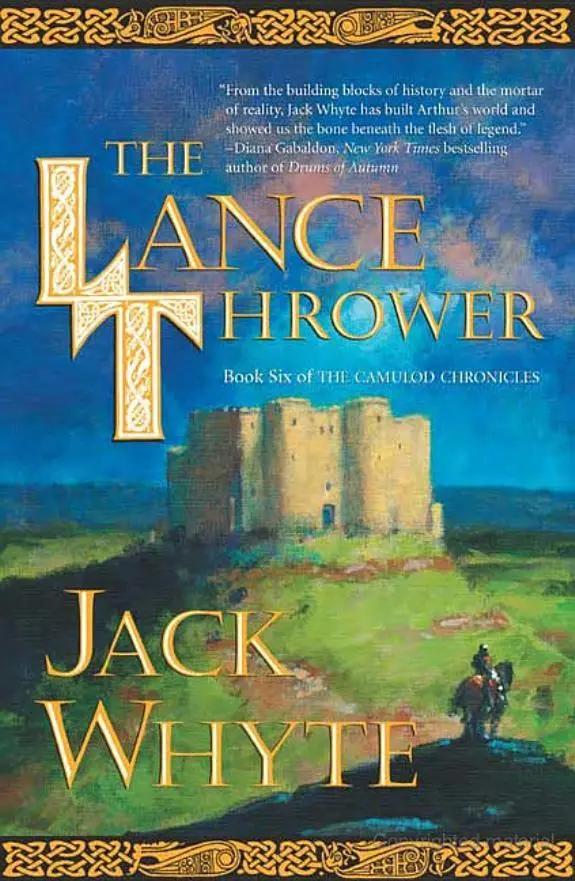
- Название:The Lance Thrower
- Автор:
- Жанр:
- Год:неизвестен
- ISBN:нет данных
- Рейтинг книги:5 / 5. Голосов: 1
-
Избранное:Добавить в избранное
- Отзывы:
-
Ваша оценка:
The Lance Thrower: краткое содержание, описание и аннотация
Предлагаем к чтению аннотацию, описание, краткое содержание или предисловие (зависит от того, что написал сам автор книги «The Lance Thrower»). Если вы не нашли необходимую информацию о книге — напишите в комментариях, мы постараемся отыскать её.
Clothar is a young man of promise. He has been sent from the wreckage of Gaul to one of the few schools remaining, where logic and rhetoric are taught along with battle techniques that will allow him to survive in the cruel new world where the veneer of civilization is held together by barbarism. He is sent by his mentor on a journey to aid another young man: Arthur Pendragon. He is a man who wants to replace barbarism with law, and keep those who work only for destruction at bay. He is seen, as the last great hope for all that is good.
Clothar is drawn to this man, and together they build a dream too perfect to last--and, with a special woman, they share a love that will nearly destroy them all...
The name of Clothar may be unknown to modern readers, for tales change in the telling through centuries. But any reader will surely know this heroic young man as well as they know the man who became his king. Hundreds of years later, chronicles call Clothar, the Lance Thrower, by a much more common name.
That of Lancelot.
The Lance Thrower — читать онлайн бесплатно полную книгу (весь текст) целиком
Ниже представлен текст книги, разбитый по страницам. Система сохранения места последней прочитанной страницы, позволяет с удобством читать онлайн бесплатно книгу «The Lance Thrower», без необходимости каждый раз заново искать на чём Вы остановились. Поставьте закладку, и сможете в любой момент перейти на страницу, на которой закончили чтение.
Интервал:
Закладка:
“So,” he said, “Clothar, son of Childebertus, have you understood what I was saying?”
I felt a sudden knot of apprehension in my throat. “I … I think so, Father.”
“I hope so, my young friend, but I will not test you on it Instead I will summarize it for you, making it as plain as is possible. Serve God, by every means at your disposal, Clothar, but do it properly, in freedom, while you gather the experience you will need should He call upon you to undertake one of His special tasks. How do I do that? you ask yourself.”
He smiled again. “Well, look at me. Consider if I had entered the Church when I was your age. Without the experience of love and marriage and the anguished loss of both, I could never have understood the pain that ordinary people feel on the loss of a spouse or a child. Without my years spent studying the imperial law, I could never have served the Church as assiduously as I have been able to through my understanding of legal issues and the basic workings of fundamental justice. And perhaps most important of all, without the years I spent in military service, exercising and coming to understand the principles of command and command structure, I could never have assumed the position that I hold now as Bishop of Auxerre, responsible for all the people who are in my charge today.
“You have greatness within you, Clothar, and nobility, and God Himself has a design for you to live by. But in order to achieve God’s will, I believe you must stay free. Plenty of time to return to the fold later, if your destiny sends you toward the Church. And that is enough of that, I think. Time now to talk of other things.”
By the time we finished eating it had grown dark outside, and one of the bishop’s brethren came in to replenish the fire in the brazier that took up most of the enormous grate. Germanus had always shown a tendency to be cold, even on warm days, and he liked to say it came from having spent far too many years in the warmer countries of the Empire, including Rome itself and Constantinople, to be truly comfortable in the cooler, more temperate climes of his homeland. Now that he was growing older and less resilient, he would add, his body was becoming less and less equipped to deal with chill temperatures and damp, nasty drafts.
When we had finished eating, we made ourselves comfortable in two large upholstered chairs that faced the fire, and Germanus sat staring into the flames for some time without speaking. I of course followed his example, perfectly content to enjoy the unaccustomed warmth of having a fire indoors on a crisp autumn night. The silence was a pleasant one and I felt perfectly at ease, knowing that my mentor would say whatever he wished to say when the time was right. And eventually he did, coming straight to the point without preamble.
“I know I told you before you left for home with Duke Lorco that I had work for you to do, but did I tell you anything of what I meant?”
“No, Father, nothing.”
“Hmm.” He fell silent again, and I glanced across at him to see whether or not his mouth was pursed in what we students had called the Bishop’s Pout, the moue that indicated he was thinking deeply. It was. Presently he stirred again and waved a hand to attract my attention.
“There is fresh, chilled grape juice in the pitcher over there beneath the cloth. Pour some for us, would you?”
When I brought him the cup he nodded in thanks.
“I want to tell you, Clothar, about a friend of mine, a man who lives in Britain. Have you ever heard of the Alleluia Victory?”
Of course I had, I told him. It was legend at the Bishop’s School.
Father Germanus, as Bishop of Auxerre, had been sent to Britain to debate the heretical teachings of a British theologian called Pelagius. I had learned about Pelagius from the loathsome Brother Anthony, whose harsh discipline had sent me, and many other boys, to the infirmary. We had learned that the teachings of Pelagius went against the Church in the matter of Divine Grace. The Church taught that mankind was incapable of achieving salvation without divine intervention on each individual’s behalf, in the form of spiritual grace acquired through the sacraments, but Pelagius had proposed the dangerous notion that each individual, made in God’s own image, contained within himself a spark of divine consciousness that allowed him to commune directly with God.
Pelagius had argued that the Church’s teaching in this matter negated the need for, and the efficacy of, any form of human law. Under the teachings of the Church, when it was reduced to its constituent elements, no man could be condemned for any sin, since he could claim that God had not given him the grace to withstand temptation.
Unfortunately, Pelagius’s own teachings, when reduced to their constituent parts, demonstrated that, since each man could speak directly to his God, men therefore had no need of priests or churches. Pelagius had been condemned and his teachings had been declared heresy, but his tenets had appealed strongly to many people, and most particularly so in Britain, where he had amassed a great following after his excommunication and death.
Germanus’s role in Britain had been to argue against the heresy in a convocation of British bishops held in the great theater at Verulamium, and on the way there, he and his traveling companions, all of whom were, like himself, Christian clerics unprepared to act as warriors, ran afoul of a band of marauders and would have been killed, had they not been rescued by a contingent of cavalry who happened to be passing through the area at the time on their way to Verulamium. As the horsemen came thundering down to the rescue, the exultant clerics had encouraged them with cries of “Alleluia!” and the tale had grown from one of a simple rescue to a mighty victory over the ungodly.
“Well, the cavalry commander who rescued me that day,” Father Germanus said, “was Caius Merlyn Britannicus, from a fortified colony called Camulod, in the west of Britain. He calls himself simply Merlyn of Camulod, and he and I became close friends, even though we had little time to get to know each other. Life works that way, sometimes. Anyway; I saw Merlyn again when I was in Britain several months ago—you may recall that I returned from there just before you left to go home—and he and I resumed our friendship where we had left off. He is a fascinating man, Clothar. Far more so now even than he was when we first met, almost two decades ago. He and I spent much time discussing certain matters of great moment for both him and me, and I made him a promise that I would return within the year to assist him with his plans and to perform a particular service for him.” He twisted his face into a grimace. “Alas, the Pope has called upon me to attend a conclave with the senior bishops in Italia, and I am constrained to obey. Unfortunately, that makes it impossible for me to keep my promise to a dear friend, and you can have no idea how deeply that angers and distresses me.
“Merlyn will understand my dilemma when he learns of it, I know, but the thought of merely writing him a letter is offensive to me. That would be too impersonal, and although Merlyn never would think so, I would perceive it as demeaning. And so I decided to ask you if you would be willing to go to Britain and meet with Merlyn on my behalf, to explain why I cannot be there and to carry my suggestions as to what he should do now that I have failed him.”
I cleared my throat, and when he looked at me questioningly I asked him if he could tell me about the personal service he was now unable to perform for Merlyn. He nodded.
“I promised him I would officiate at the coronation of his young ward, Arthur. The young man is quite extraordinary. I have never met him in person, but I have been in correspondence with him for a long time, at Merlyn’s request, and everything that I have read of his is most impressive. But apart from being scholarly and remarkably self-disciplined in his thinking, he also appears, from all accounts, to be outstandingly responsible in other, equally important areas. If he continues to make the kind of progress he has been achieving in the recent past, then according to Merlyn, and despite his extreme youth—he is a mere two years older than you—he will soon hold overall command of the cavalry forces of Camulod. He is also a devout and dedicated Christian.”
Читать дальшеИнтервал:
Закладка:
Похожие книги на «The Lance Thrower»
Представляем Вашему вниманию похожие книги на «The Lance Thrower» списком для выбора. Мы отобрали схожую по названию и смыслу литературу в надежде предоставить читателям больше вариантов отыскать новые, интересные, ещё непрочитанные произведения.








Обсуждение, отзывы о книге «The Lance Thrower» и просто собственные мнения читателей. Оставьте ваши комментарии, напишите, что Вы думаете о произведении, его смысле или главных героях. Укажите что конкретно понравилось, а что нет, и почему Вы так считаете.