Jack Whyte - The Lance Thrower
Здесь есть возможность читать онлайн «Jack Whyte - The Lance Thrower» весь текст электронной книги совершенно бесплатно (целиком полную версию без сокращений). В некоторых случаях можно слушать аудио, скачать через торрент в формате fb2 и присутствует краткое содержание. Жанр: Старинная литература, на английском языке. Описание произведения, (предисловие) а так же отзывы посетителей доступны на портале библиотеки ЛибКат.
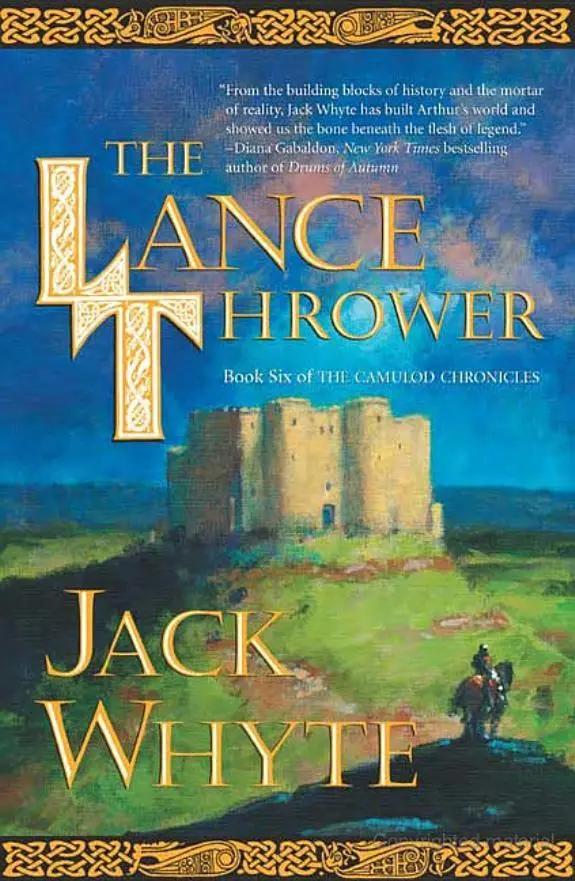
- Название:The Lance Thrower
- Автор:
- Жанр:
- Год:неизвестен
- ISBN:нет данных
- Рейтинг книги:5 / 5. Голосов: 1
-
Избранное:Добавить в избранное
- Отзывы:
-
Ваша оценка:
The Lance Thrower: краткое содержание, описание и аннотация
Предлагаем к чтению аннотацию, описание, краткое содержание или предисловие (зависит от того, что написал сам автор книги «The Lance Thrower»). Если вы не нашли необходимую информацию о книге — напишите в комментариях, мы постараемся отыскать её.
Clothar is a young man of promise. He has been sent from the wreckage of Gaul to one of the few schools remaining, where logic and rhetoric are taught along with battle techniques that will allow him to survive in the cruel new world where the veneer of civilization is held together by barbarism. He is sent by his mentor on a journey to aid another young man: Arthur Pendragon. He is a man who wants to replace barbarism with law, and keep those who work only for destruction at bay. He is seen, as the last great hope for all that is good.
Clothar is drawn to this man, and together they build a dream too perfect to last--and, with a special woman, they share a love that will nearly destroy them all...
The name of Clothar may be unknown to modern readers, for tales change in the telling through centuries. But any reader will surely know this heroic young man as well as they know the man who became his king. Hundreds of years later, chronicles call Clothar, the Lance Thrower, by a much more common name.
That of Lancelot.
The Lance Thrower — читать онлайн бесплатно полную книгу (весь текст) целиком
Ниже представлен текст книги, разбитый по страницам. Система сохранения места последней прочитанной страницы, позволяет с удобством читать онлайн бесплатно книгу «The Lance Thrower», без необходимости каждый раз заново искать на чём Вы остановились. Поставьте закладку, и сможете в любой момент перейти на страницу, на которой закончили чтение.
Интервал:
Закладка:
“There is always a need for money, in some guise or another, believe me. You may drift across the land attending to your own requirements for as long as you wish and you will have no real need for money. But come the moment when you have to undertake a task like those I have set you here, you will need money and a strong supply of it, for you are entering a realm where only money achieves effects. Thus the reason I am asking you about your friend: you will be carrying large sums of money with you and on your person. I merely wish to be assured that this Ursus is able enough to defend you against thieves and trustworthy enough that he will not be tempted to become a thief himself. Tell me all that you know about him.”
It was my turn to talk then, and I did so at length, relating everything I knew and had learned about my friend Ursus. When I was finished, Germanus sat staring narrow-eyed at me for several moments, absorbing what I had last said, and then he nodded and stood up, pushing himself out of his chair with both arms.
“Now, come and look at this.” He crossed to the large box on the floor, and I followed, eager to know what was to be revealed to me, but I could have guessed at that all night long and never have imagined what he was about to show me. The sides of the box, I could see now that we were close to it, were hinged and secured by a simple metal hasp. Germanus undid the hasp and swung the sides of the box apart, and I gasped.
My first impressions were of rich golden, burnished browns, metal and leather, reinforced by the smell that came crowding into my nostrils, richly scented polish of the kind used to burnish and buff the finest leathers. The box contained an armor tree, a simple frame of crossed pieces of wood designed to store the various pieces of a soldier’s gear. I had seen a hundred of them, here and there, but I had never seen one installed in a box, for transportation or, as it turned out to be in this instance, for long-term storage. Furthermore, the armor growing on this particular tree was unlike any I had ever set eyes upon.
Several of my relatives had magnificent armor. King Ban’s had been made for him personally, as had my cousin Brach’s, and the results were impressive and spectacular, even intimidating. What I was gazing at here, however—and I knew it beyond certainty, for it could be nothing else—was Germanus’s own armor, the armor of an imperial Roman legatus, in all its opulent magnificence. Germanus reached out and rubbed the ball of his thumb gently across the deeply ingrained texture of an ancient and much-polished scratch over the left breast of the cuirass.
“Never could get that mark out,” he murmured, “but I never really wanted to, not badly enough. It served to keep me aware of my mortality. That was done by a heavy boar spear, thrown by. the biggest man I have ever seen. It hit me square and threw me bodily backward, over my horse’s rump. Lucky for me I didn’t land on my head and break my neck; but God was with me and the only damage I sustained was this one scratch.”
I was astounded, because the cuirass was leather, not metal, and a spear such as he described should have skewered him, cuirass and all. I said so, wondering all the while if he might be exaggerating, as soldiers always seem to do, but he merely smiled and shook his head.
“I cannot speak with any certainty about the harness worn by emperors, because I have never known an emperor who was a true warrior and actually fought and thus wore real armor, as opposed to ceremonial display armor, but I suspect that this suit here may be the finest single suit of armor ever made.” Once again he extended a hand and rubbed it gently over the glossy surface of the leather breastplate before plucking the helmet from the wooden ball that supported it atop the tree and holding it up close to his eyes with both hands. “It has been many years since I last wore this,” he breathed, “and looking at it now, I could regret never wearing it again were I to permit the self-indulgence.” A cloth bag hung from the “neck” of the tree, and he set the helmet atop the box and rummaged in it, extracting a plumed crest made from alternating tufts of pure white and crimson-dyed horsehair. With the ease born of years of practice, he clicked the crest into place on the helmet, transforming it in a moment from a magnificent helm to a thing of startling and imperious beauty.
“Here, try this on. Stand still.” I stood motionless, scarcely daring to breathe as he fitted the head covering over my brows. It felt heavy, and solid, but it fitted as though it had been made for me. “Impressive,” the bishop murmured. “When one wears such a thing oneself, there is seldom opportunity to admire it. Looking at it now, though, it has a certain splendor, I must admit.” He turned back to the tree, leaving the helmet on my head. “But look at the workmanship in this device.” He was referring to the cuirass, and I removed the helmet, tucking it beneath my arm before I stooped to look more closely at the cuirass.
It really was superb, an intricate and awe-inspiring creation of boiled, dried, hammered, and burnished leather, painstakingly fashioned in the shape of a stylized male torso. The planes of the pectoral musculature were utterly smooth and polished to a mirrorlike perfection that reminded me—I smiled at the thought—of my first sight of my cousin Brach emerging from the lake. Elsewhere on the piece, though, there was no expanse of surface larger than a tiny fingernail that was not covered with embossed carvings and workmanship of breathtaking, elegant perfection: rosettes and chevrons and thorny briarwork scrolls chased and embraced each other in apparent abandon yet flawless symmetry across and around the surface of the armor. Germanus stepped back from it, to admire it from farther off.
“Hand it to me, would you?”
Obediently I placed the helmet at my feet, then prepared to lift the cuirass from the wooden frame. I grasped it securely, lifted it—and almost dropped it in my surprise, whipping my head around in consternation to see that Germanus had expected this and was grinning at me again.
“Aye,” he said. “Bear in mind I said it’s the finest armor ever made. You have almost discovered why. Bring it to the table.”
I carried the unbelievably light cuirass, full front and back plates together, to where he was already waiting for me, peering into the second box. As I balanced the cuirass, allowing it to stand on its own upon the table, the bishop held something out to me. It was a flat, rectangular object wrapped in black cloth.
“That’s the secret of the armor,” he said as I unwrapped the package and then held it up in front of me, staring at it. Whatever the device was, I knew I had never seen one before, and yet it looked familiar. It was made of metal, a gridlike form square in shape and feather light and flexible where I would have expected much more weight and rigidity. And then I realized what it reminded me of. Once, when I was a child, we had had a summer of ferocious heat, and in the course of it my nurse had taken to weaving shades of thumb-wide bulrush fronds to hang in our doorways and window embrasures to keep out the sun while allowing the air to move into the darkened house. The simple square over-and-under weave of the leaves had entranced me, I remembered, because it looked so fragile yet was paradoxically strong. And now I was looking at the same kind of weave, fundamentally simple and straightforward save that instead of rushes, the smith had used slats of metal, extremely thin and a deep, dark blue in color, forming a slender woven plate of steel that I could flex between my hands. Germanus held out his hand for the piece, and I passed it to him. He pressed his cupped hand, containing the blue mesh, hard against the left pectoral panel of the cuirass.
Читать дальшеИнтервал:
Закладка:
Похожие книги на «The Lance Thrower»
Представляем Вашему вниманию похожие книги на «The Lance Thrower» списком для выбора. Мы отобрали схожую по названию и смыслу литературу в надежде предоставить читателям больше вариантов отыскать новые, интересные, ещё непрочитанные произведения.







Обсуждение, отзывы о книге «The Lance Thrower» и просто собственные мнения читателей. Оставьте ваши комментарии, напишите, что Вы думаете о произведении, его смысле или главных героях. Укажите что конкретно понравилось, а что нет, и почему Вы так считаете.