Jack Whyte - The Lance Thrower
Здесь есть возможность читать онлайн «Jack Whyte - The Lance Thrower» весь текст электронной книги совершенно бесплатно (целиком полную версию без сокращений). В некоторых случаях можно слушать аудио, скачать через торрент в формате fb2 и присутствует краткое содержание. Жанр: Старинная литература, на английском языке. Описание произведения, (предисловие) а так же отзывы посетителей доступны на портале библиотеки ЛибКат.
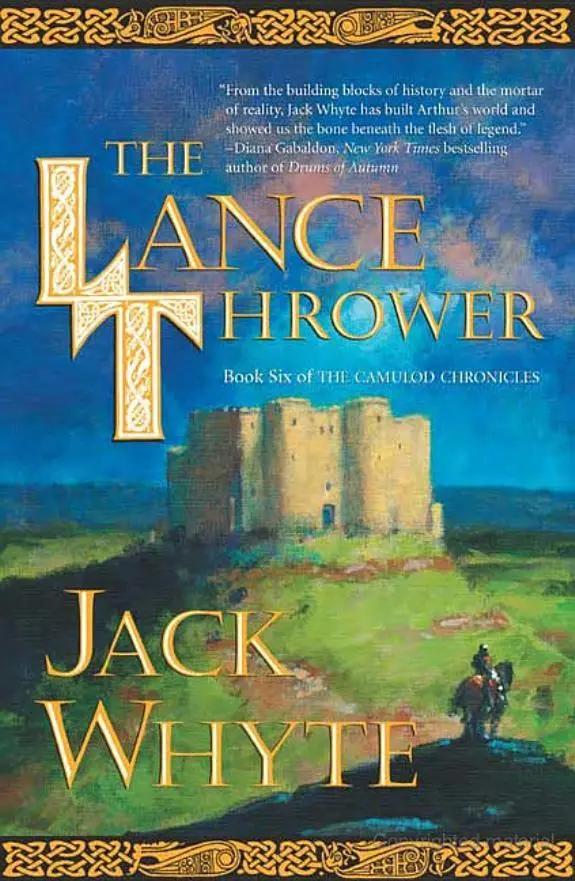
- Название:The Lance Thrower
- Автор:
- Жанр:
- Год:неизвестен
- ISBN:нет данных
- Рейтинг книги:5 / 5. Голосов: 1
-
Избранное:Добавить в избранное
- Отзывы:
-
Ваша оценка:
The Lance Thrower: краткое содержание, описание и аннотация
Предлагаем к чтению аннотацию, описание, краткое содержание или предисловие (зависит от того, что написал сам автор книги «The Lance Thrower»). Если вы не нашли необходимую информацию о книге — напишите в комментариях, мы постараемся отыскать её.
Clothar is a young man of promise. He has been sent from the wreckage of Gaul to one of the few schools remaining, where logic and rhetoric are taught along with battle techniques that will allow him to survive in the cruel new world where the veneer of civilization is held together by barbarism. He is sent by his mentor on a journey to aid another young man: Arthur Pendragon. He is a man who wants to replace barbarism with law, and keep those who work only for destruction at bay. He is seen, as the last great hope for all that is good.
Clothar is drawn to this man, and together they build a dream too perfect to last--and, with a special woman, they share a love that will nearly destroy them all...
The name of Clothar may be unknown to modern readers, for tales change in the telling through centuries. But any reader will surely know this heroic young man as well as they know the man who became his king. Hundreds of years later, chronicles call Clothar, the Lance Thrower, by a much more common name.
That of Lancelot.
The Lance Thrower — читать онлайн бесплатно полную книгу (весь текст) целиком
Ниже представлен текст книги, разбитый по страницам. Система сохранения места последней прочитанной страницы, позволяет с удобством читать онлайн бесплатно книгу «The Lance Thrower», без необходимости каждый раз заново искать на чём Вы остановились. Поставьте закладку, и сможете в любой момент перейти на страницу, на которой закончили чтение.
Интервал:
Закладка:
“There is a layer of straps of this woven steel underlying the leather. In fact it lies between two layers, with the edges of the straps overlapping very slightly, and the edges of the leather are sewn together around the outer rims of the cuirass, front and back, very artistically. If you look very closely, you may see where the two layers meet, but it is not easy to find.” I bent forward and peered closely, but I could see nothing.
“It is a wonder,” I confessed. “I have never heard of such a thing. Where was it made, Father?”
“In Constantinople, where else? The smiths there can do magical things with metal, but the man who made this armor was the finest, most skillful armorer I ever knew. I was able to do him a service when I was in law, and he made this for me specially when I left the profession and joined the armies at the behest of the Emperor. There are arm guards and greaves and an armored kirtle in the box to complete the suit, as you can see, and even the leather dome of the helmet conceals a metal cap. It has served me well, in all my travels and campaigns. I have worn it throughout the Empire.” He made a sucking sound through his teeth. “But no more. Never again.”
“What will you do with it, Father?”
He tilted his head to one side and looked at me from beneath raised eyebrows. “I shall pass it to my son, my son.”
“Your son? I had no …” My voice tailed away in embarrassment, but he pretended not to have noticed.
“Of course I cannot give him all of it. The crimson-and-white helm crest is that of a legionary legatus— the legatus of Gaul—and the martial cloak and gauntlets that go with it also bear both my personal and my official insignia as legatus of Gaul. All of those pieces are instantly recognizable to anyone who knows about such matters and so would draw unwelcome attention were someone else to be seen wearing them. But with a plain crest of brown horsehair, the helmet’s effect would be much the same, and a plain, functional military cloak of waxed brown wool will go splendidly with all the rest.” He glanced sideways at my chest. “You’re a big lad, but you still have growth to complete. Nonetheless, the cuirass should fit you well enough even now, over a heavy, quilted tunic, and you’ll grow into it soon enough. The helmet’s headband is adjustable, so even if your head grows larger, which is unlikely now, the casque will fit you and serve you well.”
I was staring at him openmouthed, unable to believe what I had heard, but finally I found my tongue. “You’re giving this to me? To me?”
“Aye, but not all of it. As I said, I’ll keep the helmet crest, the cloak, and the embroidered gauntlets—those are purely decorative in any case, heavy and cumbersome and virtually useless. But the rest is yours to wear from this time on.”
He smiled, deciding to take pity on me. “Clothar, Clothar, think about it this way: I have no son of my own and you are the son of one of my dearest friends, and you have given me as much joy and pleasure with your simple honesty and strengths as your father did. I am an old man now, and soon I will die, and when I do, if this armor is still in my possession, venal people will squabble over it and it may end up being worn by someone whose possession of it would make me lie uncomfortably in my grave. Better by far that you should have it, with my blessings. You are going as my envoy into foreign parts, to deal with powerful people and take part in great events. It is fitting that you should be dressed appropriately for the part you may be called upon to play, whatever its nature. So, will you accept this, and my blessings?”
I felt tears standing in my eyes and could only shake my head in acceptance, incapable of speech. Again he affected not to notice.
“Excellent, then come over here, for there is something else I have for you, something that you can use at all times. But it came from far beyond Constantinople.”
He went to the table, opened the larger of the two boxes that lay there and lifted out a carefully wrapped bundle, which he laid reverently on the tabletop. He reached into the box again and pulled out what I immediately recognized as a set of supple, well-used, and carefully tended black leather saddlebags. He tossed them gently toward me, and as I caught them I noticed that instead of the two normal bags to be thrown across a horse’s shoulders, this device had four deep bags, a pair on each side, one superimposed above the other, and a long strap to buckle beneath the horse’s chest and hold the assembly secure. I noticed, too, that each bag closed with a strap and buckle.
“Large bags, capacious and useful. I designed them myself, on campaign many years ago. I found that I could never have enough carrying capacity when I was on the move. You’ll enjoy those. But this is what I want to show you.” He had been working to undo the wrappings around the bundle he had first drawn from the box and now he held up the garment it had contained. It was a surcoat of some kind, a plain rectangle of some strange material, folded halfway so that it hung down front and back in equal lengths. A hemmed, square-cut hole had been provided for the wearer’s head to go through, and there were transverse slits, also hemmed and no more than a handsbreadth wide, beneath the shoulders, permitting the shoulder surfaces to project straight out without being pulled downward. Other than that, the sides were open, and it was plain to see that they were intended to be held in place by a belt or girdle and probably a sword belt. It was a plain, dusty-looking shade of the untreated light brown wool called fustian, pale enough to be sandy or earthen.
Germanus tossed it to me, and again I reacted with surprise. This thing, too, was metallic. I held it close and peered at it, then squeezed it in my hands. It contained countless thousands of tiny, almost insubstantial metal rings, all sewn into place in overlapping layers so that the garment itself was flexible and probably more comfortable than anything comparable that one might find in Gaul, although I doubted that there would be anything truly comparable.
“That tunic will deflect a hard-shot arrow fired from close quarters,” Germanus said. “I have no idea where it came from or who made it, but it, too, was given to me as a gift many years ago by a visiting king from some far-flung part of the Eastern Empire, and he himself had no idea where it came from. The main thing about it, though, is that it works, and it is light enough and comfortable enough to wear in most situations where you anticipate that there might be danger and yet you do not wish to wear full armor. And it doesn’t clink. It rustles a little, but that’s all. If you wear it traveling, beneath your new armor, it will fill up the extra room in there. How goes the time?”
“I know not, Father. I have lost track completely.”
Germanus called again for Armand, and the large young man reappeared from the anteroom, rubbing the sleep from his eyes. In response to Germanus’s question, he informed us that it was the fourth hour of the night. He glanced at the fireplace as he spoke and crossed immediately to blow on the embers, coaxing them until he had a flame going again. When he stood up to leave, the bishop thanked him and gave him permission to retire to bed.
“Time, time, time,” he said as soon as the man was gone. “There is never enough of it. Now, to work. We have to get you from here to the coast, as quickly and efficiently as possible. Tomorrow morning, after I have gone, I want you to report to Tiberias and have him select his finest horses for your use. Each of your traveling companions should have two mounts.”
“There are only two of us, Father. Ursus and myself.”
“Aye, for the time being, but I would like to change that. You will require an assistant, an escort to look after your equipment and your weapons and your horses. I have one for you, if you will consent to take him. His name is Bors and you may remember him. He was in the student intake below yours and he began this year as the informal leader of the Spartans—a brilliant and gifted student, but troubled during these past few months. His parents died in an outbreak of plague late last summer, although we did not hear word of it until after you had left us. But it transpires that it was not only his parents who died. His entire family was wiped out, leaving no one alive. The boy needs something now to rekindle his interest in living. He has been morose and depressed and his studies have suffered for it, but he is still far and away the best and brightest in the school this year. I want you to consider taking him with you. He will benefit by it and so will you, I am convinced. Talk with him tomorrow and watch him for a day or two. If you feel that such an arrangement would work, invite him to go with you. I have spoken to Tiberias Cato and he knows my feelings on the matter, so there will be no difficulties in freeing the lad to accompany you. Similarly, should you feel uncomfortable about this, then Cato will attend to it and no harm will have been done. The boy himself knows nothing of this, so his feelings will not suffer if you reject him.
Читать дальшеИнтервал:
Закладка:
Похожие книги на «The Lance Thrower»
Представляем Вашему вниманию похожие книги на «The Lance Thrower» списком для выбора. Мы отобрали схожую по названию и смыслу литературу в надежде предоставить читателям больше вариантов отыскать новые, интересные, ещё непрочитанные произведения.








Обсуждение, отзывы о книге «The Lance Thrower» и просто собственные мнения читателей. Оставьте ваши комментарии, напишите, что Вы думаете о произведении, его смысле или главных героях. Укажите что конкретно понравилось, а что нет, и почему Вы так считаете.