Jack Whyte - The Lance Thrower
Здесь есть возможность читать онлайн «Jack Whyte - The Lance Thrower» весь текст электронной книги совершенно бесплатно (целиком полную версию без сокращений). В некоторых случаях можно слушать аудио, скачать через торрент в формате fb2 и присутствует краткое содержание. Жанр: Старинная литература, на английском языке. Описание произведения, (предисловие) а так же отзывы посетителей доступны на портале библиотеки ЛибКат.
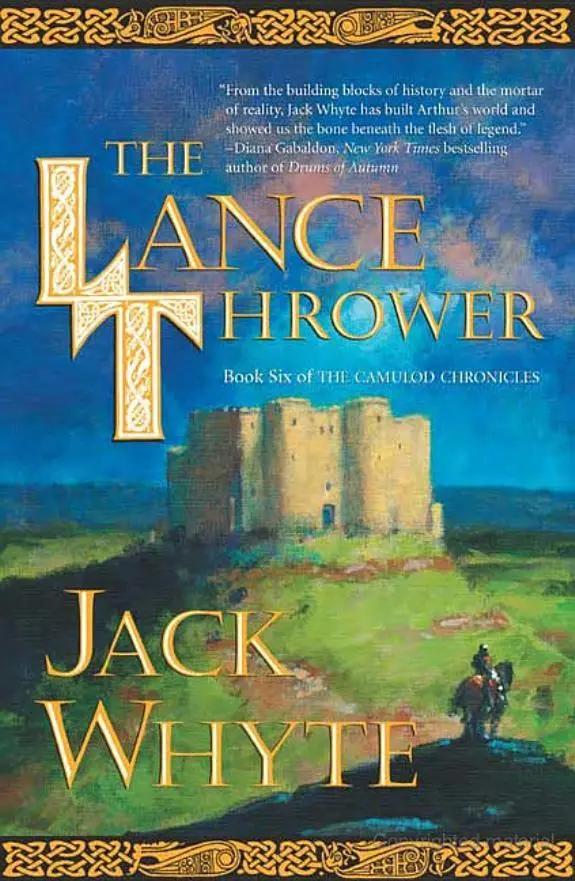
- Название:The Lance Thrower
- Автор:
- Жанр:
- Год:неизвестен
- ISBN:нет данных
- Рейтинг книги:5 / 5. Голосов: 1
-
Избранное:Добавить в избранное
- Отзывы:
-
Ваша оценка:
The Lance Thrower: краткое содержание, описание и аннотация
Предлагаем к чтению аннотацию, описание, краткое содержание или предисловие (зависит от того, что написал сам автор книги «The Lance Thrower»). Если вы не нашли необходимую информацию о книге — напишите в комментариях, мы постараемся отыскать её.
Clothar is a young man of promise. He has been sent from the wreckage of Gaul to one of the few schools remaining, where logic and rhetoric are taught along with battle techniques that will allow him to survive in the cruel new world where the veneer of civilization is held together by barbarism. He is sent by his mentor on a journey to aid another young man: Arthur Pendragon. He is a man who wants to replace barbarism with law, and keep those who work only for destruction at bay. He is seen, as the last great hope for all that is good.
Clothar is drawn to this man, and together they build a dream too perfect to last--and, with a special woman, they share a love that will nearly destroy them all...
The name of Clothar may be unknown to modern readers, for tales change in the telling through centuries. But any reader will surely know this heroic young man as well as they know the man who became his king. Hundreds of years later, chronicles call Clothar, the Lance Thrower, by a much more common name.
That of Lancelot.
The Lance Thrower — читать онлайн бесплатно полную книгу (весь текст) целиком
Ниже представлен текст книги, разбитый по страницам. Система сохранения места последней прочитанной страницы, позволяет с удобством читать онлайн бесплатно книгу «The Lance Thrower», без необходимости каждый раз заново искать на чём Вы остановились. Поставьте закладку, и сможете в любой момент перейти на страницу, на которой закончили чтение.
Интервал:
Закладка:
There was no hint of condemnation or even accusation in the bishop’s voice. “Now, that may cause you and your friends to roll your eyes, I know, but it is of extreme importance to us, within the Church, and I can only ask you to accept my personal assurance on that matter. God’s Church in Britain is in great danger at this time, gravely threatened by invading hordes of savage and implacable enemies who are godless and see Christianity as a laughable weakness. The people of Britain, including Merlyn’s people of Camulod, refer to the newcomers as Saxon Outlanders, but as such things always are, that name is far too simplistic. It implies that the invaders are of one race and one origin, whereas the truth is nowhere close to that. These so-called Saxons are a mixture of different peoples—Jutes and Anglians, Germanians and Danes, Saxons from the Danube and other, giant, blond-haired people who simply call themselves Northmen. Many of these people—most notably the Anglians—seek only a place to raise their families in peace and free of hunger. Their sole claim to the title of invaders is that they have moved in from beyond the seas, but few of them are fiercely warlike or aggressive. Others among them are, however, and among the most bloodthirsty of those are the real Saxons. Hence the name applied to all of them … it is a matter of the basest few earning hatred and fear for all of them.
“It appears, however, that the Saxons have set out to destroy God’s Church in Britain, because they recognize it, correctly, as a buttress and a rallying point for the ordinary folk of Britain to come together and withstand the Saxon threat. And so we are receiving reports that within the territories now being held by the invaders, few Christians—bishops, priests, or simple faithful—have been left alive.
“The forces of Camulod, properly ranged against the invaders with appropriate backing and the authority of the Church in Britain, could represent the salvation of our Faith. So I have written an episcopal letter to the current bishop of Verulamium, asking him to officiate at the crowning in my stead and to enlist the support of his fellow bishops in the enterprise. That is one of the documents I wish you to take with you when you go.”
I nodded my head in compliance. “Of course, Father. When would you like me to leave?”
The bishop laughed. “Not tonight, at least,” he said, “although I suppose you could, were it necessary. In the hope that you would be willing to do this for me, I have had everything ready for you to take for some time now, since I myself must leave tomorrow, as you know, for Italia. I admit, I was beginning to grow concerned, for both of us, that you might not arrive before I had to leave—but you are here now and nothing is lost. So … there is no immediate urgency for you to flee from here but you should not delay unduly, for the autumn gales will soon start stirring up the Narrow Seas between here and Britain, and no sane mariner will embark into the open sea once those begin. If you are tardy and miss the fair weather, you could be stuck on the coast for months on end before you can make a crossing. It happens frequently enough to make the seasoned traveler wary.”
“Then I will leave tomorrow.”
“Alone?”
There was something in his tone that gave me pause, and I hesitated because I had not even begun to consider what might be involved in this matter. He nodded, his expression grave. “Think about that carefully, Clothar. You may want to find someone to travel with you. I have no doubts of your ability, but you are embarking on a long and potentially harsh journey, filled with unforeseeable dangers, and looking at it purely from the viewpoint of common sense, it would be better not to tackle it alone with no one to watch your back.”
“I have a friend who rode here with me. He was with Duke Lorco’s party when they came here in the spring and he and I were the only two to survive whatever befell the Duke. He is older than I am, a mercenary and a fine soldier. His name is Ursus and we have become friends. He might be willing to come with me. I’ll ask him.”
The bishop nodded sagely. “Excellent,” he said. “Now let me tell you more of Merlyn and his plans.”
For upward of an hour then, he spoke to me glowingly of his friend Merlyn Britannicus and of Camulod, Merlyn’s home, and what it represented. Choosing his words with care, he told me briefly about how two of Merlyn’s ancestors, Publius Varrus and Caius Britannicus, had decided to remain in Britain after the departure of the legions and to fend for themselves and their dependants in a self-sufficient colony that they established in their own lands, a colony that had ended up being called Camulod, although the Camulod that they actually built was a stone-walled fortress surrounding an ancient hilltop fort that had existed since before Julius Caesar had landed in Britain four hundred years earlier.
Since its beginnings, the Camulod colony had thrived and expanded, especially after Caius Britannicus became the custodian of hundreds of heavy cavalry mounts abandoned by the armies of the imperial regent Stilicho when they were urgently called home, never to return to Britain. From then on, Camulod had become an equestrian society, and its defenders, who had always been soldiers trained in the Roman tradition, had become heavy cavalry troops, trained in the methods of Alexander of Macedon, whose own cavalry, six hundred years earlier, had conquered the known world and earned their monarch the title of “Great.” Camulod’s forces were now famed for protecting decency and human dignity within a land where anarchy and chaos had been proliferating now for decades.
Looking me straight in the eye, Germanus told me that Merlyn Britannicus, the third generation of his family to govern in Camulod, was one of the finest men he had ever known, but that he was even more impressive as a visionary. Born of mixed Roman and Cambrian Celtic blood, Merlyn had been taught by Druids for much of his early boyhood, learning the ways of that religion, but he had also been well and thoroughly trained by his Roman guardians in the classical, traditional methods of learning—including reading and writing, which the Druids lacked—and equally exposed to Christian teachings, so that his education had been far reaching. I found myself unimpressed by that as I listened, but I began to pay much more attention when the bishop moved on to tell me about Merlyn’s guardianship of the boy Arthur Pendragon.
This boy was being trained by Merlyn Britannicus not merely to govern Camulod but to govern the entire land of Britain as Riothamus, or High King. Germanus told me that the young man Arthur still had no idea of the destiny Merlyn had in mind for him. The boy believed, rather, that he was merely being raised and trained to be the finest man that he could be.
Any tendency I might have had to scoff at such a high-sounding claim died quickly when I realized that I was in much the same position—not, certainly, in being a king in training, but most definitely in finding myself surrounded at all times by teachers and instructors whom I respected and admired for their integrity, honesty, and abilities, and being guided by one towering mentor who was so clearly admirable and incorruptible that the idea of bringing shame or dishonor to him was impossible to think about.
Speaking clearly and explaining his thoughts to me as he went along, Germanus detailed the various things he wanted me to do when I arrived in Merlyn’s Camulod. The most obvious of these, and the one requiring least explanation, was the transportation and delivery of a substantial package of letters and documents. Those were for Merlyn’s eyes only, and even though the bishop admitted that Merlyn might be one of fewer than a score of nonclerical people in all Britain who still knew how to read—for there had been no schools and no teachers there since the Romans left, four decades earlier—he emphasized the dangers of people perhaps wanting to destroy the missives simply because they could not read and thus felt belittled and insulted. I mulled that point over in silence. It seemed to me that the bishop was exaggerating the danger to the documents.
Читать дальшеИнтервал:
Закладка:
Похожие книги на «The Lance Thrower»
Представляем Вашему вниманию похожие книги на «The Lance Thrower» списком для выбора. Мы отобрали схожую по названию и смыслу литературу в надежде предоставить читателям больше вариантов отыскать новые, интересные, ещё непрочитанные произведения.







Обсуждение, отзывы о книге «The Lance Thrower» и просто собственные мнения читателей. Оставьте ваши комментарии, напишите, что Вы думаете о произведении, его смысле или главных героях. Укажите что конкретно понравилось, а что нет, и почему Вы так считаете.