Jack Whyte - The Lance Thrower
Здесь есть возможность читать онлайн «Jack Whyte - The Lance Thrower» весь текст электронной книги совершенно бесплатно (целиком полную версию без сокращений). В некоторых случаях можно слушать аудио, скачать через торрент в формате fb2 и присутствует краткое содержание. Жанр: Старинная литература, на английском языке. Описание произведения, (предисловие) а так же отзывы посетителей доступны на портале библиотеки ЛибКат.
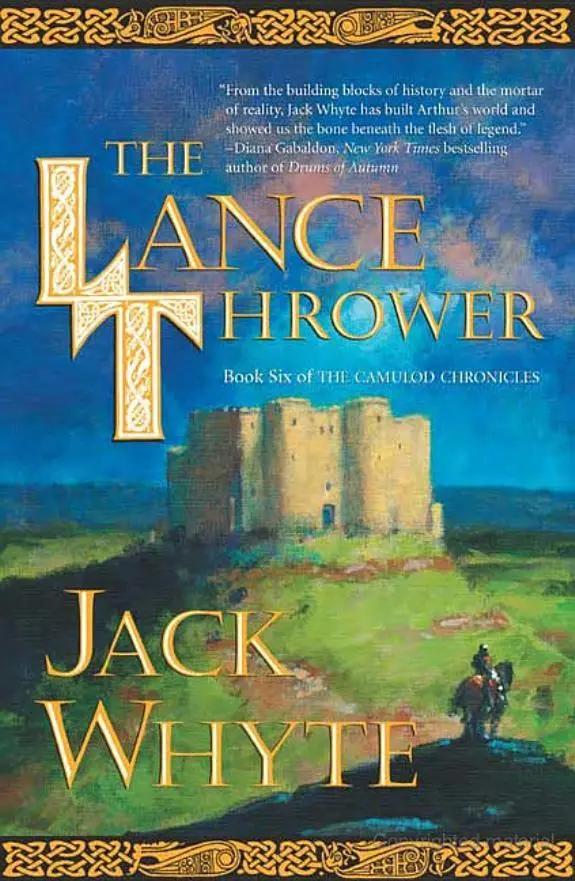
- Название:The Lance Thrower
- Автор:
- Жанр:
- Год:неизвестен
- ISBN:нет данных
- Рейтинг книги:5 / 5. Голосов: 1
-
Избранное:Добавить в избранное
- Отзывы:
-
Ваша оценка:
The Lance Thrower: краткое содержание, описание и аннотация
Предлагаем к чтению аннотацию, описание, краткое содержание или предисловие (зависит от того, что написал сам автор книги «The Lance Thrower»). Если вы не нашли необходимую информацию о книге — напишите в комментариях, мы постараемся отыскать её.
Clothar is a young man of promise. He has been sent from the wreckage of Gaul to one of the few schools remaining, where logic and rhetoric are taught along with battle techniques that will allow him to survive in the cruel new world where the veneer of civilization is held together by barbarism. He is sent by his mentor on a journey to aid another young man: Arthur Pendragon. He is a man who wants to replace barbarism with law, and keep those who work only for destruction at bay. He is seen, as the last great hope for all that is good.
Clothar is drawn to this man, and together they build a dream too perfect to last--and, with a special woman, they share a love that will nearly destroy them all...
The name of Clothar may be unknown to modern readers, for tales change in the telling through centuries. But any reader will surely know this heroic young man as well as they know the man who became his king. Hundreds of years later, chronicles call Clothar, the Lance Thrower, by a much more common name.
That of Lancelot.
The Lance Thrower — читать онлайн бесплатно полную книгу (весь текст) целиком
Ниже представлен текст книги, разбитый по страницам. Система сохранения места последней прочитанной страницы, позволяет с удобством читать онлайн бесплатно книгу «The Lance Thrower», без необходимости каждый раз заново искать на чём Вы остановились. Поставьте закладку, и сможете в любой момент перейти на страницу, на которой закончили чтение.
Интервал:
Закладка:
“Of course, that kind of talk was not too well received here, as you can imagine, and several of his teachers began to lean on him, but that only made him worse. He stopped working at his lessons altogether and went from being a bright student and a positive influence among the other boys to being a bitter, cynical recluse who never had a good word to say about anything or anyone.”
“So how did the other boys react to that?” I asked, and Cato turned to look at me with an expression of rueful skepticism that I remembered well.
“Not very well,” he said. “Some of them even joined forces to show him the error of his ways. But that was a waste of time, and often painful. Bors is a big lad, for his age, and he’s always been able to hold his own against lads twice his size. He thrashed a couple of them very badly and the others soon decided to leave him alone to stew in his misery.
“Germanus is the only one who refused to give up on the boy. I gave him up as unredeemable months ago, but the Bishop chewed on my ear for days and weeks until I decided to give the boy another chance. I did, and I kept working with the boy, biting my tongue every day and keeping what I really thought of him to myself. But nothing came of my efforts until a few days ago, and even then there wasn’t much to see. But whatever credit there is for that goes to Germanus. I don’t know what he did with the boy, or how he penetrated the tortoiseshell the lad has built about himself, but in the past couple of days young Bors has become more … tractable. Now that’s a word I can’t remember ever using before to describe a person. It’s a word I generally save for horses, obedient, biddable horses, but it fits what’s been happening with Bors. I wouldn’t say the boy’s more approachable, because he really isn’t, but there’s something happening inside that enclosed little world he lives in. Anyway, you’ll be able to judge for yourself soon enough. He should be here directly.”
By then we had been standing for some time looking at the four magnificent animals in the fenced enclosure he had led me to. All four were bays, of varying degrees of color, and all four were superb. Cato pointed out two in particular, one of them dark enough to be a chestnut, with only a single blaze of white on his forehead, the other with four white fetlocks. “Those two are yours,” he said. “There’s not much to choose from in the way of differences among the four of them, but those two would be my personal choice were I the one riding off into the unknown on them.”
“So be it, then, Magister. They shall be mine.”
“Good. They’re easy to identify as well, which does no harm. Here comes the boy.”
I recognized the boy immediately, and instantly wondered why I had not been able to recall him by name before. He had been a junior friend and something of a protégé to my own friend Stephan Lorco, following Lorco around for his first two years in the school in a condition resembling hero worship. He had already closed the outer gate behind him and was walking across the main yard of the stables, still several hundred paces from where we stood, and something in his gait, in the way he held himself, immediately caught my attention, making me look more closely to identify what it was that had struck me as being unusual, and before he had halved the distance separating us I knew what it was. He had not seen us yet, standing as we were in the shade of a low hut at the rear of the paddocks, with several lines of fencing between him and us, but there was a lack of diffidence in his walk that was unusual to the point of appearing arrogant.
Summoned from the classroom to meet with the formidable Magister Cato, he should have been filled with trepidation, wondering what he had done to engender such a command. Any other boy in the school would have been recognizably afraid. I would have been, in his place. But this boy showed no such concern. He walked confidently and purposefully, head erect, shoulders back, his pace steady and unhurried.
“He’s not afraid,” I said.
“No, not that one.” Cato’s voice was quiet. “A year ago he would have been, but now he doesn’t care. Grown up before his time, poor little catamite. There’s nothing I could say to him or do to him now that would make him feel worse, or even better, which is worse. That’s why he needs to go with you, if you’ll have him. He’s a man now, in his grief, but his body and the rest of him are still in boyhood. Those parts need to grow now, too, but in a man’s world, not a boy’s school. Bors! Over here.”
The boy turned toward the sound of Cato’s voice and came straight to where we stood. I saw him recognize me and frown slightly.
“Magister,” he said, looking at Cato and ignoring me.
Now that he was beside me I could see how much he had grown and aged in the time since I had last seen him. He was almost as tall as me now and half a head taller than the diminutive Tiberias Cato, and he was solidly made, with wide, strong shoulders; a deep, broad chest; and long, clean-lined arms and legs that rippled with well-toned, sharply defined muscles. His face was unblemished and attractive, albeit unsmiling, and his dark eyes held a guarded, reserved look.
It was a measure of my own growth in the months that had passed recently, however, that I saw him as a boy, although the fact that I was looking at him through a man’s eyes did not occur to me until much later.
“You sent for me, Magister.”
“Aye, I did,” Cato growled. “And I thank you for coming.” He ignored the slight quirk of the eyebrow that was the boy’s only response to his sarcasm. “You know Clothar of Benwick, I am sure. He is visiting us for a short time before leaving on a mission set for him by Bishop Germanus.”
Bors looked directly at me for the first time and inclined his head courteously.
“Of course, I remember him well,” he said, and then to me: “I was there when Stephan Lorco fought you for the Magister’s spatha. You should have won.”
“I have it here,” I said, tilting the hilt forward for him to see. “I was with Stephan when he was killed in an ambush, and I carry the spatha and use it now in remembrance of him.”
“Aye, that’s right, Lorco is dead, too, isn’t he?”
I was left speechless, not so much by the comment as by the tone in which it had been uttered, but Cato had been ready for something of the sort, I think, because his response was immediate.
“Aye, that’s right, as you say, he is. But Stephan Lorco was killed in battle, doing what he had been trained to do!”
That was not quite true, for poor Lorco had not even had time to see that we were being attacked, but I kept silent, watching for Bors’s response. He said nothing, however, and his only movement was to bite gently at his upper lip, but I clearly saw the pain that filled his eyes. Cato saw it too, I believe, for he spoke again in a gentler voice.
“Anyway, as I said, Clothar is leaving on a mission for Bishop Germanus. It will be dangerous, and Clothar is young to be entrusted with such responsibility, but the bishop chose him above all others for the task because he has great faith in this young man, as do we all. Since leaving here, he has fought in a short but brutal civil war in his own lands in Benwick, and has distinguished himself greatly. And he, too, knows what it is to lose close family, his parents first, and then his guardian and two brothers in this recent war. Bishop Germanus thought it might be good for you to speak with him while he is here. I thought so, too, which is why I sent for you. I know not what he might say to you, or even if you wish to speak with him, but here he is, and here you are, and I will leave the two of you alone.”
“Wait, Magister, if you would,” I said. He had been on the point of turning away but he stopped and looked at me with raised eyebrows. “I would like you to hear what I have to say to Bors.” The boy’s face was now set in resentment. I am not normally impulsive, but I knew I had to speak now what was in my mind and heart, and what was there was newly born in me, completely unconsidered and spontaneous.
Читать дальшеИнтервал:
Закладка:
Похожие книги на «The Lance Thrower»
Представляем Вашему вниманию похожие книги на «The Lance Thrower» списком для выбора. Мы отобрали схожую по названию и смыслу литературу в надежде предоставить читателям больше вариантов отыскать новые, интересные, ещё непрочитанные произведения.







Обсуждение, отзывы о книге «The Lance Thrower» и просто собственные мнения читателей. Оставьте ваши комментарии, напишите, что Вы думаете о произведении, его смысле или главных героях. Укажите что конкретно понравилось, а что нет, и почему Вы так считаете.