Jack Whyte - The Lance Thrower
Здесь есть возможность читать онлайн «Jack Whyte - The Lance Thrower» весь текст электронной книги совершенно бесплатно (целиком полную версию без сокращений). В некоторых случаях можно слушать аудио, скачать через торрент в формате fb2 и присутствует краткое содержание. Жанр: Старинная литература, на английском языке. Описание произведения, (предисловие) а так же отзывы посетителей доступны на портале библиотеки ЛибКат.
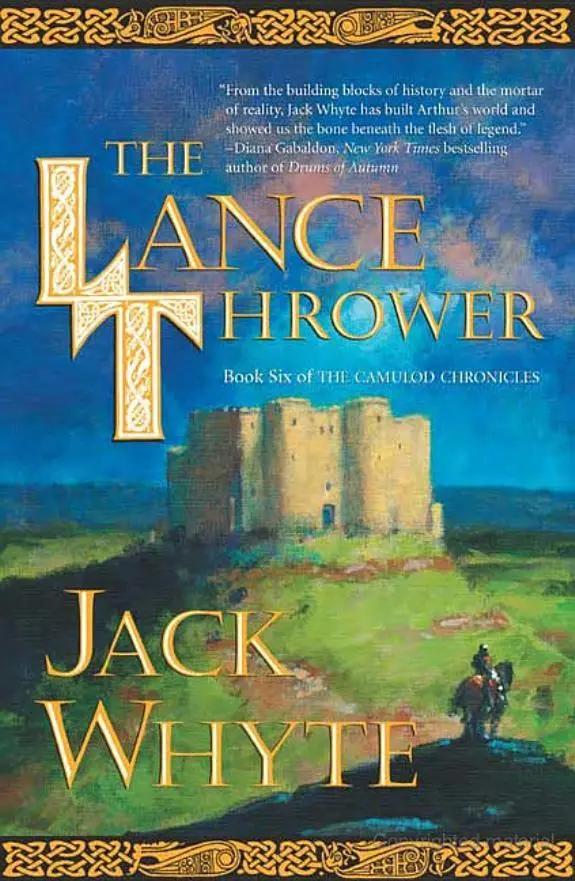
- Название:The Lance Thrower
- Автор:
- Жанр:
- Год:неизвестен
- ISBN:нет данных
- Рейтинг книги:5 / 5. Голосов: 1
-
Избранное:Добавить в избранное
- Отзывы:
-
Ваша оценка:
The Lance Thrower: краткое содержание, описание и аннотация
Предлагаем к чтению аннотацию, описание, краткое содержание или предисловие (зависит от того, что написал сам автор книги «The Lance Thrower»). Если вы не нашли необходимую информацию о книге — напишите в комментариях, мы постараемся отыскать её.
Clothar is a young man of promise. He has been sent from the wreckage of Gaul to one of the few schools remaining, where logic and rhetoric are taught along with battle techniques that will allow him to survive in the cruel new world where the veneer of civilization is held together by barbarism. He is sent by his mentor on a journey to aid another young man: Arthur Pendragon. He is a man who wants to replace barbarism with law, and keep those who work only for destruction at bay. He is seen, as the last great hope for all that is good.
Clothar is drawn to this man, and together they build a dream too perfect to last--and, with a special woman, they share a love that will nearly destroy them all...
The name of Clothar may be unknown to modern readers, for tales change in the telling through centuries. But any reader will surely know this heroic young man as well as they know the man who became his king. Hundreds of years later, chronicles call Clothar, the Lance Thrower, by a much more common name.
That of Lancelot.
The Lance Thrower — читать онлайн бесплатно полную книгу (весь текст) целиком
Ниже представлен текст книги, разбитый по страницам. Система сохранения места последней прочитанной страницы, позволяет с удобством читать онлайн бесплатно книгу «The Lance Thrower», без необходимости каждый раз заново искать на чём Вы остановились. Поставьте закладку, и сможете в любой момент перейти на страницу, на которой закончили чтение.
Интервал:
Закладка:
“There is a man in Britain, Bors, two or three years older than I am and therefore less than five years older than you, who will soon be crowned as King of Britannia. His name is Arthur—Arthur Pendragon—and I have been told by the bishop himself that the man commands an army of heavy cavalry the like of which has not been seen since the time of Alexander the Great. Britain is being invaded as I speak, by a tide of different peoples from across the seas to the east of the island. The hordes are drawn to Britain’s wealth since the Roman legions left the island two score years ago. All of them are pagans, and they seem set to destroy God’s Church in Britain and to wipe out all signs of Christianity in the path of their conquest. Arthur Pendragon’s army is the only force that can gainsay them and hurl them back to where they came from.
“His teacher, a wise and powerful man called Merlyn Britannicus, is a beloved friend to Germanus, and has shaped the new King in much the same fashion as Germanus has trained us, in compassion and decency, but also in military strength, dedicated to the preservation of the laws of God and man and using the full force of his military power to back his convictions. I am to leave for Britain within the days ahead, carrying missives to Merlyn and to the Christian bishops of the land, bidding them rally to Arthur’s support and to mobilize the earthly powers of God’s Church on behalf of the new king.”
I drew a deep breath, not daring to look at Cato, and continued. “I will deliver my dispatches to Merlyn, and to the bishops, in accordance with the wishes of Bishop Germanus, and then I may return home to Gaul. But it is in my mind that I like the notion of this new King and his campaign to save his country from the pagan hordes, and so I may stay there, to ride and fight with him, so be it that I like the man as much after meeting him as I now enjoy the idea of what he represents. I’ll take you with me, if the idea pleases you. Will you come?”
The boy’s eyes were wide with disbelief. Finally, when he realized that we were both gazing at him, waiting for an answer, he gulped breathlessly, then whispered, “Do you—?” He swallowed, but when he spoke again his voice broke into a squeak on the first utterance—quickly mastered, but nonetheless indicative of his youth. “Do you mean that?”
I glanced at Cato, whose fierce, bushy eyebrows were now riding high on his forehead. “Do I mean that? Mark this, Bors, and mark it clearly. If you do come with me, it will be as my assistant—an extension of your training under my care. I will be the master, you the apprentice. You will not travel as a warrior, or as the equal to myself or my companion Perceval, although in time you may develop into both. For the time being, however, your duties will be onerous and will revolve purely around my needs—my weapons, my armor, my horses, my provisions, and any other requirements I might have. In return, I will be your guardian and your trainer and teacher, in trust for the faith placed in me by Bishop Germanus and Magister Cato here. But I warn you, I will be your master, until such time as you have proved to me that you have progressed beyond the point of needing to be taught.
“And I warn you, too, incidentally, that you will find few people who will tell you that questioning your master’s honesty and truthfulness is a beneficial or clever way to set out upon such a relationship. This one time, however, I will ignore the slur. Yes, I mean what I say, and you still have not answered me. Will you come with me to Britain?”
His eyes had filled with tears and for a moment I thought they would spill over, but he blinked them fiercely away and turned apprehensively to Cato, who met his question with an upraised hand. “Don’t come to me for guidance. As the man says, he will take you in trust for Bishop Germanus and myself. If you want to go, I have a horse picked out for you.”
The young man who walked away from us a short time later still walked with purpose and determination, but there was an air of excitement about him that had not been there when he first arrived.
“That was … sudden,” Cato said when we were alone again. “Unexpected, but well done, I think. I have the feeling you will not regret your impulsiveness.”
With Bors dismissed, Cato suggested that I follow him. I never could listen to a suggestion from Cato without hearing an order, and so I rushed to keep up as he walked back toward the camp.
“That spatha was never meant to be the prize, you know,” he growled. “I suppose I would have gotten around to giving it to you eventually, but I had something else in mind that afternoon. Then you went and fouled everything up by letting Lorco win.”
He led me into a low hut and into the tiny cubicle that served him as both home and workspace. There he pointed toward the farthest corner, where two sheaves of spears were stored.
“Those are what you should have won that day,” he said. “Won as a prize, upon the field, they would have been a trophy and would have saved me from the taint of playing favorites by giving them all to you. Now there’s no need to fret over any of that. They’re yours, a gift. Do you remember how to use them?”
I certainly did. He had brought these strangely strong yet lightweight, delicately shafted spears with him from the land where he had been raised, the land of the Smoke People. Each spear was tipped with a long, tapering, triangular metal head that came to a needle point and could, when well thrown, penetrate even the finest ring mail. The shafts were of the strange sectional and intensely hard wood that Cato called bambu. They were wondrous weapons, their slight weight and utter straightness permitting them to be thrown with great accuracy by anyone who had perfected the tricks of using them. On its most elemental level, the technique required an aptitude for wrapping the shaft quickly in the coils of a thin leather thong. With the thong gripped in the throwing hand, the hurled spear would begin to spin as the thong unwound, adding to its velocity and force. It was a wonderful weapon, and unique.
“They weigh next to nothing, but their length makes them awkward to transport,” Cato said. “But that’s why I went to such trouble choosing the boy’s two horses. You can pack one quiver of these on each side of the packhorse and stow the rest of its load around them. You have two bundles there, with just over a score of spears in each. Might seem like a lot, particularly when you’re traveling with them, but it isn’t, believe me. The things are irreplaceable, so every one you lose or break takes you one step closer to having none.”
Once again I was left fumbling for words by the munificence of such an unexpected gift, and the protests and objections that emerged from my lips sounded inane and self-serving even to me. In response to my witless question about what he would do once he no longer had them in his possession, Tiberias Cato merely smiled and cocked an eyebrow.
“What will I do without them? Much the same as I have done with them these past twenty years, which is nothing at all. But I’ll have less difficulty in resisting the temptation to use them to rid myself of some of the weaker sisters among our students. I frequently used to imagine myself standing in the middle of the practice ring, picking the slackers right off the backs of their circling mounts. So by taking these out of my reach, you’ll be assuring the future safety of the students. They are yours, Clothar, as is the spatha and the legate’s armor. Use them as we know you can and will, and we’ll make no complaints.
“Now, let’s go and find something to eat. Young Bors can pick these up for you later.”
Five days after that conversation, we rode into Lutetia to inquire after Perceval’s brother Tristan, making our way directly to the garrison headquarters, where we were told we would have to speak to the adjutant.
Читать дальшеИнтервал:
Закладка:
Похожие книги на «The Lance Thrower»
Представляем Вашему вниманию похожие книги на «The Lance Thrower» списком для выбора. Мы отобрали схожую по названию и смыслу литературу в надежде предоставить читателям больше вариантов отыскать новые, интересные, ещё непрочитанные произведения.







Обсуждение, отзывы о книге «The Lance Thrower» и просто собственные мнения читателей. Оставьте ваши комментарии, напишите, что Вы думаете о произведении, его смысле или главных героях. Укажите что конкретно понравилось, а что нет, и почему Вы так считаете.