Jack Whyte - The Lance Thrower
Здесь есть возможность читать онлайн «Jack Whyte - The Lance Thrower» весь текст электронной книги совершенно бесплатно (целиком полную версию без сокращений). В некоторых случаях можно слушать аудио, скачать через торрент в формате fb2 и присутствует краткое содержание. Жанр: Старинная литература, на английском языке. Описание произведения, (предисловие) а так же отзывы посетителей доступны на портале библиотеки ЛибКат.
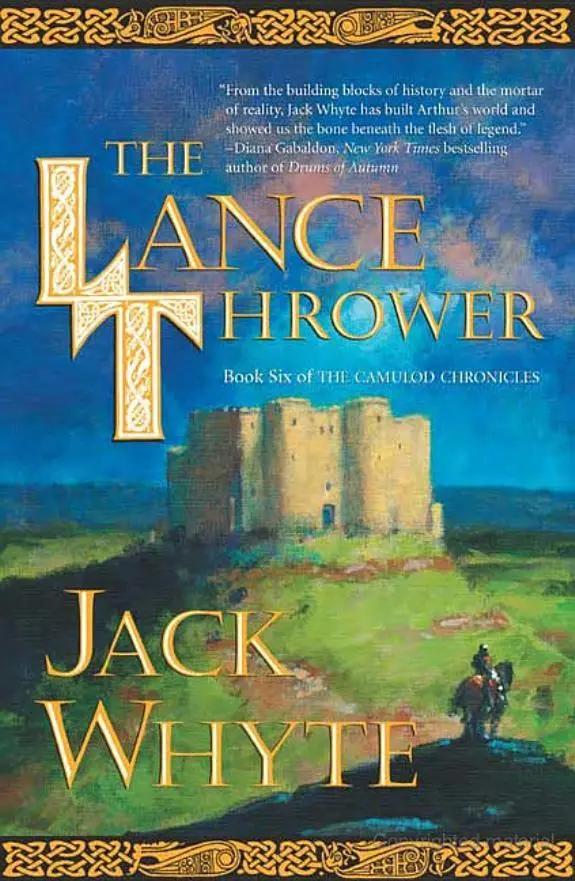
- Название:The Lance Thrower
- Автор:
- Жанр:
- Год:неизвестен
- ISBN:нет данных
- Рейтинг книги:5 / 5. Голосов: 1
-
Избранное:Добавить в избранное
- Отзывы:
-
Ваша оценка:
The Lance Thrower: краткое содержание, описание и аннотация
Предлагаем к чтению аннотацию, описание, краткое содержание или предисловие (зависит от того, что написал сам автор книги «The Lance Thrower»). Если вы не нашли необходимую информацию о книге — напишите в комментариях, мы постараемся отыскать её.
Clothar is a young man of promise. He has been sent from the wreckage of Gaul to one of the few schools remaining, where logic and rhetoric are taught along with battle techniques that will allow him to survive in the cruel new world where the veneer of civilization is held together by barbarism. He is sent by his mentor on a journey to aid another young man: Arthur Pendragon. He is a man who wants to replace barbarism with law, and keep those who work only for destruction at bay. He is seen, as the last great hope for all that is good.
Clothar is drawn to this man, and together they build a dream too perfect to last--and, with a special woman, they share a love that will nearly destroy them all...
The name of Clothar may be unknown to modern readers, for tales change in the telling through centuries. But any reader will surely know this heroic young man as well as they know the man who became his king. Hundreds of years later, chronicles call Clothar, the Lance Thrower, by a much more common name.
That of Lancelot.
The Lance Thrower — читать онлайн бесплатно полную книгу (весь текст) целиком
Ниже представлен текст книги, разбитый по страницам. Система сохранения места последней прочитанной страницы, позволяет с удобством читать онлайн бесплатно книгу «The Lance Thrower», без необходимости каждый раз заново искать на чём Вы остановились. Поставьте закладку, и сможете в любой момент перейти на страницу, на которой закончили чтение.
Интервал:
Закладка:
“Hmm. You always were an attentive student.” He turned his eyes to Ursus. “Did you fight with Clothar in this war, Master Ursus?”
To my great surprise, Ursus flushed crimson. “No, sir,” he said, “I did not. I left to return to my base in Carcasso before the war in Benwick really broke out.”
“Ursus had no reason to remain in Benwick, Magister.” Both men turned to look at me, and I felt myself flushing as deeply as Ursus had. “He had no reason to be there at all,” I added, lamely, “other than to deliver me to my family, a task he took upon himself when Duke Lorco and his party vanished.” I looked from one to the other of them and grinned, feeling unaccountably better. “I must have been very young, in those days, to have appeared to be in need of an escort. That was all of seven months ago.”
Wasting no words, I then told my teacher the story of the war, and how it had ended suddenly with Gunthar’s being struck down by an apoplexy in the course of a fit of rage. “Clement, Queen Vivienne’s physician, thinks the apoplexy that killed him was the cause of his madness, rather than the other way around,” I added, seeing their uncomprehending expressions. “Clement believed Gunthar’s worsening behavior might have been caused from the very beginning by some kind of … some kind of alien thing growing inside his head.” I was fully aware of how stupid that statement had sounded, but Tiberias Cato did not scoff.
“A tumor,” he said.
“Aye, that was the word! That’s what Clement called it. A tumor. He said it is a hidden, malignant growth that can develop slowly over years, occupying more and more room within a man’s head, and then suddenly explode and kill him. And as it grows, he says, it deprives its host—for the man in whom it grows hosts it as surely as an oak tree hosts a mistletoe—of life and strength and sanity. You knew the word, Magister. Have you heard of such a thing before?”
“Aye, Clothar, that I have. I had a friend who died of it, long years ago in the army. It is not a pleasant way to die.”
“Did your friend go insane?”
“Not in the way you mean, I think, but by the time he died he was no longer the friend I had known for so long. It altered him beyond recognition, not merely physically, although it did that, too, but mentally—intellectually. The military surgeons were helpless—they knew what it was but they couldn’t cut into it without killing him. By the time the final stages hit him, he had been sick for three months, growing worse every day until it eventually killed him.” He broke off and spun to look up at me. “Have you spoken to the bishop yet?”
“No, I haven’t even seen him yet. We’re just on our way in now. We have been traveling for weeks.”
Cato frowned. “Then you’d better go directly to his quarters. He’ll want to see you without delay.”
“Why, Magister?”
“Because he has been waiting for you for more than a month, that’s why! And he leaves tomorrow for Italia, on Church business. He is required to be there long before the solstice and he will not return here for at least two months after that, in the early spring. And he has a mission for you to carry out that will not wait until he returns.” He waved a hand at me, dismissing me. “Mount. Mount up and ride, you have no time to waste and neither does the bishop. Go directly to his chambers. Hurry! Master Ursus here will walk with me and keep me company on the road back into town and I will see him safely quartered as a guest of the school. Leave your saddlebags and bedding roll with us. Off with you now. We will talk again tomorrow, you and I.”
Germanus was meeting with several of his senior colleagues when I arrived in his quarters, and the junior cleric who sat on guard before the door to the episcopal chambers was a newcomer whom I did not recognize. He did not know me, either, but I had no trouble seeing that he disapproved of my dusty, road-soiled appearance from the moment he first set eyes on me. He sucked in his prudish little mouth and informed me primly and not quite discourteously that the Lord Bishop was in council and not to be disturbed under any circumstances. I nodded and returned the fellow’s disdainful look measure for measure. He was perhaps two years older than me, and every aspect of his appearance befitted the description “cleric.” He was pallid, soft looking, and stoop shouldered, his mouth turned down at the edges and his eyes creased with wrinkles from squinting in bad light, trying to decipher manuscripts written by others as insipid as himself.
I turned my back on him as though to leave, but then unhooked the spatha from my side and spun around, dropping the sheathed sword on the table in front of him so that he reared back and raised his hands to fend off a blow.
“I am not threatening you with it, man, I’m offering you an opportunity to save your hide and soothe my ruffled pinions at the same time. Now listen to me carefully. Whether you believe it or not, Bishop Germanus will want to see me. You say he is not to be disturbed. Very well. I am not asking you to disturb him. I merely want you to walk into his chambers, to where he can see you, and to stand there, holding that sword in such a way that he can see it. There is no need for you to speak, no need for you to interrupt him, no need for you to do anything except stand where he can see you and what you are holding. Can you understand that?” He could.
“Now, let us examine the alternative, should you refuse to do as I ask. The bishop, I have been told by Tiberias Cato, has been waiting for me to arrive here for more than a month, although I did not know that. In consequence, I could not expect you to know that, either, so I will not complain about you. But I promise you Bishop Germanus will not be happy to know that you refused to announce me.”
The man was instantly on his feet, clutching the sheathed sword in a white-knuckled grip and backing away from me as though I might be rabid and about to leap at him. He released one hand from its death grip and fumbled behind him for the door handle, keeping his eyes on me as he backed through the doorway and closed it, shutting me out.
Within moments the door was flung open again and Germanus himself stood in the opening.
“You came,” he said, and stepped toward me, opening his arms to embrace me, and as I returned his embrace, feeling the strength of his old arms hugging me to his bosom, I was struck, despite the vigor of his hug, by the extent to which he had aged since last we met. He was clean shaven and smooth cheeked again, after several years of going bearded, and his mane of hair was snowy white, but still thick and healthy. He held me at arm’s length and scanned me with his eyes, his gaze moving slowly, meticulously, over my face and body.
“Older,” he said. “And stronger, more vigorous and, aye, wiser, more learned. You are become a warrior, my son, not merely a man.” He sighed a great, gusty breath, and smiled. “But then, we expected no less, those of us who know you. Come inside, come in. You and I have much to discuss and little time in which to do it, but your timing could really not be better. My conference with my brethren is almost complete, only a few remaining tasks to delegate for the term of my absence, and then I will be free of my parochial responsibilities until I return from Italia, which means I may have the rare treat of spending an evening at my own pleasure tonight. If you will please me by waiting—in here, I mean, in my chambers, not outside—I shall conclude my affairs and dismiss my brethren, and then you and I will eat and drink a cup of watered wine together. Will you do that for me?”
“Aye, Father,” I answered, smiling, “I will, and most particularly if the wine be well and truly watered, for I still mislike its being too strong.”
Читать дальшеИнтервал:
Закладка:
Похожие книги на «The Lance Thrower»
Представляем Вашему вниманию похожие книги на «The Lance Thrower» списком для выбора. Мы отобрали схожую по названию и смыслу литературу в надежде предоставить читателям больше вариантов отыскать новые, интересные, ещё непрочитанные произведения.








Обсуждение, отзывы о книге «The Lance Thrower» и просто собственные мнения читателей. Оставьте ваши комментарии, напишите, что Вы думаете о произведении, его смысле или главных героях. Укажите что конкретно понравилось, а что нет, и почему Вы так считаете.