Jack Whyte - The Lance Thrower
Здесь есть возможность читать онлайн «Jack Whyte - The Lance Thrower» весь текст электронной книги совершенно бесплатно (целиком полную версию без сокращений). В некоторых случаях можно слушать аудио, скачать через торрент в формате fb2 и присутствует краткое содержание. Жанр: Старинная литература, на английском языке. Описание произведения, (предисловие) а так же отзывы посетителей доступны на портале библиотеки ЛибКат.
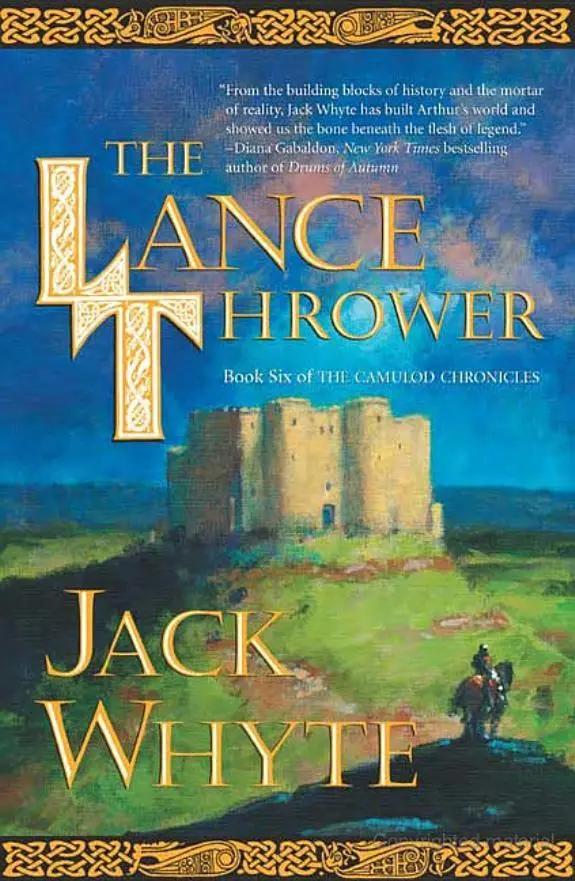
- Название:The Lance Thrower
- Автор:
- Жанр:
- Год:неизвестен
- ISBN:нет данных
- Рейтинг книги:5 / 5. Голосов: 1
-
Избранное:Добавить в избранное
- Отзывы:
-
Ваша оценка:
The Lance Thrower: краткое содержание, описание и аннотация
Предлагаем к чтению аннотацию, описание, краткое содержание или предисловие (зависит от того, что написал сам автор книги «The Lance Thrower»). Если вы не нашли необходимую информацию о книге — напишите в комментариях, мы постараемся отыскать её.
Clothar is a young man of promise. He has been sent from the wreckage of Gaul to one of the few schools remaining, where logic and rhetoric are taught along with battle techniques that will allow him to survive in the cruel new world where the veneer of civilization is held together by barbarism. He is sent by his mentor on a journey to aid another young man: Arthur Pendragon. He is a man who wants to replace barbarism with law, and keep those who work only for destruction at bay. He is seen, as the last great hope for all that is good.
Clothar is drawn to this man, and together they build a dream too perfect to last--and, with a special woman, they share a love that will nearly destroy them all...
The name of Clothar may be unknown to modern readers, for tales change in the telling through centuries. But any reader will surely know this heroic young man as well as they know the man who became his king. Hundreds of years later, chronicles call Clothar, the Lance Thrower, by a much more common name.
That of Lancelot.
The Lance Thrower — читать онлайн бесплатно полную книгу (весь текст) целиком
Ниже представлен текст книги, разбитый по страницам. Система сохранения места последней прочитанной страницы, позволяет с удобством читать онлайн бесплатно книгу «The Lance Thrower», без необходимости каждый раз заново искать на чём Вы остановились. Поставьте закладку, и сможете в любой момент перейти на страницу, на которой закончили чтение.
Интервал:
Закладка:
Two days later, while Gunthar’s cavalry guards were scouring the southern territories looking for us, we wiped out two similar but smaller posts in the northwest quadrant of our range, attacking both simultaneously with thirty riders. This time, too, we were fortunate enough to find a score of horses stabled in one of the farms, and when we left, having set fire to the buildings and piled the dead in the middle of the farmyard, we took the horses with us, a welcome addition to our own stables.
Those raids marked the formal start of our campaign, and for the next two months we remained neck deep in conflict with what seemed to be an inexhaustible supply of fresh troops spilling out of Gunthar’s territories, for territories—his and ours—had been established soon after the beginning of hostilities. Gunthar’s forces had possession of a series of four minor but strongly fortified castles that were clustered near to each other in the south and eastern area of what had been Ban’s kingdom, and the close linkage of those four strongholds, coupled with the hilly yet densely wooded terrain they occupied, enabled Gunthar to set up a solid and virtually self-sufficient province there that he could hold without great difficulty against any and all comers. There was little arable land within the region he controlled, so he had few convenient sources of supply of freshly grown food-stuffs, but since he and his followers were essentially brigands and Outlanders, they stole what they needed from wherever they could find it.
That brief time removed me forever from the status of boyhood, although because of it, I was never able to undergo the formal rites of passage into manhood. Informal rites there were aplenty to replace them, however, and I never heard anyone complain that my sword was being wielded by someone who lacked a man’s credentials. I rode out of the red-wall caves on the morning of that first raid as a complete tyro—a green recruit who had absorbed many of the rudiments of basic training but had yet to distinguish himself in any way in the matter of combat or military conduct or manly prowess. It was true that I had killed more than one man, but none of the people who rode with me that day knew that. In their eyes, I was a mere boy, several years junior to the youngest of them.
Within the week, however, on a raid in which we had divided our force into two squadrons of thirty men each, the group I rode in was trapped by a detachment of Gunthar’s mounted guards, who diverted us into a steep-sided valley that had no other way out. They outnumbered us by close on two to one and we had a sore time fighting our way clear, for before we realized what was happening they had herded us into a narrow chute at the extreme end of the valley, where we were so tightly jammed together that we had no room to fight. Caught on the outside of the crush at the rear of our squadron, far from the nearest of our attackers and angry at my own inability to move closer to the fighting, I unslung the bow that hung by my saddle and had been given to me by King Ban. I threw the quiver of war arrows across my shoulders, jumped down from my horse, and scrambled up the steep hillside that reared above me. It was hard going, for the ground was soft and sandy, and I found it difficult to gain a purchase on the slope with my feet, but eventually I came to a level spot where I could look down at the scene below me. It was chaotic, but I could see everything clearly, and so I began to aim and shoot.
The arrows I was using were the very ones that had killed Ban of Benwick, the arrows given to me by King Ban himself, upon his deathbed. These large, heavy war arrows, with their flared and wickedly barbed heads, could pierce armor from a distance as short as the one from which I was shooting, and the enemy below me were all too close for me to miss. My assault broke the fury of their attack within moments, for it was sustained and deadly, with never a missed target on my part. I drew and aimed and fired as quickly as my hands could move, and I had been well trained in making those movements. I dropped five men with my first five arrows, and by that time even those who had not noticed me before were aware of my presence above them.
The first move by an enemy rider to disengage and ride away caught my eye, and I drove him out of the saddle with a hard shot that skewered his cuirass between his shoulder blades. I heard the noise as he crashed to the ground. Then it became difficult to select a target, because so many men were suddenly in retreat, and naturally, our men were thundering after them, intent now on revenge. As it was impossible to tell friend from foe when they were galloping away from me, I slid quickly back down the hill and salvaged as many of my spent arrows as I could before I remounted my horse and spurred after my companions.
I was feasted that night, the tale of my “counterattack” being the talk around our campfires. We had lost seven men in the encounter, but it might have been far worse and it certainly would have been far more disastrous had I not had my bow and arrows with me. Of all the sixty men riding in Samson’s two squadrons, I was the only bowman.
I had good fortune in the next raid, too, managing to quickly spot a weakness in the force that was facing us. It was the kind of occurrence that takes place in the blinking of an eye, when you identify an opportunity, and the decision to exploit it or to let it pass by is instantaneous. In this instance, leading a diversionary thrust across the enemy’s front to distract them from advancing directly against our main position, I saw an opening between two sections of the enemy where no space should have been, and I swung aside and charged straight into it. Fortunately, the men directly behind me followed without thought and we were able to act as a wedge, splitting the enemy into two groups that were more easily surrounded and dealt with.
From being the greenest tyro in the group, I had progressed to being known by everyone and acquiring a growing reputation as a man of luck and good judgment, which was extremely flattering but precisely the kind of conceit that Germanus and Tiberias Cato had warned me against more times than I could remember. A short time after that, however, Sigobert, the veteran cavalry commander who had been Samson’s second in command for years, was killed in a skirmish with some displaced Burgundian bowmen. His command was taken over by another veteran, Rigunth, but then Rigunth rode into an ambush at the head of a small group three days later and was killed with all his men.
When the word of Rigunth’s death arrived, Samson came looking for me and appointed me, temporarily, to the position of squadron commander. I accepted without a blink, having heard only the word temporary and fully anticipating that someone would quickly be promoted from the cadre of junior officers to fill the spot. By the time two weeks had passed, however, I was sufficiently perturbed to seek out Samson. I found him sitting at a makeshift table by one of the fires, studying a map that had been drawn by one of our clerks who had a talent for such things, and cleared my throat to announce myself and let him know I wished to speak with him.
He put down the map and the pen he had been holding and looked at me strangely, his mouth twisted sideways in a half smile. I told him briefly what was bothering me and asked him when I could expect to be relieved of my temporary duties, and he leaned backward, clutching the edge of the table and wiggling his shoulders to loosen them from the strain of having sat still for so long.
“Why are you asking me that?” he responded. “We’re in the middle of a war, Cousin. Are you telling me you are not enjoying your command?”
“No, that’s not what I’m saying at all, Samson. I’m enjoying it thoroughly, but it has been more than two weeks now and for the past few days I’ve been worrying that I might be enjoying it too much.”
Читать дальшеИнтервал:
Закладка:
Похожие книги на «The Lance Thrower»
Представляем Вашему вниманию похожие книги на «The Lance Thrower» списком для выбора. Мы отобрали схожую по названию и смыслу литературу в надежде предоставить читателям больше вариантов отыскать новые, интересные, ещё непрочитанные произведения.







Обсуждение, отзывы о книге «The Lance Thrower» и просто собственные мнения читателей. Оставьте ваши комментарии, напишите, что Вы думаете о произведении, его смысле или главных героях. Укажите что конкретно понравилось, а что нет, и почему Вы так считаете.