Jack Whyte - The Lance Thrower
Здесь есть возможность читать онлайн «Jack Whyte - The Lance Thrower» весь текст электронной книги совершенно бесплатно (целиком полную версию без сокращений). В некоторых случаях можно слушать аудио, скачать через торрент в формате fb2 и присутствует краткое содержание. Жанр: Старинная литература, на английском языке. Описание произведения, (предисловие) а так же отзывы посетителей доступны на портале библиотеки ЛибКат.
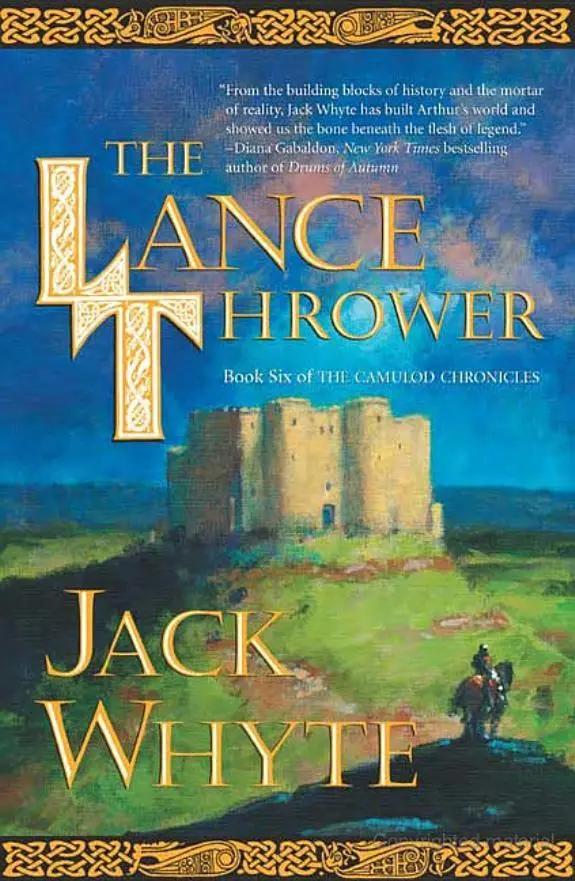
- Название:The Lance Thrower
- Автор:
- Жанр:
- Год:неизвестен
- ISBN:нет данных
- Рейтинг книги:5 / 5. Голосов: 1
-
Избранное:Добавить в избранное
- Отзывы:
-
Ваша оценка:
The Lance Thrower: краткое содержание, описание и аннотация
Предлагаем к чтению аннотацию, описание, краткое содержание или предисловие (зависит от того, что написал сам автор книги «The Lance Thrower»). Если вы не нашли необходимую информацию о книге — напишите в комментариях, мы постараемся отыскать её.
Clothar is a young man of promise. He has been sent from the wreckage of Gaul to one of the few schools remaining, where logic and rhetoric are taught along with battle techniques that will allow him to survive in the cruel new world where the veneer of civilization is held together by barbarism. He is sent by his mentor on a journey to aid another young man: Arthur Pendragon. He is a man who wants to replace barbarism with law, and keep those who work only for destruction at bay. He is seen, as the last great hope for all that is good.
Clothar is drawn to this man, and together they build a dream too perfect to last--and, with a special woman, they share a love that will nearly destroy them all...
The name of Clothar may be unknown to modern readers, for tales change in the telling through centuries. But any reader will surely know this heroic young man as well as they know the man who became his king. Hundreds of years later, chronicles call Clothar, the Lance Thrower, by a much more common name.
That of Lancelot.
The Lance Thrower — читать онлайн бесплатно полную книгу (весь текст) целиком
Ниже представлен текст книги, разбитый по страницам. Система сохранения места последней прочитанной страницы, позволяет с удобством читать онлайн бесплатно книгу «The Lance Thrower», без необходимости каждый раз заново искать на чём Вы остановились. Поставьте закладку, и сможете в любой момент перейти на страницу, на которой закончили чтение.
Интервал:
Закладка:
A short time after that he held up his hand and stopped. “Here we are. This is the end of the road, and I think it’s also the place you were asking me about. Low ceiling, close to the outside, easy to supply and big enough to feed and shelter fifty horses. Mind you, it’s going to be the end of the secret entrance as a secret.”
I nodded. “That is true—but if the secrecy was intended in the beginning as a means of saving the castle and its occupants from disaster and defeat someday in the distant future, then it has already served its purpose, for it can’t ever be used and then continue to be a secret, can it? Now we will use it to excellent purpose, and we will maintain at least a semblance of secrecy for as long as we can. If we continue to enjoy good fortune, Gunthar and his people may never find out about it. I’ll grant you, that may be wishful thinking, but any period of time we can grasp and maintain in this matter will serve us in good stead. Let me have a look at the place.”
We were in the first chamber into which the secret doorway opened from the back of the red-wall caves—and in the light of my flickering torch, held at arm’s length above my head, I could see that it was perfect for our needs. Foremost, it was spacious, and the ground was solid stone, dry and almost perfectly flat, save for a few bumps and extrusions that would bother no one—and no horse. The smoke from our two torches was whipped away to some vent high above our heads, and a cool current of air blew gently and steadily around us. I could see where and how we could halter horses in lines of six or eight on both sides of a small central ridge of stone that bisected the floor, and there was plenty of dry, open space in which to pile and store bales of hay and other fodder.
The best feature of all, however, was a spring of pure water that welled from a hole in the stone wall at approximately the height of a tall man and flowed down into a large natural basin before spilling over again to form a narrow stream that ran along the cave wall until it was lost in darkness and distance. Not even in Tiberias Cato’s stables in Auxerre had there been such a wonderful source of fresh water.
I told Clodio the place was perfect and thanked him for his trust, and he grimaced and stepped away from me, toward the wall of the cave. I watched him go, wondering how I had offended him, but he stopped short of the wall beside a spine of rock that thrust up from the floor and beckoned to me. I stepped to his side and looked where he was pointing, but I could see nothing except the rock spine surmounted by a projecting knob of stone. When I turned back to him, my eyebrows raised, he nodded, and closed his hand over the stone knob, pulling it back toward him. It swung open, hinged in some way, and beneath it was a hollow space. Clodio reached into the space and I saw him twist something to his left. Immediately, a wide section of the solid stone wall at least six paces to the right of where we were standing began to swing silently in toward us and tilt upward from the base of the wall. It looked wide enough to permit entry to two horses side by side, and, holding my torch high above my head, I stepped forward to look at what was happening and saw the system of levers that were operating the mechanism.
“That is impressive,” I said.
Clodio came up beside me, his strange gait appearing sinuous and natural in the flickering torchlight. “Aye, it is, I know, but the opening device is mummery. There’s no need for secrecy on this side of the door. Anyone in here already knows why he’s here and what’s going on. It’s only the other side of the wall that needs masking, and that works perfectly. Mind you, the door is a long way from the controlling device over there, and if I hadn’t shown you that, you’d have thought this thing opened by magic, would you not?” I nodded, and he led me through the door and showed me the corresponding trigger on the other side.
The following day I made the final arrangements for what would become the biggest thorn in Gunthar’s side in the time to come, and I began by convening a meeting of my elders and superiors and telling them what I envisioned. They listened closely and, to their credit, made no demur. I did not flatter myself, however, that, they had all suddenly become impressed by my bravery and my impressive cavalry skills; to them I was a mere boy, untested and untried, who had taken part in one skirmish without being blooded and before that had been absent in foreign parts for many years, and the truth was that they had nothing at all to lose by humoring me and acceding to my wishes. The horses we currently had inside the castle were useless there, and the cumbersome preparations to raising and lowering the drawbridge ensured that there was no possibility of employing surprise in bringing them out from the castle. The enemy bowmen waiting beyond the walls would have ample time to aim and shoot them down before the animals could even clear the end of the bridge. It was the single biggest flaw in the design of the drawbridge; and there was nothing we could do to change it now, in the middle of hostilities.
Nonetheless, we also had a huge logistical problem that offered us, paradoxically, a means of achieving what we wanted.
We had taken more than two hundred prisoners in our capture of the castle, and now we were faced with the double task of feeding them and guarding them. More than half of the prisoners had willingly thrown in their lot with us when they were captured, switching their allegiance from Gunthar as easily as a horse switches its tail at a fly, in return for their immediate freedom and an ongoing source of comfortable bedding and regular, well-prepared meals that were vastly preferable to what they could expect to receive as prisoners. The hundred or so that remained in our custody, however, were both a nuisance and a massive inconvenience.
I therefore proposed to Chulderic and the others that we set these people free again, but that we do so in a way that would work to our advantage. I explained my thinking and they listened, nodding occasionally in acknowledgment of the common sense involved in what I had to say. When I had finished, all eyes turned to Chulderic, who sat glowering at me from beneath heavy brows. His frown grew even darker as he began firing short, blunt questions at me, and I answered them as tersely and concisely as he phrased them. Finally, when I answered what had been the last of his questions, he surprised me by uttering a single sharp bark of laughter and slapping his hand on the arm of his chair.
“Do it, boy! If it works, it will be the making of you as a man. If it doesn’t work, it will provide all of us older men with something to laugh over on a winter’s night when we are too old to fight.”
Just after the evening meal, when the smoke of the cooking fires still hung in the air and the men in both camps, Gunthar’s and ours, were feeling well fed and lazy with an uneventful day behind them and their bellies full, the guards on duty herded all our prisoners from the enclosure in the inner defenses where they had been kept since their capture, tied their hands behind their backs and shackled their feet with pieces of rope that were long enough to allow them to walk comfortably but not to run. With longer ropes they tied the prisoners to each other in chains of a score of men each, making five chains in all. With those preparations completed, they then led the roped and hobbled prisoners out through the main gates and along the curtain-wall passage and lined them up against the castle wall, facing out toward their former comrades on the far side of the broad ditch.
With a shrill squeak of windlasses and rattling of chains, the bridge began to descend. That brought the enemy forward through their masking fringe of trees to see what we were about, but when they saw the prisoners all lined up and facing them, they hesitate There was a period of confusion among their ranks; with people coming and going, and then there was a stirring at their rear as a small party of mounted men emerged from the trees and made their way toward the head of the drawbridge, obviously to discover for themselves what was happening. A trumpet blast from the battlements above us stopped them short, too, just beyond arrow range, as a line of our bowmen, in response to the signal, positioned themselves in the embrasures along the top of the wall above us, showing their weapons plainly. Moments later, at another blast of the trumpet, a trio of riders emerged from behind our curtain wall and rode out under the white banner that symbolized a call to meet to discuss terms.
Читать дальшеИнтервал:
Закладка:
Похожие книги на «The Lance Thrower»
Представляем Вашему вниманию похожие книги на «The Lance Thrower» списком для выбора. Мы отобрали схожую по названию и смыслу литературу в надежде предоставить читателям больше вариантов отыскать новые, интересные, ещё непрочитанные произведения.







Обсуждение, отзывы о книге «The Lance Thrower» и просто собственные мнения читателей. Оставьте ваши комментарии, напишите, что Вы думаете о произведении, его смысле или главных героях. Укажите что конкретно понравилось, а что нет, и почему Вы так считаете.