Jack Whyte - The Lance Thrower
Здесь есть возможность читать онлайн «Jack Whyte - The Lance Thrower» весь текст электронной книги совершенно бесплатно (целиком полную версию без сокращений). В некоторых случаях можно слушать аудио, скачать через торрент в формате fb2 и присутствует краткое содержание. Жанр: Старинная литература, на английском языке. Описание произведения, (предисловие) а так же отзывы посетителей доступны на портале библиотеки ЛибКат.
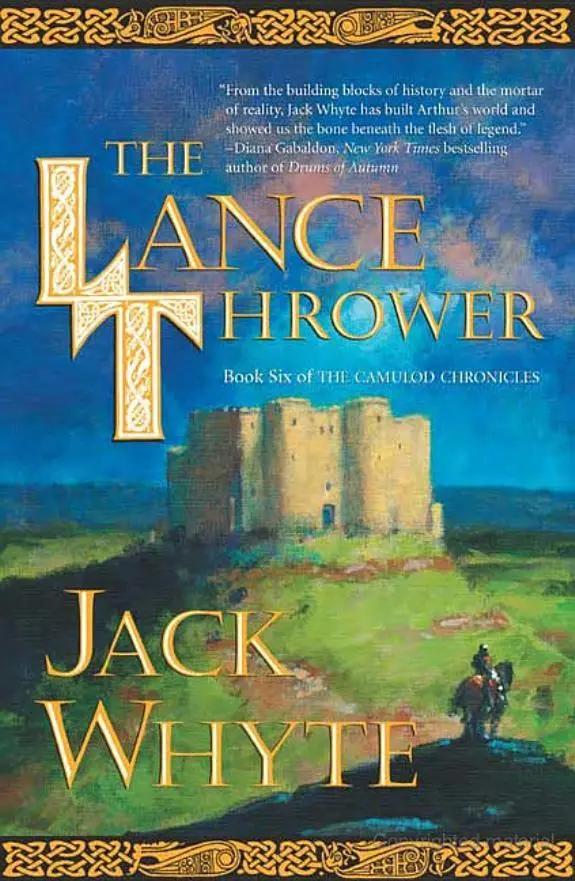
- Название:The Lance Thrower
- Автор:
- Жанр:
- Год:неизвестен
- ISBN:нет данных
- Рейтинг книги:5 / 5. Голосов: 1
-
Избранное:Добавить в избранное
- Отзывы:
-
Ваша оценка:
The Lance Thrower: краткое содержание, описание и аннотация
Предлагаем к чтению аннотацию, описание, краткое содержание или предисловие (зависит от того, что написал сам автор книги «The Lance Thrower»). Если вы не нашли необходимую информацию о книге — напишите в комментариях, мы постараемся отыскать её.
Clothar is a young man of promise. He has been sent from the wreckage of Gaul to one of the few schools remaining, where logic and rhetoric are taught along with battle techniques that will allow him to survive in the cruel new world where the veneer of civilization is held together by barbarism. He is sent by his mentor on a journey to aid another young man: Arthur Pendragon. He is a man who wants to replace barbarism with law, and keep those who work only for destruction at bay. He is seen, as the last great hope for all that is good.
Clothar is drawn to this man, and together they build a dream too perfect to last--and, with a special woman, they share a love that will nearly destroy them all...
The name of Clothar may be unknown to modern readers, for tales change in the telling through centuries. But any reader will surely know this heroic young man as well as they know the man who became his king. Hundreds of years later, chronicles call Clothar, the Lance Thrower, by a much more common name.
That of Lancelot.
The Lance Thrower — читать онлайн бесплатно полную книгу (весь текст) целиком
Ниже представлен текст книги, разбитый по страницам. Система сохранения места последней прочитанной страницы, позволяет с удобством читать онлайн бесплатно книгу «The Lance Thrower», без необходимости каждый раз заново искать на чём Вы остановились. Поставьте закладку, и сможете в любой момент перейти на страницу, на которой закончили чтение.
Интервал:
Закладка:
Chulderic’s spokesman, a junior cavalry officer whose name I did not yet know, rode forward to the enemy party and told them bluntly that we were releasing the prisoners because they were eating food that we needed ourselves. He demanded that the enemy commander withdraw his forces as a sign of good faith while the release was carried out, and pointed up to where our bowmen watched vigilantly, the height of their positioning giving them an enormous advantage over their opposite numbers.
As I had anticipated, the enemy commander could scarcely believe what he was hearing, because our message implied plainly that our concerns over our ability to feed ourselves were strong enough to make us release strong, healthy prisoners who would immediately rearm themselves to fight against us again. He complied without further discussion and ordered his men to withdraw. As the enemy fell back, vacating the field in front of the bridge, our soldiers began to shepherd their prisoners across in front of them.
As soon as they crossed the bridge, they spread the prisoners as far apart as the ropes joining them would permit and then held them in place, arranging the five extended rows of men so that they overlapped and formed a wide human screen between the bridge end and the enemy position. Only when they were satisfied with their positioning did the commander of the guard nod his permission and a single drummer began to rap out the cadence of a march that would take the prisoners forward in lockstep, without tripping in their hobbles and falling down. The first few steps were tentative and hesitant, but the rhythm caught quickly and the bound men began to march quite smartly toward their freedom.
At that precise moment, in response to a prearranged signal, the lead riders of a column of horsemen swung around the end of the curtain wall and spurred their mounts hard toward the drawbridge. Sixty riders, gathering speed and impetus with every stride, in a single column three abreast and twenty deep, were across the bridge and veering away to the right before the enemy could react. And when they did react, Gunthar’s people were impeded by the strings of helpless, hobbled men spread out between them and the fleeing riders, for flee we did, as hard and as fast as we could, intent only upon riding out of arrow range as quickly as possible and making a clean escape thereafter. We knew they would follow us, but we knew, too, that where we were going they would never find us.
We reached the red-wall caves to find Clodio waiting for us and the secret entrance at the back of the caves already open, and we led our mounts inside, into the darkness of the first cavern. Once there, with the high, blazing fires burning brightly, the horses assumed it was night and settled drown immediately, behaving normally as they were secured with the standard horse lines they submitted to every night.
Over the course of the next six days, with the horses safely quartered, we busied ourselves making a temporary home for men and animals in the King’s Caverns, widening and digging out the few narrow wrigglers easily now that there was no need for secrecy and we could assign as many men as needed to the task of chipping and digging away the rock walls and widening the gaps in the worst places. There was no observable evidence of time passing down there in the depths of the caverns; it was permanent night, and so we set six consecutive watches of men to work at the mining task, each watch laboring for four hours a day so that the work went on without pause until it was completed. Even so, it took four solid days and nights of hard labor to achieve what we wanted.
That done, and the way open for easy access from one end of the caverns to the other, it was a simple task to bring down bales of straw and hay from the stables in the castle through the open door at the far end and to transport them to the red-wall caves at the other. It was deeply satisfying to know, too, that while we were consolidating our new resources in the caverns, Gunthar’s people were turning the countryside upside down in their attempts to discover how sixty men and horses could simply vanish into nowhere.
By the time seven days had elapsed we were confident that the mystery of our escape would have faded from the forefront of the enemy’s awareness. From their point of view, our disappearance had been complete and completely mystifying. They could only assume that we had ridden out and away, beyond our own borders, perhaps to gather help or buy the support of mercenaries. In all that time, we made no moves against them from the castle and they had made no attempt to attack us.
As soon as the widening of the wrigglers had been completed, an armed party was dispatched by night, leading a light wagon pulled by a two-horse team, to bring back the Queen, the women in her party, and the physician Clement. They returned the following morning, arriving outside the red-wall caves just after sunrise, and the Queen’s party was escorted on foot through the caverns and into the safety of the castle without incident. Seven days had passed since Vivienne had learned of King Ban’s death.
I had ridden out earlier that morning with two companions, just before dawn, one of four three-man teams dispatched to explore the surrounding countryside and glean any information we could about the activities and disposition of Gunthar’s forces within a radius of five miles. Our hunt was to the northeast, covering the ground on both sides of the northeast line, left to the line due north of the caves as far as the edge of Lake Genava, and then right to the line due east of them, so that we covered a full quarter of a circular area, riding back and forth in steadily increasing arcs as we moved farther out from our starting point on each sweep and leaving one scout behind in the cleared area of every third arc to keep an eye to our rear in case of any unforeseen developments at our back. It took us two full days to cover the entire area, and we knew that our other three teams were doing the same in the remaining three quadrants, which meant that by the time we returned to our starting point and assembled all the information that each of the four search teams had discovered, we would know everything we needed to know about what was happening within an area approaching ninety to a hundred square miles around the castle, and we would be able to draw up comprehensive plans for dealing with Gunthar’s men—their holdings and their dispositions—throughout that area.
Two days after that, I rode out through the red-wall caves for the first time with Samson and our two cavalry squadrons—sixty mounted men. We swung far to the south this time, to where team number three had identified a heavy concentration of enemy forces they presumed to be Burgundians, billeted in the strongly made and recently fortified buildings of what had once been a prosperous farm. I counted upward of a full hundred men in the place, and we spent a long time working our way down a hillside at their backs, through difficult and heavily overgrown terrain, to hit them from behind, from where they had least expected an attack—especially a mounted one—to materialize.
We hit hard and fast, giving them no time to rally themselves against us. Apart from our own mounts, there was not a horse in the entire place, and so we had no solid opposition. A few hardy souls formed isolated pockets of resistance, knowing that they were in desperate straits, but they went down quickly under the weight of our horseflesh, and we left few of them alive. In what was always known as “the butcher’s accounting,” we counted fifty-two enemy dead, and another thirty-eight wounded, all of whom we gathered together and left behind us under guard, having first relieved them of their weapons. A number of others managed to flee the slaughter nevertheless, and we let them go, content to have them carry the tale of the attack and its outcome back to whoever might have the responsibility for listening to them. We were happy to have Gunthar know that there was a potent and highly mobile cavalry force out there in his territories, raiding his raiders. However, by the time his exploratory force came seeking us, thirsting for revenge, we had disappeared back into the safety of our secret caverns.
Читать дальшеИнтервал:
Закладка:
Похожие книги на «The Lance Thrower»
Представляем Вашему вниманию похожие книги на «The Lance Thrower» списком для выбора. Мы отобрали схожую по названию и смыслу литературу в надежде предоставить читателям больше вариантов отыскать новые, интересные, ещё непрочитанные произведения.








Обсуждение, отзывы о книге «The Lance Thrower» и просто собственные мнения читателей. Оставьте ваши комментарии, напишите, что Вы думаете о произведении, его смысле или главных героях. Укажите что конкретно понравилось, а что нет, и почему Вы так считаете.