Jack Whyte - The Lance Thrower
Здесь есть возможность читать онлайн «Jack Whyte - The Lance Thrower» весь текст электронной книги совершенно бесплатно (целиком полную версию без сокращений). В некоторых случаях можно слушать аудио, скачать через торрент в формате fb2 и присутствует краткое содержание. Жанр: Старинная литература, на английском языке. Описание произведения, (предисловие) а так же отзывы посетителей доступны на портале библиотеки ЛибКат.
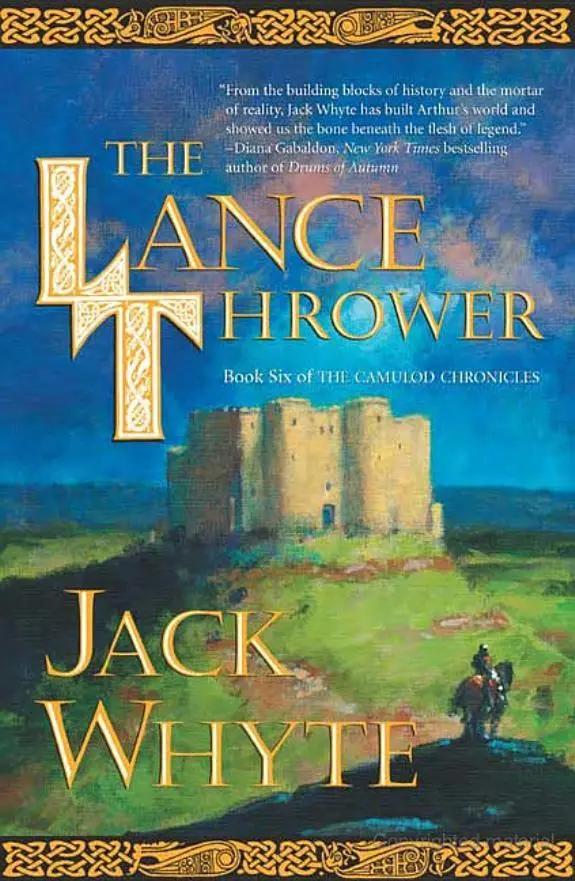
- Название:The Lance Thrower
- Автор:
- Жанр:
- Год:неизвестен
- ISBN:нет данных
- Рейтинг книги:5 / 5. Голосов: 1
-
Избранное:Добавить в избранное
- Отзывы:
-
Ваша оценка:
The Lance Thrower: краткое содержание, описание и аннотация
Предлагаем к чтению аннотацию, описание, краткое содержание или предисловие (зависит от того, что написал сам автор книги «The Lance Thrower»). Если вы не нашли необходимую информацию о книге — напишите в комментариях, мы постараемся отыскать её.
Clothar is a young man of promise. He has been sent from the wreckage of Gaul to one of the few schools remaining, where logic and rhetoric are taught along with battle techniques that will allow him to survive in the cruel new world where the veneer of civilization is held together by barbarism. He is sent by his mentor on a journey to aid another young man: Arthur Pendragon. He is a man who wants to replace barbarism with law, and keep those who work only for destruction at bay. He is seen, as the last great hope for all that is good.
Clothar is drawn to this man, and together they build a dream too perfect to last--and, with a special woman, they share a love that will nearly destroy them all...
The name of Clothar may be unknown to modern readers, for tales change in the telling through centuries. But any reader will surely know this heroic young man as well as they know the man who became his king. Hundreds of years later, chronicles call Clothar, the Lance Thrower, by a much more common name.
That of Lancelot.
The Lance Thrower — читать онлайн бесплатно полную книгу (весь текст) целиком
Ниже представлен текст книги, разбитый по страницам. Система сохранения места последней прочитанной страницы, позволяет с удобством читать онлайн бесплатно книгу «The Lance Thrower», без необходимости каждый раз заново искать на чём Вы остановились. Поставьте закладку, и сможете в любой момент перейти на страницу, на которой закончили чтение.
Интервал:
Закладка:
“How so?”
I stared at him, surprised that he could not see my meaning, for to me it was as obvious as the nose on my face. “Because I’m beginning to be afraid that when someone is appointed to fill the post, I’ll resent him for taking over.”
His expression did not change by as much as a twitch. “Why would you resent someone for obeying instructions and accepting a promotion? That’s what soldiers do, is it not?”
“Aye, but—”
“But what? Are you afraid he might do the job better than you?”
“No, how could I be? I don’t even know who we are talking about.”
“But whoever he may be, he might still do the job better than you can?”
“I doubt it.”
Samson raised an eyebrow, perhaps aware that he had dealt a blow to my vanity.
There was a long pause after that, and then my cousin looked down at the map he had discarded to listen to me. When he spoke his voice sounded distant, and carried a distinct chill. “Think about this, Cousin Clothar, and consider your answer well. You are what—sixteen? Sixteen, aye. Now, are you asking me to believe that you can handle this post—the leadership of an entire squadron—better than anyone else I might appoint?”
That put a curb on my tongue. I hesitated, then decided to be truthful, no matter the cost. I ought to be able to speak the truth to my cousin with impunity, and I could see no acceptable reason for pretending that I did not believe in myself.
“Yes, Cousin,” I said. “That’s what I’m telling you.”
He looked up at me, and his face crinkled in a wide grin. “Excellent,” he said. “I think so, too. Get on with it, then.”
I felt myself gaping at him.
“I said get on with it, Clothar. You are now officially in full command of Beta squadron, so may I return to my map? It really is quite important.”
I walked away in a daze, attempting to come to terms with the realization that I was now Commander Clothar in fact as well as in name.
Nine days after my assumption of command over my thirty-man squadron, Gunthar launched an all-out campaign to obliterate us, and I began to regret the hubris that had driven me to assume such an enormous responsibility. I lost three men in one afternoon, right at the outset of that campaign, all of them shot out of the saddle by bowmen who had managed to infiltrate our defenses and set themselves up in a blind where there was only one trail that passed by. They knew we would have to use it sooner or later. Their chance came sooner than they had expected, judging from the lack of debris we found afterward around their hiding place and from the fact that they took their first three targets efficiently. But they died themselves very quickly thereafter, because they had neglected to provide themselves with an escape route.
Three men lost might not seem like many to some observers, but that was one full tenth of my force, and the old Roman word for killing one in ten of one’s troops was decimation. We had been decimated by a trio of nameless bowmen. We would replace our men when we returned to our base in the castle, but our pool of available replacements was growing no larger and every diminution of that resource was a permanent one.
Gunthar, on the other hand, seemed to suffer from no such constraints. In any encounter between our forces and his, we were more than likely to emerge victorious. No one knew the reasons for that, but there could be no doubt that it was true, because the casualty count at the end of each fight and skirmish was unequivocal. Face-to-face, hand to hand, and nose to nose, the number of casualties demonstrated that we outfought them regularly by a count of at least three casualties for them against every two for us. But there was no parity in the situation. If Gunthar lost a hundred men, he would field two hundred fresh ones in the coming days. Every single man we lost, on the contrary, increased our cumulative weakness, and as each day passed we grew more and more aware of just how weak we were becoming.
We had one turn of good fortune that came when our fortunes seemed at their lowest and we most needed something in the way of a ray of light in the darkness that was hemming us in. Ingomer, lord of the neighboring property of Vervenna, returned from the eastern patrol as soon as he received the word we sent him of Theuderic’s death at Gunthar’s hands.
Understandably enough, he rode directly to his home at the head of six hundred men to rescue his wife before doing anything else or reporting his presence to anyone, but he found its buildings burned and walls toppled. Distraught, and believing his wife and newborn child dead, he immediately went looking for Gunthar, bent on vengeance. Fortunately, before he could encounter any of Gunthar’s mercenaries, he met Samson, who told him his wife and child were safe in Genava. Enormously relieved, Ingomer returned directly to Castle Genava to greet his beautiful young wife and to meet his newborn son, and he and his six hundred men had remained in the castle after that.
Most beneficially for our beleaguered garrison, however, Ingomer rode right up to the drawbridge with his six hundred horsemen, defying Gunthar’s watchdogs to challenge them. At the last moment, just as the drawbridge was descending, Ingomer rapped out an order, and two full wings of his riders, a hundred horsemen to a wing, turned their horses smartly and split apart into two groups, then swung into a pincer formation and swept into the woodlands beyond the lea from left and right, routing the hidden enemy there, who, being mainly bowmen, were unable to use their weapons defensively to any great extent among the trees. While the first two wings of cavalry scoured through the woods in opposing arcs and finally spilled back out into the open, Ingomer turned the remainder of his force about and led all four hundred of them slowly and inexorably into the trees, mopping up the last remaining vestiges of resistance among Gunthar’s occupying force.
Inside the castle we had never known exactly how many enemy warriors were ranged against us out there, and the wide-ranging estimates that were bandied about were based mainly upon random observations when there was little to observe. Ingomer and his men, however, had left upward of a hundred of the enemy dead among the trees. Those who remained alive were stripped of their armor, clothing, and weapons and set free to make their own way through the surrounding forest to wherever they might wish to go. We had no interest in taking prisoners, and we knew that once disarmed and naked, Gunthar’s mercenaries would not find it easy to rearm themselves quickly. Stripped bare, they would be fortunate to make it back through the bogs and forest that lay between them and their nearest support bases, and doubly fortunate to do so without stumbling across any of the local people who lived out there among the trees and had no reason to be hospitable toward any of Gunthar’s mercenaries.
That was one of the brighter moments in the campaign, but over and above everything else I can recall about that time is the feeling of hopelessness that grew upon us daily as we suffered continual and irreplaceable losses of men and horses while simultaneously watching Gunthar’s numbers swell.
Brach and Chulderic held joint command of the castle and its garrison, although Chulderic was nominally commander in chief of all the forces of Benwick, and Brach merely commanded the infantry, a position more or less forced upon him by his immense size. He simply could not find a horse large enough to bear him when he was armed and armored, so any yearnings that he might ever have had to be a cavalryman had long since been abandoned as unrealistic. After Ingomer’s rout of the watchdog guards beyond the bridge, we fully expected Gunthar to mount an expedition of some kind to replace them and we quickly brought out our foot soldiers to prepare defensive positions within the woods before new enemy forces could be moved in. The expected attack never occurred, however, and we were left to wonder why Gunthar would simply allow such a strategic position to be abandoned. We wasted no time while we were wondering such things, however, and we quickly put our newly freed infantry to use against the Burgundian mercenaries, enjoying the fact that, for a brief time, the difference they made was wonderful. At every clash of arms, Gunthar’s creatures were sent scampering for their lives and the morale of our troopers swelled for several weeks. But then the same reality that governed our cavalry asserted itself over the infantry, too. Their losses were simply too consistent to be sustainable.
Читать дальшеИнтервал:
Закладка:
Похожие книги на «The Lance Thrower»
Представляем Вашему вниманию похожие книги на «The Lance Thrower» списком для выбора. Мы отобрали схожую по названию и смыслу литературу в надежде предоставить читателям больше вариантов отыскать новые, интересные, ещё непрочитанные произведения.







Обсуждение, отзывы о книге «The Lance Thrower» и просто собственные мнения читателей. Оставьте ваши комментарии, напишите, что Вы думаете о произведении, его смысле или главных героях. Укажите что конкретно понравилось, а что нет, и почему Вы так считаете.