Jack Whyte - The Lance Thrower
Здесь есть возможность читать онлайн «Jack Whyte - The Lance Thrower» весь текст электронной книги совершенно бесплатно (целиком полную версию без сокращений). В некоторых случаях можно слушать аудио, скачать через торрент в формате fb2 и присутствует краткое содержание. Жанр: Старинная литература, на английском языке. Описание произведения, (предисловие) а так же отзывы посетителей доступны на портале библиотеки ЛибКат.
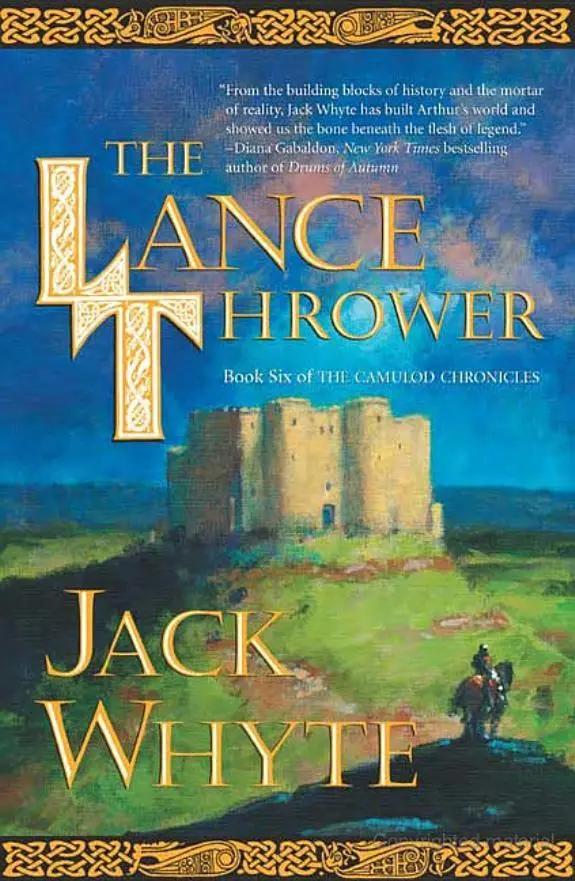
- Название:The Lance Thrower
- Автор:
- Жанр:
- Год:неизвестен
- ISBN:нет данных
- Рейтинг книги:5 / 5. Голосов: 1
-
Избранное:Добавить в избранное
- Отзывы:
-
Ваша оценка:
The Lance Thrower: краткое содержание, описание и аннотация
Предлагаем к чтению аннотацию, описание, краткое содержание или предисловие (зависит от того, что написал сам автор книги «The Lance Thrower»). Если вы не нашли необходимую информацию о книге — напишите в комментариях, мы постараемся отыскать её.
Clothar is a young man of promise. He has been sent from the wreckage of Gaul to one of the few schools remaining, where logic and rhetoric are taught along with battle techniques that will allow him to survive in the cruel new world where the veneer of civilization is held together by barbarism. He is sent by his mentor on a journey to aid another young man: Arthur Pendragon. He is a man who wants to replace barbarism with law, and keep those who work only for destruction at bay. He is seen, as the last great hope for all that is good.
Clothar is drawn to this man, and together they build a dream too perfect to last--and, with a special woman, they share a love that will nearly destroy them all...
The name of Clothar may be unknown to modern readers, for tales change in the telling through centuries. But any reader will surely know this heroic young man as well as they know the man who became his king. Hundreds of years later, chronicles call Clothar, the Lance Thrower, by a much more common name.
That of Lancelot.
The Lance Thrower — читать онлайн бесплатно полную книгу (весь текст) целиком
Ниже представлен текст книги, разбитый по страницам. Система сохранения места последней прочитанной страницы, позволяет с удобством читать онлайн бесплатно книгу «The Lance Thrower», без необходимости каждый раз заново искать на чём Вы остановились. Поставьте закладку, и сможете в любой момент перейти на страницу, на которой закончили чтение.
Интервал:
Закладка:
Another of the remaining three riders tugged frantically at his reins, trying to pull his horse around to face me, but he had reined his horse in so that he could watch Samson as he fell and, in consequence, he had no momentum. He was heavily bearded, but I saw every line on his face above the growth clearly as I killed him, too, driving the point of my spatha through his right eye. I pulled the point free again immediately and swung back-handed at someone who was trying to reach me from behind my right shoulder, and as I did so I saw the unhorsed spearman moving toward me on the ground, carrying the bloodstained spear that he had recovered from Samson’s body. Something hit me heavily across the shoulders, once and then again, and I felt my horse collapsing beneath me. I glanced down and saw that the spearman had butchered it, and I threw myself from the saddle before I could be pinned beneath its body. I rolled and came up on my knees beside the body of my cousin, watching the last three of his killers preparing to kill me, too. The spearman on foot had his weapon pointing at me again and the other two were moving apart to come at me from two sides. Then came a sound of charging hoofbeats and a babble of voices shouting my name as a squad of my own troopers charged past me and my three adversaries were cut down.
Shaken by the swiftness of events and my unexpected rescue, I tried to rise to my feet but found that I was incapable of raising either of my knees from the ground. I turned instead to the ruined body of my cousin Samson and bent forward to close his eyes, which, by some strange mischance, appeared to be staring directly into mine, although they were already glazed with that peculiar emptiness that differentiates a dead body from a living one. I remained there, kneeling over him for some time as I tried to find words to pray for his soul. But that was one of the few times in my entire life that I found myself unable to utter a single word of prayer.
The battle had been a complete disaster for us. We had won again, according to the butcher’s accounting, but I knew we could never hope to recover from such losses and we were finished as a cohesive fighting force. The enemy had left thirteen dead men on the field and more than half again as many horses—we had no way of knowing how many of the survivors had been wounded or how serious those wounds were. We, however, had lost eight men dead and a full score more bore wounds of one kind or another, although, miraculously, none of those were serious enough to be life-threatening. Unfortunately, the same could not be said for the injured horses. Few horses injured in battle could ever be healed, and although only five of our horses—two of them mine—had been killed outright during the fighting, we had to kill seven more wounded animals. We had not been at full strength at the start of the battle, fielding only half a hundred fighting men instead of our normal three score, but when the activities were all over and the dead all buried—with the sole exception of Samson, whose body we would take with us—we assembled to make our way homeward and we presented a sorry sight, even to ourselves. We numbered thirty-two whole men out of our original strength of sixty.
Weary and discouraged, I gave the signal to proceed, and we headed home with our dead King at our center, laid out on a makeshift bier on the bed of the light two-horse supply wagon that always accompanied us on our extended raids. He lay on his back on a thick bed of fresh-cut reeds, his hands crossed upon his chest beneath the expanse of his war cloak, which, arranged in careful folds, served to conceal his body from profane eyes and the indignities of weather.
My first thoughts at the start of that journey were all to do with my cousin Brach, who had now become King of Benwick with Samson’s death. He would be beside himself, I knew, over both the loss of his beloved brother and the unsought, unwished-for accession to the status of kingship. Brach, despite his visual splendor and apparent suitability to play the King’s role, was not a man who would ever enjoy the pomp and ceremonies that went with being a monarch. Spectacular as were his exploits in war, he was nonetheless too genuinely humble and too self-effacing ever to be comfortable in such a highly visible capacity as that of King of Benwick. But then, I thought, life seldom asks for our approval in advance of what it decrees for us. Brach’s fate was to be a king. He could not control that, any more than I could control what my destiny might be.
I spent the remainder of the journey, then, deliberating about what I would say to Chulderic when we arrived at the castle, but he was waiting for us when we reached the red-wall caves, and I went into conference with him immediately, drawing him aside to where we could speak without being overheard.
With Samson’s death, I told him, we had reached the limits of our cavalry’s usefulness as a striking force. We were dangerously, almost fatally, vulnerable in terms of renewable numbers—of both men and horses. We were still able, barely, to continue replacing the troopers who were killed or left unable to ride and fight on, but we had exhausted our supply of able veterans and were now reduced to using untrained riders—foot soldiers and young boys who dreamed of glory in riding out to war but barely knew one end of a horse from the other, with some of them believing that horses had tails purely to indicate that feeding the animal should be performed from the other end. The time had come, I told Chulderic, for us to cut our losses and consolidate the strengths remaining to us by keeping our surviving riders in the castle, acting as defensive garrison troops,, and their horses inside the caves where they would be held in reserve pending an emergency.
Chulderic had sat staring at Samson’s covered bier on the wagon bed as he listened to me, and now he nodded his head and agreed with my assessment of the situation. We would take Samson in and bury him within the castle walls, he said, and then we would prepare for a siege. But while we were doing that, we would also work to reopen the postern gate, the old, walled-up doorway above the lakeside rocks at the rear of the castle. Thus, he opined, we would have two means of exit should the need for escape ever arise.
Hearing him say those words demonstrated to me, more than anything else could have, just how bad our situation was. At the outset of the war, Chulderic would never have voiced such a possibility. Within the space of a short couple of months, however, his entire outlook on life had changed, and every facet of the changes involved reflected in some way upon the perfidy and evil of the man against whom he was fighting.
Gunthar had never been a lovable person, even as a boy, and my own memories of him from my childhood days were of a sullen, melancholy young man with a foul temper and an unpleasant disposition. He was lavish with incessant insults, utterly uncaring whom he offended. His reputation had grown less and less wholesome and his behavior more and more violent as he aged, too, and most people came to prefer simply to stay out of his way.
The most frightening thing about Gunthar, however, was his unpredictability. Of all his many attributes, that one alone was utterly predictable, and it frightened everyone, including his closest allies. And in the very recent past, we had heard persistent rumors that his behavior was growing ever more and more outrageous, erratic, and capricious, and that even his closest associates were increasingly apprehensive of being too long around him at any one time, fearful for their own lives. We had dismissed most of what we heard, however, principally because of the way it came to us. Rumors without some kind of solid ratification were seldom reliable.
Three days after that conversation with Chulderic, on the day following Samson’s interment in one of the castle’s interior courtyards, I was summoned to join Brach shortly after dawn. I had been up late, serving as captain of the night watch, and so had been asleep for little more than an hour when I was roughly shaken awake. Annoyed, but knowing that Brach would not disturb my sleep without good cause, I splashed water over my head, my face, and the back of my neck and toweled myself into wakefulness before going to join him.
Читать дальшеИнтервал:
Закладка:
Похожие книги на «The Lance Thrower»
Представляем Вашему вниманию похожие книги на «The Lance Thrower» списком для выбора. Мы отобрали схожую по названию и смыслу литературу в надежде предоставить читателям больше вариантов отыскать новые, интересные, ещё непрочитанные произведения.







Обсуждение, отзывы о книге «The Lance Thrower» и просто собственные мнения читателей. Оставьте ваши комментарии, напишите, что Вы думаете о произведении, его смысле или главных героях. Укажите что конкретно понравилось, а что нет, и почему Вы так считаете.