Jack Whyte - The Lance Thrower
Здесь есть возможность читать онлайн «Jack Whyte - The Lance Thrower» весь текст электронной книги совершенно бесплатно (целиком полную версию без сокращений). В некоторых случаях можно слушать аудио, скачать через торрент в формате fb2 и присутствует краткое содержание. Жанр: Старинная литература, на английском языке. Описание произведения, (предисловие) а так же отзывы посетителей доступны на портале библиотеки ЛибКат.
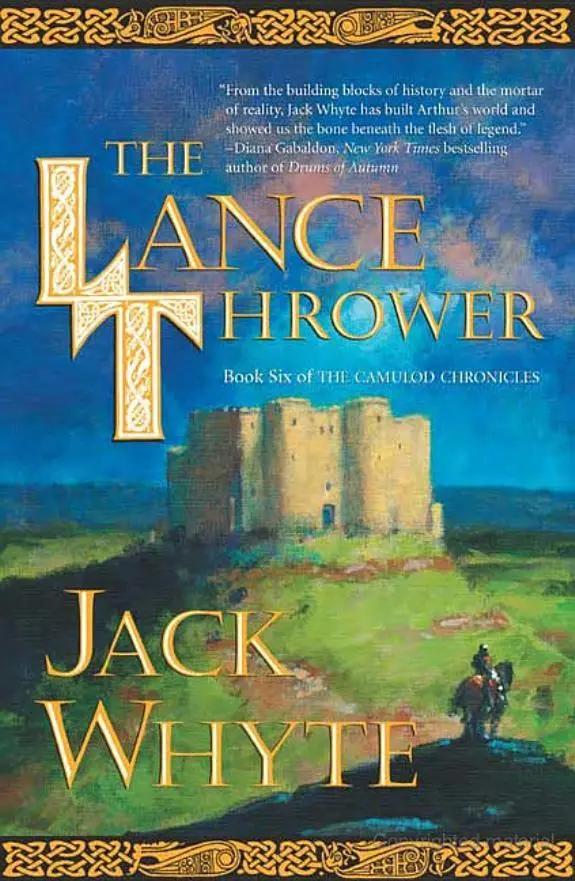
- Название:The Lance Thrower
- Автор:
- Жанр:
- Год:неизвестен
- ISBN:нет данных
- Рейтинг книги:5 / 5. Голосов: 1
-
Избранное:Добавить в избранное
- Отзывы:
-
Ваша оценка:
The Lance Thrower: краткое содержание, описание и аннотация
Предлагаем к чтению аннотацию, описание, краткое содержание или предисловие (зависит от того, что написал сам автор книги «The Lance Thrower»). Если вы не нашли необходимую информацию о книге — напишите в комментариях, мы постараемся отыскать её.
Clothar is a young man of promise. He has been sent from the wreckage of Gaul to one of the few schools remaining, where logic and rhetoric are taught along with battle techniques that will allow him to survive in the cruel new world where the veneer of civilization is held together by barbarism. He is sent by his mentor on a journey to aid another young man: Arthur Pendragon. He is a man who wants to replace barbarism with law, and keep those who work only for destruction at bay. He is seen, as the last great hope for all that is good.
Clothar is drawn to this man, and together they build a dream too perfect to last--and, with a special woman, they share a love that will nearly destroy them all...
The name of Clothar may be unknown to modern readers, for tales change in the telling through centuries. But any reader will surely know this heroic young man as well as they know the man who became his king. Hundreds of years later, chronicles call Clothar, the Lance Thrower, by a much more common name.
That of Lancelot.
The Lance Thrower — читать онлайн бесплатно полную книгу (весь текст) целиком
Ниже представлен текст книги, разбитый по страницам. Система сохранения места последней прочитанной страницы, позволяет с удобством читать онлайн бесплатно книгу «The Lance Thrower», без необходимости каждый раз заново искать на чём Вы остановились. Поставьте закладку, и сможете в любой момент перейти на страницу, на которой закончили чтение.
Интервал:
Закладка:
“I’m convinced,” he said. “The war is over. Let them go home, so be it they go quickly. We have a land to resurrect here.”
I returned to Tulach within the half hour, my features carefully schooled to give this man no inkling of the reaction his tidings had caused within the castle walls. Once again, he spoke out as soon as I came within hearing range.
“Well? Are we to fight?”
“You have a full day to withdraw,” I told him, “until this time tomorrow, at which point we will send cavalry to look for you, but not to pursue you. If they find you, then they will attack. That is our offer. Accept it or leave it, as you will, but do so now.”
He pursed his lips quickly as I spoke, showing quick-flaring anger, but as soon as I had finished speaking, he said, “So be it. My men are ready. We will be far beyond Benwick’s borders by this time tomorrow.” He nodded to his two escorts, and as he made to swing away I stopped him.
“One more question: where is Gunthar?”
Tulach turned his head slowly and looked back at me, and for a moment I thought he was not going to answer me at all, but then he hawked and spat. “He’s in Chabliss,” he said, naming the smallest of the four forts clustered in the southeast quadrant of our territories. “He lies where he fell, in front of the fire, steeped in his own excrescences. I wish you joy of finding him.”
He pulled his horse into a rearing turn and sank his spurs into its flanks, and as he and his two fellows disappeared beyond the fringe of trees in the distance I realized for the first time that Gunthar’s War was over. It had happened very suddenly and very tamely, with the death of single man from natural causes, but it had caused as much carnage and grief and misery as any other war during its brief existence.
I stood there for what felt like a long time after Tulach’s departure, staring toward the point where he had entered the distant trees and been lost to my sight. Gunthar was dead and the war was over. The knowledge was there in my mind, as was my acceptance of it, but I had yet to feel the impact of its meaning. Gunthar was dead. There was something outrageous about that, something obscene in the casual, matter-of-fact banality of it. One of Bishop Germanus’s favorite sayings came into my mind, and I heard his voice repeating it sonorously: In the midst of life we are in death. I knew what it meant, knew that it was a warning to humankind of how tenuous their hold on life really is, but I knew too that it was a ludicrous commentary in this case, because we here in Benwick had been living for months in the midst of death. And now Gunthar was dead, casually gone, snuffed out like a flame in a draft. Vanished.
And as my thoughts moved on to all the other deaths he had occasioned in his brief, demented passion, I grew angrier than I had ever been before—angry at Gunthar for having died so selfishly and dismally, depriving me of the pleasure of killing him with my own hands and avoiding the vengeance of the many thousands he had wronged and betrayed. I found that I was angry at God, too, for permitting such a grossly indecent fiasco to take place … so many lives lost and squandered so needlessly when the executioner was fated to collapse and die in his own blood and effluent and at the intervention of no one.
Another of the Bishop’s sayings came to my mind. Sic transit gloria mundi … the glories of this world pass quickly … Gunthar, the arch-enemy, sprawled, befouled by his own wastes, in front of a dead fire, his blood-filled eyes glaring from a blackened face. Seeing him there, in my mind’s eye, I began eventually to think that perhaps, perhaps, there was a justice and a kind of vengeance implicit in the manner of his being struck down while in a fit of rage. But I had no impulse to forgive God for the wasted, blighted lives he had permitted the madman to effect.
Later, I know not how much later, I hawked and spat and turned to walk back across the drawbridge and into the castle. No one had sought to disturb my solitary vigil and no one made any attempt now to intercept or interrupt me as I made my way back to my bed and my interrupted sleep.
The suddenness of the war’s end threw me completely off balance, changing my life instantly from one filled with chaotic urgencies and burgeoning despair into one in which I had nothing substantial to do, and all the time in the world to dedicate to not doing it. We were aware that there had been Burgundian invasions to the north of our lands, but no evidence of any threat to us in Benwick had materialized, and so we paid no attention to anything outside our own boundaries and were content to wallow in the lethargy that settled suddenly upon those of us who had been most heavily involved in the fighting. The experience could have been a damaging one—I can see that clearly now with the assistance of hindsight—but before I had the opportunity to drift into any set pattern of idle behavior, I recalled a comment that Ursus had made months earlier, during our long journey to the south, on a day when we had been forced to go out of our way and make a wide and difficult detour to avoid a large bear with three cubs.
The sow had settled herself, with her trio of charges, by the side of a mountain river that swept in close at one point—a matter of several paces—to the edge of the narrow path we had been following through difficult, hilly terrain for two days. We saw her fishing in the white water of the rushing stream just as the last stretch of the downhill pathway swooped down from where we were to the riverside where her cubs tussled with each other by the water’s edge, still too small and too young to brave the current. It would have been folly to attempt to pass them by unseen, and we had no desire to kill the creatures, so we had muffled our curses and cursed our misfortune and scrambled painfully upward, leading our horses slowly and with great difficulty, high and hard, scaling the steep hillside with much muttering and grumbling until we reached the summit and were faced with the even greater task of making our way back down again in safety toward the narrow, well-trodden path that was our sole way out of the hills in the direction we were heading.
We had made the ascent in something more than an hour, but it took us three times that long to go back down again, because of our horses and the need to find a route they would accept. In the late afternoon, however, looking down from high above the path we had left that morning, we saw it choked with Burgundian warriors heading directly toward the sow and her cubs, and we knew beyond doubt that, had it not been for the animals, we would have blundered directly into these people and probably died there.
That experience had seduced Ursus into a philosophical frame of mind for the remainder of that day, and he had said something to the effect that God sometimes throws us valuable gifts disguised as uncommon and annoying nuisances. The memory of that occasion, coming when it did, made me look at my sudden idleness as a gift of time in which to take stock of my life. After ten consecutive days, however, during which I did nothing at all, other than to think deeply about who I was becoming and what I had achieved, I found myself not only unable to arrive at any clear decisions about my life, but not even able to define any new perspectives on which to base decisions. And this despite the fact that I knew there were decisions I must make.
Discouraged by the entire exercise and feeling both foolish and inadequate, I went to Brach and apologized for what I was sure he must see as my laziness and lack of attention to duty in the days that had passed. When I told him I had been thinking, however, instead of being as angry at me as I had expected him to be, Brach laughed and asked me if I knew what I had been searching for. When I merely blinked at him and told him I had no idea, he laughed even more and told me to go away somewhere and think further, and at greater length, this time in isolation and free of all distraction. Once I had arrived at some kind of conclusion about what I wanted, I was to come back and tell him.
Читать дальшеИнтервал:
Закладка:
Похожие книги на «The Lance Thrower»
Представляем Вашему вниманию похожие книги на «The Lance Thrower» списком для выбора. Мы отобрали схожую по названию и смыслу литературу в надежде предоставить читателям больше вариантов отыскать новые, интересные, ещё непрочитанные произведения.







Обсуждение, отзывы о книге «The Lance Thrower» и просто собственные мнения читателей. Оставьте ваши комментарии, напишите, что Вы думаете о произведении, его смысле или главных героях. Укажите что конкретно понравилось, а что нет, и почему Вы так считаете.