Jack Whyte - The Lance Thrower
Здесь есть возможность читать онлайн «Jack Whyte - The Lance Thrower» весь текст электронной книги совершенно бесплатно (целиком полную версию без сокращений). В некоторых случаях можно слушать аудио, скачать через торрент в формате fb2 и присутствует краткое содержание. Жанр: Старинная литература, на английском языке. Описание произведения, (предисловие) а так же отзывы посетителей доступны на портале библиотеки ЛибКат.
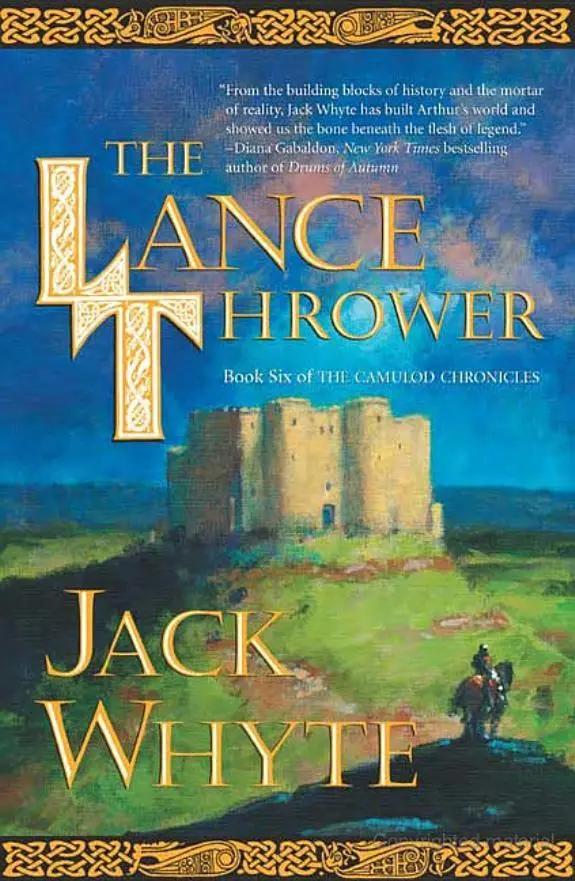
- Название:The Lance Thrower
- Автор:
- Жанр:
- Год:неизвестен
- ISBN:нет данных
- Рейтинг книги:5 / 5. Голосов: 1
-
Избранное:Добавить в избранное
- Отзывы:
-
Ваша оценка:
The Lance Thrower: краткое содержание, описание и аннотация
Предлагаем к чтению аннотацию, описание, краткое содержание или предисловие (зависит от того, что написал сам автор книги «The Lance Thrower»). Если вы не нашли необходимую информацию о книге — напишите в комментариях, мы постараемся отыскать её.
Clothar is a young man of promise. He has been sent from the wreckage of Gaul to one of the few schools remaining, where logic and rhetoric are taught along with battle techniques that will allow him to survive in the cruel new world where the veneer of civilization is held together by barbarism. He is sent by his mentor on a journey to aid another young man: Arthur Pendragon. He is a man who wants to replace barbarism with law, and keep those who work only for destruction at bay. He is seen, as the last great hope for all that is good.
Clothar is drawn to this man, and together they build a dream too perfect to last--and, with a special woman, they share a love that will nearly destroy them all...
The name of Clothar may be unknown to modern readers, for tales change in the telling through centuries. But any reader will surely know this heroic young man as well as they know the man who became his king. Hundreds of years later, chronicles call Clothar, the Lance Thrower, by a much more common name.
That of Lancelot.
The Lance Thrower — читать онлайн бесплатно полную книгу (весь текст) целиком
Ниже представлен текст книги, разбитый по страницам. Система сохранения места последней прочитанной страницы, позволяет с удобством читать онлайн бесплатно книгу «The Lance Thrower», без необходимости каждый раз заново искать на чём Вы остановились. Поставьте закладку, и сможете в любой момент перейти на страницу, на которой закончили чтение.
Интервал:
Закладка:
Clodio eventually lit the fire in the brazier with a twig from his firebox, and as he waited for the flames to catch and take hold he moved to the barrel, selected a stick and pulled it out, then thrust it under my nose for me to smell it. It stank—a rank, sulphurous stench that made me catch my breath. It was a kind of pitch, he told me, but thinner than the kind the shipwrights used to seal the seams of their vessels. This substance was called naphtha, he said. He thrust the end I had sniffed into the flames of the brazier and the thing exploded with a roar and instantly became a brightly flaming torch, burning hard and fiercely enough to sustain the roar of sound that had accompanied its birth. It was brighter. than any other torch I had ever seen, illuminating the entire space within which we stood.
Now I could easily see that this cavern, at least, had a roof, uneven and stained with moisture, arching over my head at about twice my own height. And against the wall, securely fastened into the rock, was a pair of angled brackets clearly designed to hold torches. There was one torch in place, and I looked at it curiously. The top end of it was encased in a cage of rusted wire, inside of which there appeared to be tightly wrapped rags of cloth, stiff and dry and brittle looking. Clodio reached up to it with the torch in his hand and it ignited with another ferocious whoosh of leaping flames.
“The brackets were built possibly hundreds of years ago and probably at the same time as the doors. They’re all made of lead, not iron, so they don’t rust—it’s very wet down here. There’s a line of them all along the path to the other side. Most are on the walls, but there are a few in places where there are no walls. Those ones are mounted on poles. Two brackets to a station, post or wall, makes no difference. Look how far apart the holders are. That’s so you can be sure that either one will burn without igniting the other. Going across, you light the one that’s waiting for you and put a fresh one in the empty holder. See?” He kicked at the ground, where I saw the charred remnants of several old torches, burned right down to the butts.
“Once these things are lit, you can’t put them out, so you just leave them to burn themselves out. But that’s why you bring a bucket of ten or twelve fresh ones with you each time you cross. Burn the dry one, leave a wet one. The pitch comes from two places—two pools of the stuff that never dry up. You just throw in a bucket and bring it out full, then lug it back here and pour it into the barrel there. No trouble finding the pools, even in the dark. You can smell them from half a mile away. Fall into one, though, you’ll never come out again. Stuff kills you. King Ban knew someone who fell in, when he was a boy. They pulled him out, but he had already breathed in some of the stuff and he died right there.
“So, those are the rules. The brackets are about sixty paces apart, and there’s a fresh barrel of soaking torches every tenth station. There’s three ten-station stretches from here to the other end, so it’s just slightly under two miles.”
“Is it all flat?”
“None of it’s flat, lad. You’ll see that as soon as we start to move. From here, it’s all slightly downhill for about a mile, then it levels out for a very short distance and begins to climb again. ’Course, it’s all irregular, and the path we’ll be following isn’t very wide in places, and there are some very nasty drops on either side from time to time. But that shouldn’t bother you as long as you don’t look down into any of them. Just keep your eyes fixed on the ground you can see ahead of you by the light of your torch.
“There’s a couple of tiny passages, too—wrigglers, I call them. Those are the places I warned Samson and Brach about. Narrow spots—tight places where you have to squeeze through, and it’s best not to think too hard about where you are, but just remember to breathe out and keep moving until you’re through and out on the other side. There’s seventeen caverns down here. Some of them are tiny, others are enormous. This one here is smaller than some of the rooms in the castle upstairs, but it opens out into another that’s ten times as big. Some of them are beautiful, too, even at night. There is daylight down here, in places—holes in the roof, high above your head, and the light falls down from them like beams of solid gold. Then there are places even more strange and filled with wonders that you’ll have to see for yourself … you wouldn’t believe me if I just told you about them. Now, fill up that bucket over there with twelve of those torches and let’s get started.” He set out immediately, leaving me to scramble to obey him and then catch up, my hands and arms filled with the means of bringing light to the darkness.
“How do you make the torches?”
Clodio was lowering himself carefully down a sloping rock face and he took the time to regain a solid footing before he answered me.
“I cut handles, good solid ones that offer a fair, firm grip. Willow and hazel sticks are best, I’ve found, because they grow more or less straight. I cut them to length and then jam the narrower end into the space made for them in the metal cages I have made specially for them. The cages are made from heavy iron wire and the same smith has been making them for me now for fifteen years, so he makes me a batch of them in a single day. Then I stuff the cages with old rags, anything I can scrounge. Old army blankets are best, though, if you roll them tightly enough they burn for hours and hours. Then all that’s left to do is leave them to soak in the barrel of naphtha until you’re ready to take them out and mount them in the brackets. Given enough time up there without being used, they’ll dry out completely and you’d never know they’d ever been wet. But one spark’s enough to set them off, even when they’re bone dry.” He made a choking sound, and it took me a moment to realize that he was laughing to himself.
“What?” I asked.
“Oh, I was just thinking. I make a batch of new torches two times each year, usually around the solstice because that’s a good, solid time to remember to do certain things, and each year I might have to change three, perhaps more, of the wire cages.” He giggled again. “Old Marcy the smith’s been making them for me, as I said, for fifteen years and he still doesn’t know what they’re for. He’s tried following me, asking people about them, he’s tried everything to find out, but I never say a word. It’s driving him mad. Come on now, we’d best be moving.”
It took us nigh on an hour to traverse the caverns, lighting beacons as we went to guide us back, and only in two places did I have difficulty squeezing through the narrow wrigglers he had warned me about. The second time, I came so close to being unable to get through that I found myself on the verge of absolute panic at one point, beginning to believe that I would die there, wedged in an impossibly tiny hole in the center of the earth. When I regained sufficient presence of mind to remember what Clodio had said about breathing out, however, I forced myself to exhale each breath all the way and relax my body, and I was able to win through, but I had to stop and catch my breath then and there, to collect myself and master the fear that still leapt in my chest like a flickering fire.
“If that’s the only way through there,” I said, struggling to keep my voice level, “then you were right. Brach will never see this place. He’s far too big even to fit into the entrance there, let alone crawl through the wrigglers. We would lose him, and Samson, too, because neither of them would ever give in and they’d never back away. Brach would keep trying to squeeze through until it killed him.”
“Aye, and it would, without mercy. Almost got you, there, didn’t it, until you remembered what I said about breathing out. Are you ready now to move on?”
Читать дальшеИнтервал:
Закладка:
Похожие книги на «The Lance Thrower»
Представляем Вашему вниманию похожие книги на «The Lance Thrower» списком для выбора. Мы отобрали схожую по названию и смыслу литературу в надежде предоставить читателям больше вариантов отыскать новые, интересные, ещё непрочитанные произведения.







Обсуждение, отзывы о книге «The Lance Thrower» и просто собственные мнения читателей. Оставьте ваши комментарии, напишите, что Вы думаете о произведении, его смысле или главных героях. Укажите что конкретно понравилось, а что нет, и почему Вы так считаете.