Kingsley Amis - Dear Illusion - Selected Stories
Здесь есть возможность читать онлайн «Kingsley Amis - Dear Illusion - Selected Stories» весь текст электронной книги совершенно бесплатно (целиком полную версию без сокращений). В некоторых случаях можно слушать аудио, скачать через торрент в формате fb2 и присутствует краткое содержание. Год выпуска: 2015, Издательство: New York Review of Books, Жанр: Современная проза, на английском языке. Описание произведения, (предисловие) а так же отзывы посетителей доступны на портале библиотеки ЛибКат.
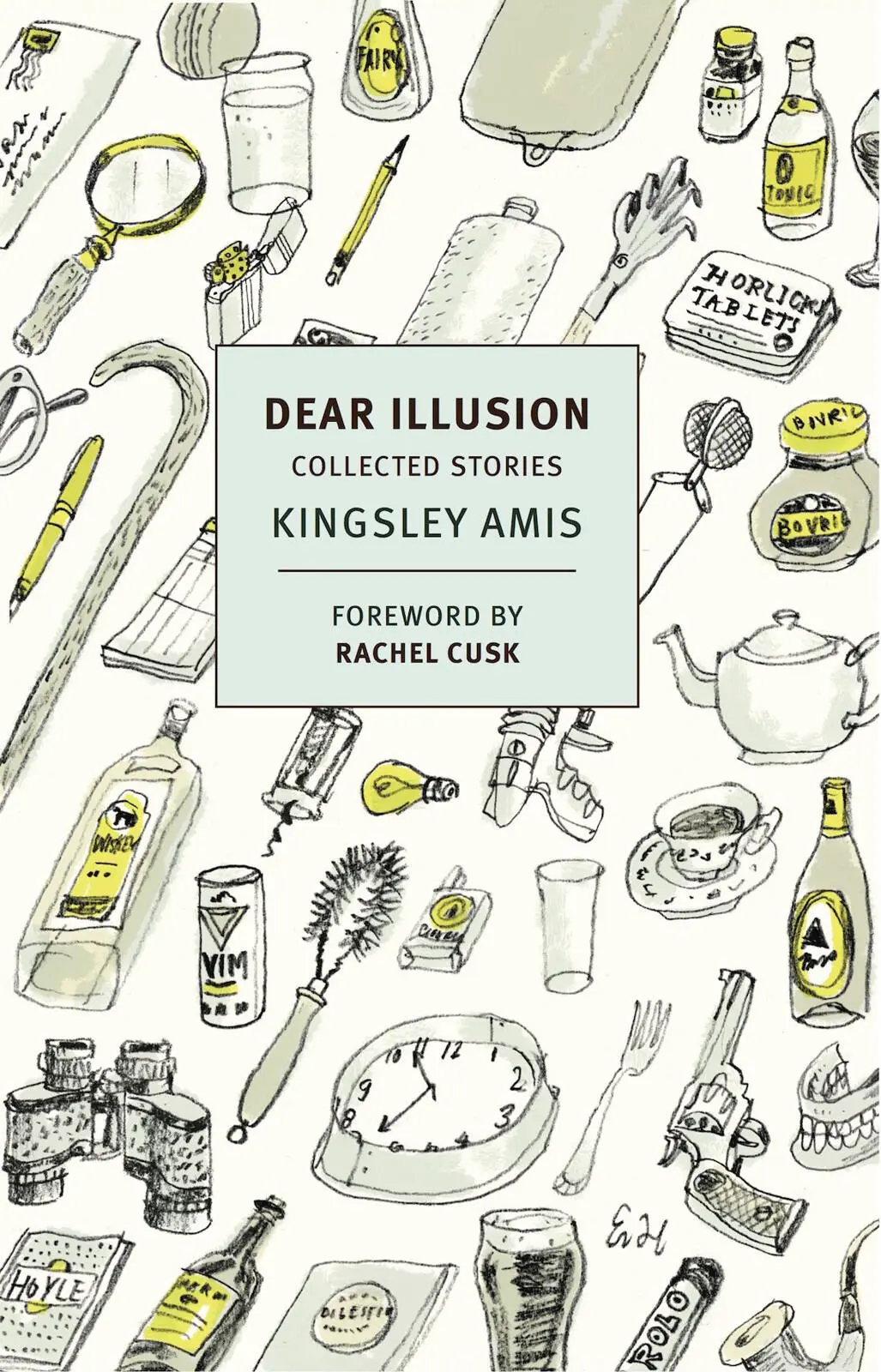
- Название:Dear Illusion: Selected Stories
- Автор:
- Издательство:New York Review of Books
- Жанр:
- Год:2015
- ISBN:нет данных
- Рейтинг книги:4 / 5. Голосов: 1
-
Избранное:Добавить в избранное
- Отзывы:
-
Ваша оценка:
Dear Illusion: Selected Stories: краткое содержание, описание и аннотация
Предлагаем к чтению аннотацию, описание, краткое содержание или предисловие (зависит от того, что написал сам автор книги «Dear Illusion: Selected Stories»). Если вы не нашли необходимую информацию о книге — напишите в комментариях, мы постараемся отыскать её.
Dear Illusion: Selected Stories — читать онлайн бесплатно полную книгу (весь текст) целиком
Ниже представлен текст книги, разбитый по страницам. Система сохранения места последней прочитанной страницы, позволяет с удобством читать онлайн бесплатно книгу «Dear Illusion: Selected Stories», без необходимости каждый раз заново искать на чём Вы остановились. Поставьте закладку, и сможете в любой момент перейти на страницу, на которой закончили чтение.
Интервал:
Закладка:
‘Well…’
‘What about the rhymes?’
She looked at her page again and this time noticed something. ‘Oh.’
‘Precisely. Mind and kind are perfectly acceptable, if a little trite. Abroad and board , despite the words’ similarity to the eye, are not acceptable, as any speaker from the west of England or Ireland or America outside the South would spot immediately.’ If Edward’s habitual manner had anything vague or preoccupied in it, there was nothing of either to be seen in him by this time.
Lucy perhaps saw this. She said tentatively, ‘ Abroad rhymes with Claude and Maud , and…’
‘And fraud . And board with abhorred and harpsichord and what you will. No poet of the eighteenth century, certainly not one as fastidious and well educated as Gray, could even have contemplated such a false equivalence.’
‘So my sententious quatrain is a fake.’
‘I’m afraid so. The work of a contemporary speaker of standard English, at a guess, possessing a good but not intimate knowledge of English poetry of the period, and more certainly a defective ear. Now. To begin with, not your work, Lucy?’
‘No. I found it in a cupboard in one of the guest bedrooms at home among some sheets of typing paper, which was what I’d really been after, the typing paper. I’d come across it there ages before and I’d just left it and forgotten about it until I needed some, some typing paper. You know how you do. And it was just there in with the other sheets, the sheet with that stanza typed on it.’
‘But who’d typed it, who’d written it, have you any idea?’
‘Not really. Some guest, I suppose. I’m often not there, you know, at home. Most of the time, in fact.’
‘Can I see it, the paper you found?’
Lucy hesitated. ‘I chucked it away. Probably somebody going in for one of those weekend competitions in the New Statesman or somewhere. You know — write some lines in the manner of this or that well-known poem.’
‘Very likely.’ This explanation, like the rest of Lucy’s last couple of remarks, did not satisfy Edward, but the light fog of boredom in which he habitually lived had begun to seep back in, and for the moment he could not understand or quite believe in the animation of his first response to what now seemed four rather ordinary lines. ‘But… what made you put it into your essay like that, in a way that suggested as strongly as possible that it was a bona fide part of Gray’s poem?’
‘Oh, that was just rather silly.’ Lucy showed some discomfort at being asked such a question. ‘I was wondering if you’d spot it, but I knew you would and of course you did as soon as I finished reading it, didn’t you?’
‘Almost. But I still don’t quite see what you hoped to gain from your little deception.’
‘Nothing at all. It was just a joke.’
Edward’s response to this information suggested he was no stranger to jokes, but had got out of the habit of responding to them. Perhaps he had come to find it an effort to laugh. ‘I thought as much,’ he said, laughing now. ‘But it seems to have recoiled on your own head, Lucy dear.’
‘What? Oh, I see. Yes, I suppose it has a bit. In a way.’
‘Well, I think we might get on with things, don’t you?’
And in no time she was citing the carrying-over of the sense between the sixteenth and seventeenth stanzas as the only case in the entire poem, and pronouncing on the significance of that. It was a well-written essay, one that showed some real feeling for literature, as Lucy’s always were and always did. When she had finished reading it and discussing it and its subject with Edward, they agreed that for next time she should consider the justice of Johnson’s remark, ‘In all Gray’s odes there is a kind of cumbrous splendour which we wish away.’
She was rising to go when Edward said to her, ‘Have you really no notion at all who it was that put together that piece of pseudo- Elegy you found?’
‘None whatever, I’m afraid. As I said, I’m not usually there.’
‘It might have been interesting to know.’
The matter was left at that for the time being.
Some weeks later, Edward was sitting in the common room of his college drinking a glass of sherry before dinner. He regularly did so whenever he dined in college, and he did that most nights, not because he particularly enjoyed either the fare or the company but because he preferred them to the alternative, a solitary meal prepared by himself in his kitchen at the old mill house. He was on visiting terms with several married couples both in Cambridge itself and in the country outside, but he was not the kind of man to attract or to welcome any kind of regular arrangement for getting himself fed by friends. Now and then he dined out in another college, and once or twice a term he spent the weekend at the house of his brother-in-law, but the evening in question was what his evenings generally were.
The presence in the armchair next to his of Roger Ashby, the Fellow in Modern European History, had over some years become an expected part of those evenings. Edward had no objection, except when Ashby commented on what he saw as the similarity of their situations, having divorced his wife four years previously and not remarried. This proved not to be one of those occasions. Instead, so to speak, he asked in a meaning tone if Edward had seen the newspaper that day.
‘Not yet,’ said Edward. He had explained more than once to Ashby that he held off doing so until the time of his final snack and his nightcap at home.
‘Thing in it that’s bound to interest you. A fellow claims to have discovered some previously unknown lines from Gray’s Elegy . Which if I mistake not is a poem that lies within your field, my dear fellow-toiler?’
‘Very much so. Does the paper quote the passage in question?’
‘Yes, but I fear… Ah. Excuse me.’
While Ashby crossed the room and returned to his seat, Edward felt in himself an onset of that same excitement that had visited him when Lucy started to recite her spurious stanza. Now as then, he found it hard to sit still.
‘Yes,’ said Ashby, turning to the middle pages of the captured newspaper and clearly preparing to read the relevant part aloud.
Edward forestalled that by saying, ‘Let me see if I already know how those lines run.’
‘I thought you said you hadn’t yet—’
‘Nevertheless, I have a feeling I may know them. You can hear me if you would.’
Ashby gave in with a fairly good grace, and said nothing while Edward recited verbatim what he had heard from Lucy at that tutorial. This feat of memory drew no appreciation from Ashby, who kept his eyes on what was before them and moved his head tentatively in small lateral jerks. ‘Is that all?’ he asked finally.
‘Yes. Am I right?’
After a headshake of greater amplitude than before, Ashby said, ‘Well, it might be best if I simply read you what’s here.’
‘I’d sooner see it with my own eyes,’ said Edward. He had a well-founded distrust of the other man’s willingness or ability to read anything aloud without oral annotations of his own. The words on the page proved to be set out in a way that obscured their function as part of a stanzaic scheme, but he soon rectified that in his mind and read:
Should one retrace his steps whose foolish dream
From righteous labours lured him far astray,
None but would hail him as he drove his team,
And court his company at close of day.
Secure all night within his peasant cot,
Each morn he treads the land that gave him birth,
And contemplates some not unhonoured spot
To house his weary bones in native earth.
Читать дальшеИнтервал:
Закладка:
Похожие книги на «Dear Illusion: Selected Stories»
Представляем Вашему вниманию похожие книги на «Dear Illusion: Selected Stories» списком для выбора. Мы отобрали схожую по названию и смыслу литературу в надежде предоставить читателям больше вариантов отыскать новые, интересные, ещё непрочитанные произведения.




Обсуждение, отзывы о книге «Dear Illusion: Selected Stories» и просто собственные мнения читателей. Оставьте ваши комментарии, напишите, что Вы думаете о произведении, его смысле или главных героях. Укажите что конкретно понравилось, а что нет, и почему Вы так считаете.