Kingsley Amis - Dear Illusion - Selected Stories
Здесь есть возможность читать онлайн «Kingsley Amis - Dear Illusion - Selected Stories» весь текст электронной книги совершенно бесплатно (целиком полную версию без сокращений). В некоторых случаях можно слушать аудио, скачать через торрент в формате fb2 и присутствует краткое содержание. Год выпуска: 2015, Издательство: New York Review of Books, Жанр: Современная проза, на английском языке. Описание произведения, (предисловие) а так же отзывы посетителей доступны на портале библиотеки ЛибКат.
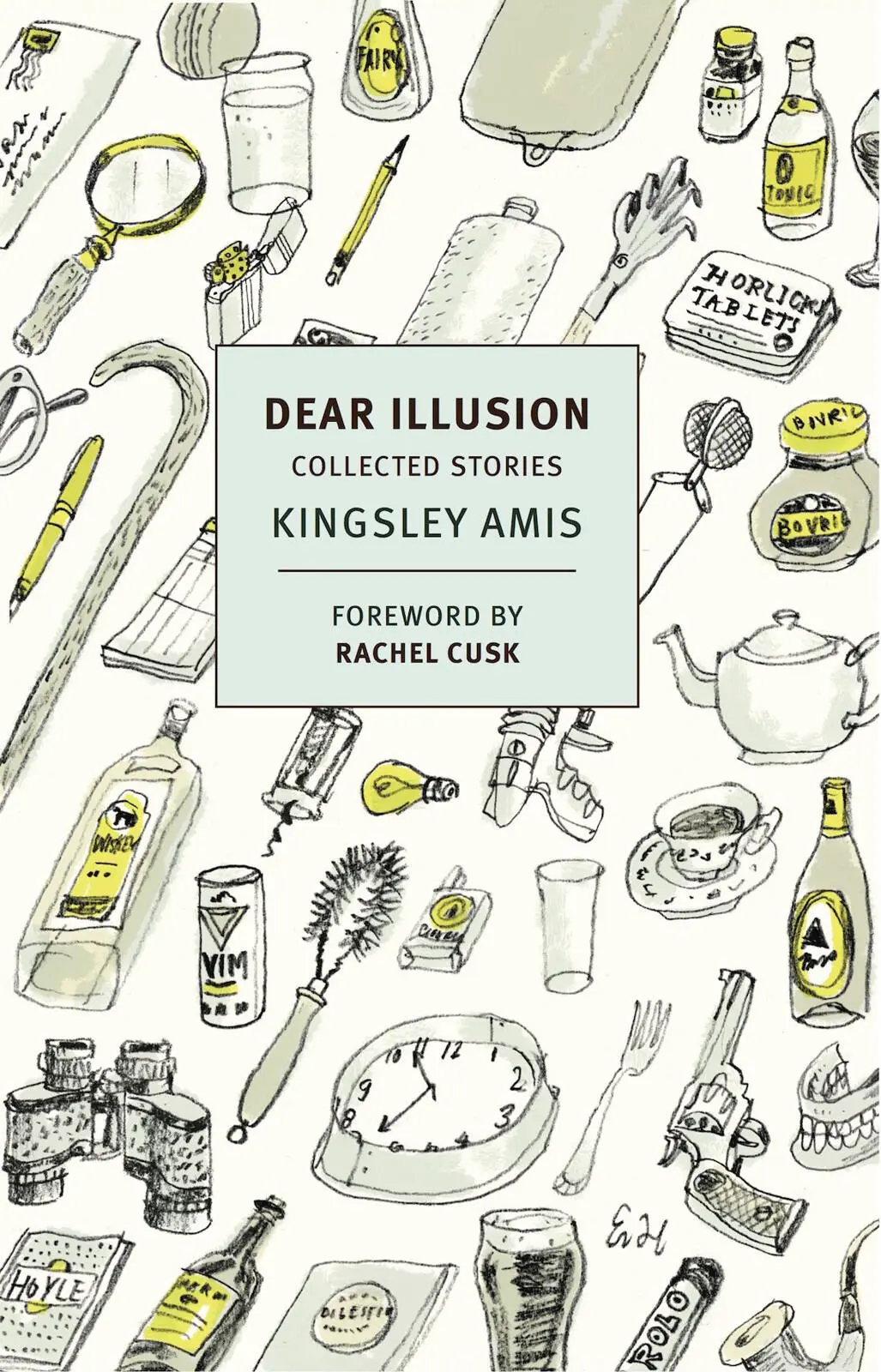
- Название:Dear Illusion: Selected Stories
- Автор:
- Издательство:New York Review of Books
- Жанр:
- Год:2015
- ISBN:нет данных
- Рейтинг книги:4 / 5. Голосов: 1
-
Избранное:Добавить в избранное
- Отзывы:
-
Ваша оценка:
Dear Illusion: Selected Stories: краткое содержание, описание и аннотация
Предлагаем к чтению аннотацию, описание, краткое содержание или предисловие (зависит от того, что написал сам автор книги «Dear Illusion: Selected Stories»). Если вы не нашли необходимую информацию о книге — напишите в комментариях, мы постараемся отыскать её.
Dear Illusion: Selected Stories — читать онлайн бесплатно полную книгу (весь текст) целиком
Ниже представлен текст книги, разбитый по страницам. Система сохранения места последней прочитанной страницы, позволяет с удобством читать онлайн бесплатно книгу «Dear Illusion: Selected Stories», без необходимости каждый раз заново искать на чём Вы остановились. Поставьте закладку, и сможете в любой момент перейти на страницу, на которой закончили чтение.
Интервал:
Закладка:
Edward had fully taken in these lines before it occurred to him to do as much as glance at the surrounding matter. This informed him that the two stanzas quoted had come to light among a packet of manuscript papers in the library of a London house whose name meant nothing to him. The authenticity of the documents was uncertain, but was being checked by experts in eighteenth-century literature and in the history of writing materials. The finder of the papers wished to remain anonymous while verification was still proceeding, but was himself a well-known authority on the poetry of the period.
Some minutes had gone by since Edward had begun to read, a longer interval than Ashby normally let pass in silence. He turned out to be on his way back from the buttery hatch carrying two glasses of sherry, and soon overrode Edward’s protest that a single drink before Hall was as much as he allowed himself.
‘Have you formed any opinion on the authenticity of those verses?’ asked Ashby.
‘My first tentative impression,’ said Edward carefully, ‘is that their author is unlikely to have been Thomas Gray.’ His mind was still perturbed at this unlooked-for sequel to the Lucy stanza, as he called it to himself, and what it might mean.
‘You are clearly not one of the experts consulted by the anonymous finder. Which is a little surprising, isn’t it? Given your well-known eminence.’
‘Thank you, Roger, but there are quite a few others of at least equal eminence.’
‘Really. Perhaps less ready than you to detect a forgery.’
‘That’s possible too, of course.’
‘Whereas a successful forgery would be worth a great deal of money.’
‘These days a reasonably careful and physically prepossessing forgery of such a famous poem, even if openly acknowledged to be a forgery, would be worth a substantial sum, especially in America. It would be interesting to have a look at that manuscript. I wonder whether—’
What Edward wondered competed unsuccessfully with the buzzing of the internal telephone. Answering this was something Ashby seemed to like doing. He threaded his way across the room between couples of old dons and young dons and a parson or two and spoke into the instrument. When he hung up his eyes were on Edward.
‘Call from Suffolk for you in the lodge,’ said Ashby. ‘A Miss Masterman.’
Edward was picking up the receiver in the porter’s lodge in much less time than he had taken over the newspaper. He was breathing quite fast as he gave his name.
‘This is your favourite pupil and relative,’ said the familiar youthful voice. ‘How are you?’
‘Fine, but why aren’t you in Cambridge?’
‘Revising for exams, of course. You could give me a tip or two there, especially over the Metaphysicals. It’s been simply ages since we saw you down this way. I was just thinking, if you happen to be free, why don’t you turn up at your usual time on Friday?’
‘My dear Lucy, I can’t think of anything I’d rather do.’
The warmth of Edward’s response was clearly a little surprising to Lucy. ‘Oh,’ she said. ‘Well, that is good news, I must say. I’m afraid it’ll be deadly dull, just me and the aged parents.’
‘Couldn’t be better.’
‘Couldn’t it? I was going to offer an inducement, but it seems you don’t need one.’
‘What sort of inducement?’
‘Just, there’s a bit more to tell you about, you remember, that Gray’s Elegy thing. You know, that cod verse I stuck in my essay.’
He very nearly screeched at her to tell him instantly, but thought he had better refrain in the circumstances. Instead, he asked her, ‘You’ve seen the paper today, have you?’
‘Well yes, but what about it?’
‘Look again. Page 7.’
‘A second and more successful attempt, or at least a subsequent one.’
Lucy had settled herself on the floor of her parents’ drawing room in one of those squatting attitudes impossible for any normal male west of Suez. ‘Are we sure about that? If it matters, that is.’
‘That sort of thing always matters,’ said Edward from the sofa. ‘No, we’re not sure, how could we ever be, but there’s a strong suggestion in the fact that this time he avoids the cockney rhyme we noticed in your text. Presumably he noticed it too. Could I have another look at what you’ve shown me?’
‘My text, golly!’ said Lucy, passing him the typewritten sheet.
‘M’m. Yes, this is a workpaper all right, leading to fair copy, probably with one or two precursors. Earlier efforts to you.’
‘Thank you, Uncle.’
‘How certain are you that there are no other bits hanging about somewhere?’
‘As certain as I can be without taking the bloody place apart brick by brick.’
‘All right, Lucy. Well, there it is. I’d give a lot to know who it was that cooked up this stuff.’
‘Would you? What would you do if you did know? What good would it do you?’
‘Put it down to interest. Or instinct. I just want to know.’
‘Would it help to know who typed what you’ve got there?’
‘What are you talking about, of course it would. A hundred, a thousand to one they’re the same person. Why? Surely you’re not going to tell me you know who it was? I don’t think I could stand another shock.’
Lucy jumped up from the rug and seated herself next to Edward, turning her top half round towards him in her best unselfconscious style. ‘I’m afraid I have been rather saving this up to tell you face to face.’
‘Like the typescript. All right, but please keep it as short as you can.’
‘Of course, what do you take me for? The first thing was me tracing the typewriter. That was easy.’
She brought out a sheet that, while a little crumpled, resembled in its general appearance the one he already held. Edward compared them.
‘The typings are certainly very similar,’ he said after a minute or two.
‘More than just very similar. Look at the “d” in mind and abroad and so on. The bulgy part has got a little break in it near the bottom. You see? And the “s” all over the place, too far over to the right. And the “h”. Almost like an “n”.’
After a shorter interval, Edward said, ‘Yes, I do see. But what…’
‘It belongs to my dad. As soon as I saw it, the original one, I thought I knew it. Somebody staying here for the weekend borrowed it off him one afternoon. Would you like to know who it was?’
‘Oh, I suppose I might as well, now we’ve come this far.’
‘Good. He’s called Colonel Orion Procope.’ She spelt the surname. ‘Three syllables, stress on first,’ she explained. ‘Strikes a chord?’
‘There’s a restaurant in Paris called something analogous, but I’m afraid I’ve never heard of any such person.’
‘I’ve an idea there’s a Sir in front of most of that or perhaps a Lord hanging about somewhere, and I’m pretty sure there’s an MC after it. Evidently he did something jolly gallant in the desert. Any better?’
‘Sorry.’
‘Well, I had a shot, at least. Mind you, the colonel, which is how he likes to be addressed — Colonel Orion Procope has rather got the look of, you know, someone who changes his name about a bit. Anyway, you’ll have the chance of judging such things for yourself in a little while.’
‘What!’
‘My turn to be sorry,’ said Lucy, neither sounding nor looking particularly sorry. ‘Yes, he’s coming to dinner. I promise that’s the last of my surprises.’
‘For this weekend at least. Well, that’s a comfort.’
Before they went off to change, Lucy released some further crumbs of information about the gallant colonel. He lived no great distance away, across Suffolk, near the coast; having never married, he lived there on his own, ‘apart no doubt from the occasional fisherman’, according to Lucy; he got invited over for the weekend a couple of times a year, for dinner or Sunday lunch two or three times as often; he might never have been invited at all but for his apparently lonely situation, ‘and he most likely wouldn’t have been even so, if Mum weren’t such an old softie’; he had first met Lucy’s father in the course of some ‘strangulatingly boring’ piece of business in the City of London; he had never been known to say much about his history.
Читать дальшеИнтервал:
Закладка:
Похожие книги на «Dear Illusion: Selected Stories»
Представляем Вашему вниманию похожие книги на «Dear Illusion: Selected Stories» списком для выбора. Мы отобрали схожую по названию и смыслу литературу в надежде предоставить читателям больше вариантов отыскать новые, интересные, ещё непрочитанные произведения.




Обсуждение, отзывы о книге «Dear Illusion: Selected Stories» и просто собственные мнения читателей. Оставьте ваши комментарии, напишите, что Вы думаете о произведении, его смысле или главных героях. Укажите что конкретно понравилось, а что нет, и почему Вы так считаете.