Kingsley Amis - Dear Illusion - Selected Stories
Здесь есть возможность читать онлайн «Kingsley Amis - Dear Illusion - Selected Stories» весь текст электронной книги совершенно бесплатно (целиком полную версию без сокращений). В некоторых случаях можно слушать аудио, скачать через торрент в формате fb2 и присутствует краткое содержание. Год выпуска: 2015, Издательство: New York Review of Books, Жанр: Современная проза, на английском языке. Описание произведения, (предисловие) а так же отзывы посетителей доступны на портале библиотеки ЛибКат.
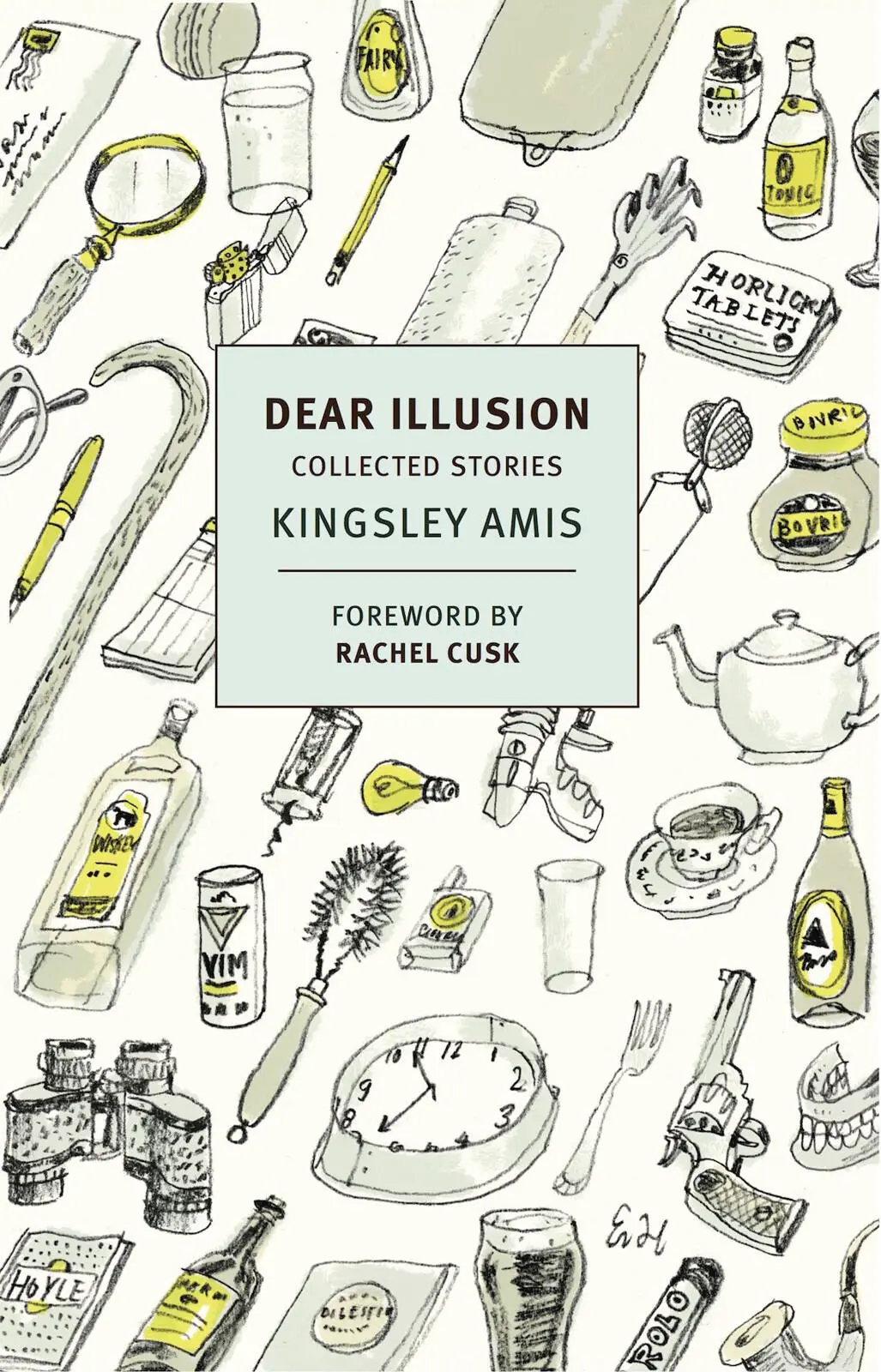
- Название:Dear Illusion: Selected Stories
- Автор:
- Издательство:New York Review of Books
- Жанр:
- Год:2015
- ISBN:нет данных
- Рейтинг книги:4 / 5. Голосов: 1
-
Избранное:Добавить в избранное
- Отзывы:
-
Ваша оценка:
Dear Illusion: Selected Stories: краткое содержание, описание и аннотация
Предлагаем к чтению аннотацию, описание, краткое содержание или предисловие (зависит от того, что написал сам автор книги «Dear Illusion: Selected Stories»). Если вы не нашли необходимую информацию о книге — напишите в комментариях, мы постараемся отыскать её.
Dear Illusion: Selected Stories — читать онлайн бесплатно полную книгу (весь текст) целиком
Ниже представлен текст книги, разбитый по страницам. Система сохранения места последней прочитанной страницы, позволяет с удобством читать онлайн бесплатно книгу «Dear Illusion: Selected Stories», без необходимости каждый раз заново искать на чём Вы остановились. Поставьте закладку, и сможете в любой момент перейти на страницу, на которой закончили чтение.
Интервал:
Закладка:
2. It has been said in London that he is of Creole or coloured blood. (Kenyon.)
3. His ancestry includes a West Indian grandmother. (Kenyon.)
4. The style in which he expresses himself, while correct grammatically, is fundamentally different from that of a true-born Englishman, not merely in his choice of words, but in his way of putting them together and their movement in his verses. (My own reading of the last-named and memory of what I heard of his first letter to Ba, also my glimpse of its cover.)
5. Mine is a slave-owning family domiciled in Jamaica for many years, indeed Elizabeth was the first for some generations to have been born in England.
6. I am myself of dark colouring.
7. Elizabeth is indeed of pale complexion, but there are distinct olive or sallow tints in that pallor. (Witness my personal pet-name for her.)
8. No West Indian person can be certain of his or her pedigree.
9. By a phenomenon known, I believe, as atavism, plants and animals have a tendency to reproduce earlier types. (My own observations in Jamaica.)
10. The laws of heredity are at present not well understood, but a child will often resemble its grandfather or grandmother rather than either of its immediate parents. (Common knowledge.)
It surely stands to reason and to common experience, requiring no further argument, that the presence of Creole blood on both sides of a union must redouble to an incalculable degree the chances of Creole blood in the issue .
No doubt in days to come the question of the colour of a human being’s skin will seem no more and no less interesting than the colour of eyes or hair. Here in England in the reign of Queen Victoria, those days must appear impossibly far off. By the very same consideration, how could I tell my daughter that the combined heredities of herself and Browning might — very likely would not, but still might — produce black offspring? How could I go so far as to say I had a reason for trying to forbid their further association? The result must have been not only to destroy Ba’s love for me, as the bearer of the worst of bad tidings, but also to place at risk her prospects of happiness. The latter I could not face. Better for all three concerned that I should continue to appear to my dearest Ba, and perhaps in time to the world, the very epitome of a selfish, obstinate, unreasoning tyrant. That is the part I must continue to play until my death. I resolve to do so and to keep my secret.
I pray that the Italians may be a more tolerant people in this regard than the English. They are after all a darker-skinned race than we.
Wimpole Street,
October, 1846
IV
Until now I have resisted all temptations to add to the foregoing. I subjoined not a word even on that blackest day in November, 1850 when Elizabeth’s Poems in two volumes appeared in a new edition that contained a section entitled Sonnets from the Portuguese , evidently addressed to the man now her husband. I could bring myself to do no more than hastily glance through these poems; they seemed to me of a most improper, indeed disgusting intimacy, but it was not that which wounded my feelings. The title is intended to puzzle or misdirect the reader, but if it had been specifically meant to cause me pain it could not have been more artfully devised. For ‘little Portuguese’ was my own personal pet-name for her, kept a secret between the two of us, an affectionately teasing allusion to her pale honey-coloured skin. The thought of her violation of this precious confidence, of my name for her being, so to speak, filched away and handed to a man who, whatever else may be said of him, had known her for only five of her forty-four years — there are no fitting words. The first shock brought a return of the asthma from which I had suffered earlier in the year, and even now the hurt remains keen.
But for the moment, in the face of a second, graver blow, I am incapable of such Stoical forbearance. Yesterday I was in my dining room at 50 Wimpole Street when I heard from the hall the unmistakable sound of a child’s laughter and screams of delight. These were noises quite foreign to my house. I at once connected them with the known presence in London, not merely of my estranged daughter and her husband on their third visit, but of their six-year-old son, the child whose very existence I had tried to efface from my mind. Knowing what I must do, I inhaled several deep breaths; then, willing my head not to renew its trembling, I opened the dining-room door and strode into the hall.
There, on all fours in imitation of a lion or some such beast, was my son George Moulton-Barrett, and, retreating from him in feigned alarm, there was my grandson, Robert Wiedemann Browning. We stared at each other for what seemed an eternity, but was probably no more than two minutes. I could think of nothing to say and doubt whether, in any case, I could have spoken a word. The little lad facing me, whose looks reminded me strongly of my dead son Edward’s, could have served as artist’s model for a picture of a typical English boy, with the unambiguous fair colouring that that implies.
At last I turned and went back into the dining room, having mastered my strong desire to pick the youngster up and hug him to my breast. When I was breathing more or less normally I summoned George there. He stood before me, serious, dependable, the one of my sons I most respected.
‘Whose child is that, George?’ I asked, still not finding speech easy.
‘Ba’s child, father,’ he answered.
‘And what is he doing here, pray?’
‘He is waiting, sir, waiting until it’s time to return to his mother. I mean to take him on the short journey in a few moments. Would you come with us?’
‘I fear not, George. Truly I cannot.’
‘Papa, I beg of you. It would make Ba so happy.’
‘No, my boy. Leave me. And kindly remove the child forthwith.’
When I heard the front door shut after the two, I lowered my head into my hands and may possibly have shed a tear. So it had all been for nothing, I said to myself. What I had taken for facts had not all been facts, that or my conclusions from them had been erroneous. But if I truly thought I had been wrong, why had I refused to go to Ba with George and her son?
After a troubled night, I awoke this morning with the answer rising to my lips. My daughter is now forty-nine years old and some months. In the nature of things, it must be unlikely that she could bear another child, so unlikely that I can rule it out, feel untroubled by any possibility. But I find I still cannot bring myself to come face to face with her, and with him . I could bear her silent reproaches, his silent triumph, but not their pity. Her pity.
Wimpole Street,
August, 1855
V
The above is of course fiction, but it contains much fact, the prime example being Mr Barrett’s ten points.
With the exception of (4), all are matters of record. (9) and (10) certainly hold for the mid-nineteenth century, and I was told of (8) by a Jamaican friend in the 1970s. As regards (4), Mr Barrett had undoubtedly seen something in Browning’s work which many would agree was there without thinking it the result of being an untrue-born Englishman. Further, it might be instructive to produce suitably recondite but representative extracts from Browning and, say, Wordsworth, Leigh Hunt, Byron, Keats, Hood, Beddoes, Tennyson, Clough and Arnold, and present them blind to a good class with the instruction to pick out which one was the work of a West Indian. The Browning sample might be the following excerpt from ‘Nationality in Drinks’, which Mr Barrett could easily have read, since it was first collected in Dramatic Romances and Lyrics in 1845:
Up jumped Tokay on our table,
Читать дальшеИнтервал:
Закладка:
Похожие книги на «Dear Illusion: Selected Stories»
Представляем Вашему вниманию похожие книги на «Dear Illusion: Selected Stories» списком для выбора. Мы отобрали схожую по названию и смыслу литературу в надежде предоставить читателям больше вариантов отыскать новые, интересные, ещё непрочитанные произведения.





Обсуждение, отзывы о книге «Dear Illusion: Selected Stories» и просто собственные мнения читателей. Оставьте ваши комментарии, напишите, что Вы думаете о произведении, его смысле или главных героях. Укажите что конкретно понравилось, а что нет, и почему Вы так считаете.