Kingsley Amis - Dear Illusion - Selected Stories
Здесь есть возможность читать онлайн «Kingsley Amis - Dear Illusion - Selected Stories» весь текст электронной книги совершенно бесплатно (целиком полную версию без сокращений). В некоторых случаях можно слушать аудио, скачать через торрент в формате fb2 и присутствует краткое содержание. Год выпуска: 2015, Издательство: New York Review of Books, Жанр: Современная проза, на английском языке. Описание произведения, (предисловие) а так же отзывы посетителей доступны на портале библиотеки ЛибКат.
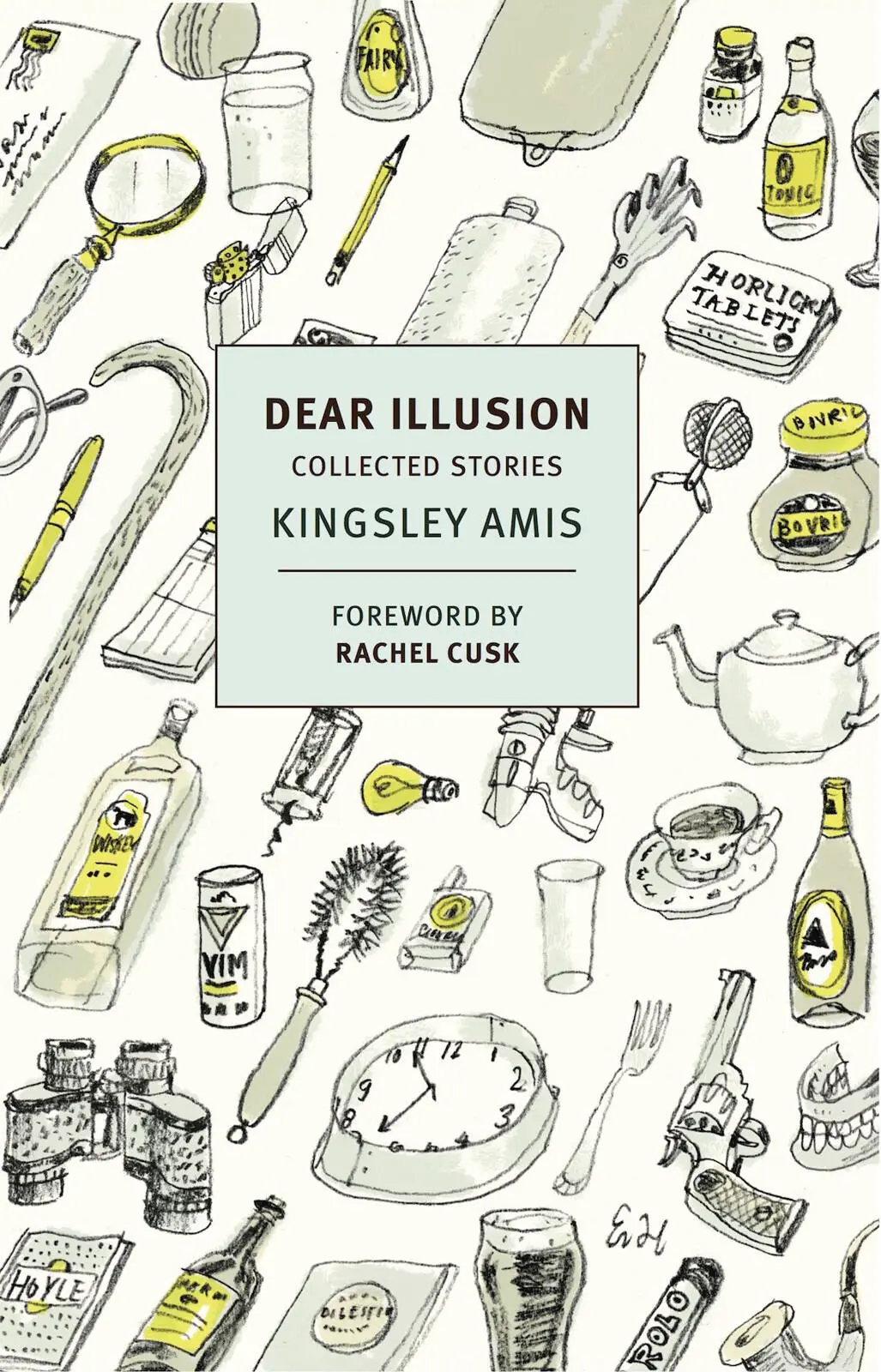
- Название:Dear Illusion: Selected Stories
- Автор:
- Издательство:New York Review of Books
- Жанр:
- Год:2015
- ISBN:нет данных
- Рейтинг книги:4 / 5. Голосов: 1
-
Избранное:Добавить в избранное
- Отзывы:
-
Ваша оценка:
Dear Illusion: Selected Stories: краткое содержание, описание и аннотация
Предлагаем к чтению аннотацию, описание, краткое содержание или предисловие (зависит от того, что написал сам автор книги «Dear Illusion: Selected Stories»). Если вы не нашли необходимую информацию о книге — напишите в комментариях, мы постараемся отыскать её.
Dear Illusion: Selected Stories — читать онлайн бесплатно полную книгу (весь текст) целиком
Ниже представлен текст книги, разбитый по страницам. Система сохранения места последней прочитанной страницы, позволяет с удобством читать онлайн бесплатно книгу «Dear Illusion: Selected Stories», без необходимости каждый раз заново искать на чём Вы остановились. Поставьте закладку, и сможете в любой момент перейти на страницу, на которой закончили чтение.
Интервал:
Закладка:
Like a pygmy castle-warder,
Dwarfish to see, but stout and able,
Arms and accoutrements all in order;
And fierce he looked North, then, wheeling South,
Blew with his bugle a challenge to Drouth,
Cocked his flap-hat with the tosspot-feather,
Twisted his thumb in his red moustache,
Jingled his huge brass spurs together,
Tightened his waist with its Buda sash,
And then, with an impudence nought could abash,
Shrugged his hump-shoulder, to tell the beholder,
For twenty such knaves he should laugh but the bolder;
And so, with his sword-hilt gallantly jutting,
And dexter-hand on his haunch abutting,
Went the little man, Sir Ausbruch, strutting!
Other facts in my story include Browning’s first letter to Elizabeth and the extracts from it; the paraphrase of her reply; Mr Barrett’s membership of the Reform Club; his asthmatic weakness, including the severe attack of 1850; Browning’s visit in August, 1846 and the reason offered for its prolongation; and Mr Barrett’s meeting with his grandson. ‘The Portuguese’ was certainly Browning’s pet-name for Elizabeth; there is no evidence it was ever her father’s.
With one exception, I mean the thoughts and feelings I attribute to Mr Barrett to be sincere on his part, truthful. The exception is his final paragraph, where his explanation for not wanting to face Elizabeth and Browning strikes me as distinctly thin. His ‘real’ motive is more likely to have been fear of betraying his jealousy at seeing the two unequivocally together, with their offspring. (Not a sexual jealousy: I have never believed that he harboured a guilty passion for his daughter.) And perhaps he was still obsessed by his theory. Anyhow, he died in 1857 at the age of seventy-two; Elizabeth survived him by only four years.
I myself think it most unlikely that Browning, any more than Elizabeth, had some ‘Creole’ blood, though, if he had had, Victorian literature and the world in general would be that much more interesting. He would have been the English member of a great trio of European coloured writers of the nineteenth century, the others being Alexander Dumas père (black grandmother) and Alexander Pushkin (black great-grandfather), both of whom can be taken as sharing something of his spirit.
A few additional facts may be of interest. In 1972 I gave a talk on Tennyson to a literary society in Barnet. I was glad that what I had to say was entirely favourable to the poet, because my audience included his highly articulate ninety-three-year-old grandson, Sir Charles Tennyson (1879–1977), though that is by the way. In the closing stages of the meeting, the secretary of the society took me aside.
‘Now I know Tennyson wasn’t the same person as Browning, but we have a Mrs [I forget] in the audience, a descendant of Browning’s brother. Would you like a word with her?’
‘Very much,’ I said.
The word I had with the lady was not memorable, but I was most interested to find she was black, especially when I checked afterwards and found that Browning had no brother. None known to history, that is.
[1] Note : I am now satisfied that the abusive term scoundrel is unjust, together with the following clause, and that they represent nothing more than a transient, though once deeply felt, emotion of mine. —E. B. M-B.
[2] Not by any means all of them, alas. My dearest Mary, Elizabeth’s mother, had died seventeen years before this at the age of forty-seven. —E. B. M-B.
BORIS AND THE COLONEL
I
Edward Saxton was the Fellow and Director of Studies in English at a small Cambridge college, and concurrently a lecturer in that subject at that university. His special interest, on which he had given a course for over fifteen years, was the work of Thomas Gray, William Collins, Oliver Goldsmith and lesser poets of the eighteenth century who were then collectively regarded as precursors of the Romantic movement. The events recounted here took place in 1962, when Edward was forty-five years old; a thin, rather tall figure with a perceptible stoop.
He still lived where he had done when his wife had died suddenly two years earlier, in what called itself an old mill house in a village some miles east of Cambridge. He had a green shooting-brake and used it to drive himself to and fro most days during term. One such day in late spring found him in the college room he used for teaching, a few minutes before his first pupil was due.
This pupil was unlike his others in more than one way. To begin with it was a girl he expected, an undergraduate at one of the women’s colleges. Also unusually, she was so interested in her subject that, over and above a weekly tutorial hour with her own Director of Studies, she had come to an arrangement whereby she showed her work to Edward four times a term. This was due partly to his personal qualities and partly to her third point of singularity, a family connection with him.
Lucy Masterman was a niece of Louise, Edward’s dead wife, child of her elder brother, now in her second year at the university and nearly twenty years old. She was sturdy, dark-haired, rosy-cheeked, with large watchful brown eyes, a feature she had shared with Louise. She still retained the artless manner she had shown as a little girl, though Edward had sometimes thought she found it came in handy when dealing with grey-haired scholars like himself.
That manner was in place when, punctual as ever, she arrived. Indeed, that morning it was slightly more marked than usual, if anything, but when he looked back afterwards it seemed no time at all before Lucy was reading him her essay, and scarcely longer till she was illustrating her set theme, ‘Gray’s use of the rhymed quatrain in his Elegy ’.
Far from the madding crowd’s ignoble strife (she read)
Their sober wishes never learned to stray;
Along the cool sequestered vale of life
They kept the noiseless tenor of their way.
Lucy’s comment was that the simple inhabitants of Gray’s village might have been surprised to receive such a weighty tribute, with its heavy, regular rhythms and its tendency to epigram. A stanza such as the following, she went on, might have sounded more comfortable and comprehensible:
But if one should return whose errant mind (she read)
From rustic toil once took him far abroad,
All then would labour merely to be kind,
And crave his presence at their humble board.
The excitement that filled Edward on hearing these last four lines was quite unfamiliar to him, and it was not paralleled by anything that happened later. It had reached its full strength almost at once, and he could not remember afterwards how he had restrained himself from giving way to his feelings. For a moment he was young again, when anything had seemed possible. As Lucy paused, he asked her to stop for a minute in tones suited to a real command, and in an uncharacteristic movement got up and paced the floor.
‘Did you know, Lucy,’ he said in his diffident tenor, when nearly half that minute had passed and he was himself again, ‘that that stanza appears nowhere in any received text of the Elegy ?’
She blushed easily, as he had noticed. She did so now. ‘I thought it might be a cancelled stanza from one of the extant manuscripts.’
‘The so-called Eton manuscript has seven such stanzas, none of which even approximately resembles in any way the four lines you have just read me.’
Her blush deepened but she said nothing.
‘In any case Gray would never have written those lines,’ he pursued.
‘You seem very sure.’
‘So would you be, my dear, if you were once to hear in them what I heard. Read them aloud again.’ As soon as she had finished, Edward said, ‘There. Does that sound all right to you?’
Читать дальшеИнтервал:
Закладка:
Похожие книги на «Dear Illusion: Selected Stories»
Представляем Вашему вниманию похожие книги на «Dear Illusion: Selected Stories» списком для выбора. Мы отобрали схожую по названию и смыслу литературу в надежде предоставить читателям больше вариантов отыскать новые, интересные, ещё непрочитанные произведения.





Обсуждение, отзывы о книге «Dear Illusion: Selected Stories» и просто собственные мнения читателей. Оставьте ваши комментарии, напишите, что Вы думаете о произведении, его смысле или главных героях. Укажите что конкретно понравилось, а что нет, и почему Вы так считаете.