Kingsley Amis - Dear Illusion - Selected Stories
Здесь есть возможность читать онлайн «Kingsley Amis - Dear Illusion - Selected Stories» весь текст электронной книги совершенно бесплатно (целиком полную версию без сокращений). В некоторых случаях можно слушать аудио, скачать через торрент в формате fb2 и присутствует краткое содержание. Год выпуска: 2015, Издательство: New York Review of Books, Жанр: Современная проза, на английском языке. Описание произведения, (предисловие) а так же отзывы посетителей доступны на портале библиотеки ЛибКат.
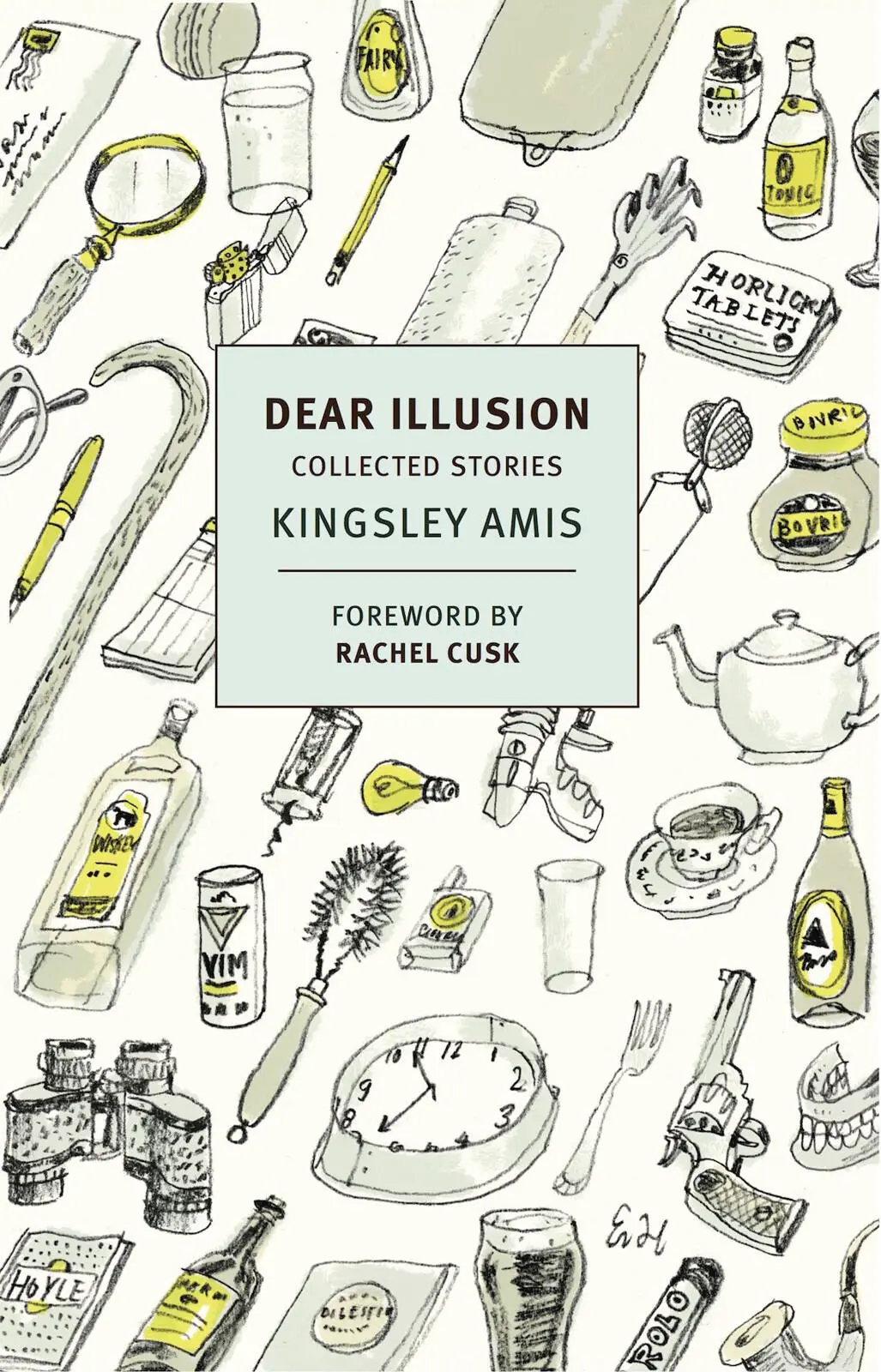
- Название:Dear Illusion: Selected Stories
- Автор:
- Издательство:New York Review of Books
- Жанр:
- Год:2015
- ISBN:нет данных
- Рейтинг книги:4 / 5. Голосов: 1
-
Избранное:Добавить в избранное
- Отзывы:
-
Ваша оценка:
Dear Illusion: Selected Stories: краткое содержание, описание и аннотация
Предлагаем к чтению аннотацию, описание, краткое содержание или предисловие (зависит от того, что написал сам автор книги «Dear Illusion: Selected Stories»). Если вы не нашли необходимую информацию о книге — напишите в комментариях, мы постараемся отыскать её.
Dear Illusion: Selected Stories — читать онлайн бесплатно полную книгу (весь текст) целиком
Ниже представлен текст книги, разбитый по страницам. Система сохранения места последней прочитанной страницы, позволяет с удобством читать онлайн бесплатно книгу «Dear Illusion: Selected Stories», без необходимости каждый раз заново искать на чём Вы остановились. Поставьте закладку, и сможете в любой момент перейти на страницу, на которой закончили чтение.
Интервал:
Закладка:
‘This feeling bad,’ said Sue, telling herself that after all she was a journalist — ‘can you describe it any more fully?’
‘No. If I could I would, believe me. I don’t know what the poems have to do with it, either. I tried once not writing the poem down, but all that happened then was that I forgot it and started feeling bad again, so the only net result was that I was a poem short. Of course, if you look at it in one way, it’s all rather like that business they call occupational therapy, where people weave carpets to take their mind off themselves and their problems. The point there is that it doesn’t make any difference to anybody whether the carpets are any good or not. I’ve been wondering for over thirty years, on and off, if it’s the same with my poems.’
The placid, rather monotonous voice stopped as Bowes shoved his stocky bulk squarely between the other two and let off a long burst of click-and-buzz. He had been well within earshot for some time, but his assumption of his own total primacy over anybody interviewing or being interviewed had its helpful side: he was stone-deaf to all talk not directly about sex, cars or photography. Sue thought Potter might have guessed something of the sort. She used the couple of minutes’ interval to complete, in her own semi-shorthand, a nearly verbatim account of what Potter had said in the last four or five. She was certain that the information in it had never been divulged before.
Clearly and succinctly, Bowes now intimated that they were all to move indoors, to where Potter worked. Potter said he worked nowhere in particular, or everywhere, though there was a little table where he occasionally wrote things down, and Bowes answered that that was what he had meant.
They entered a low-ceilinged room that quite a few people would have felt inclined to call a parlour. By a window giving on to the front garden there was a characterless table and a hard chair with a flattened cushion. On the table Sue saw a cheap scribbling pad, one of its sheets detached and showing evidence of writing on the side not in view: no doubt that morning’s poem. Bowes at once set about assembling an indoor cairn on a larger, oval table: a biscuit-barrel and two empty decanters from the sideboard, ornamental mugs and pottery figures from the mantelshelf, a multi-tiered cake-stand complete. The general style of these, and of other objects in the room, was in a current fashion, but that would be coincidence; they must be survivals of what the Potters had bought when they were first married in 1924, or had come by from their parents. To judge from his behaviour, and the shakier evidence of his work, Potter was not a man to care for or notice what was around him.
Sue moved to a small bookcase that held the expected complete works in the expected new-looking condition, and a few dozen other volumes, mostly paperbacked and all, or all of those she could take in at a glance, by authors she had never heard of. Potter’s reading habits were well enough known, but she judged that a short trot over familiar ground would give him time to adjust to the change of scene and, with luck, to prepare himself for further revelations.
‘Do you read a lot, Mr Potter?’ asked Sue, while Bowes began setting up his lights and reflectors.
‘Not a lot, no. I’ve never really taken to it. Either it’s in you or it isn’t is how I’d put it, and it doesn’t seem to be in me. Oh, I quite enjoy books about Poland and Samoa and places like that where I’ve never been, but that’s about as far as it goes.’
‘No poetry?’
‘Yes, a little from time to time, just to see what other people are doing. I sometimes buy one of those anthologies.’
‘Who do you like particularly?’
‘Well, it’s hard to say. The standard seems to be so high, it’s amazing. Let’s see, I like Christopher Logue, John Betjeman, Allen Ginsberg, Philip Roth, Basil Bunting, John Berryman, Roy Fuller, John Lennon, Sylvia Plath, Fats Larwood, Robert Lowell… And Ezra Pound and W. H. Auden, of course. But, as I say, so many people are good.’
‘But surely—’ Sue cut herself off, realizing she could not say any of the seven or eight things she wanted to say. ‘Surely you prefer some of those names to others?’
‘Not… not really.’
‘I see. Have you any, what our readers would call hobbies?’
‘You mean how do I spend my time. I do quite a lot of walking; there’s still some country left round here. I have to answer quite a few letters, and then my agent rings me up. And in the evenings my wife and I play halma or something, or we watch television.’
‘In the chair, please, Mr Potter,’ said Bowes opportunely, setting off the equivalent of a smallish, slow-burning phosphorus bomb. ‘That’s lovely. Doing very well.’
Potter sat on for a few moments, seeming to shrink a little physically in the glare. Then he said, ‘As I was telling you, Mrs Macnamara, I keep wondering about those poems of mine. The people who weave those carpets have had other things in their lives. They’ve done other things. They’ve been builders or lawyers or sailors or mothers or lorry-drivers or something. Or they’ve told jokes very well or got drunk a lot or… had a lot of women or played tennis or travelled or helped other people. I couldn’t have done some of those things and I didn’t want to do any of the others. I’ve never done anything but write poems. So if the poems are no good my life’s been wasted.’
‘Oh, but everybody agrees they’re good. I was reading—’
‘Not everybody. I don’t agree for one. I don’t say I disagree, but I don’t agree. And unless I’m very much mistaken, neither do you.’
Sue could find nothing to say. She flinched at a sudden click-accompanied movement of Bowes behind her shoulder.
‘Good.’ Potter nodded approvingly. ‘Well, my dear, I was afraid all that was going to sound pompous, and it has. And not only sounded pompous. I think I must have got more conceited as I’ve grown older. It’s conceited of me to wonder whether I’m anything more than somebody who’s been lucky enough to be able to make up his own occupational therapy without any help from outside. But it’s a bad bargain no matter how you look at it.’
‘Could I have you writing, please?’ ordered Bowes from the shadows.
‘Of course,’ said Potter, taking out a felt-tipped pen and doodling quite convincingly on his pad. ‘It’s a bad bargain even if the poems are good. Whatever that may mean. From my point of view, nothing at all could compensate for getting on for forty years of feeling bad with a couple of days of not feeling so bad and ten minutes of feeling all right thrown in about once a month. There’s a very good young doctor in the town here who took over not so long ago from the fellow I’ve always had. He reads a bit of poetry and he says he likes what I write. I’ve told him a lot of what I’ve told you. He takes my point about occupational therapy and he says I sort of psychoanalyse myself through my work so that I can carry on. But I’m fed up with carrying on. He’s got every pill under the sun in that surgery of his, and he says he could probably find one that would make me feel all right most of the time, but it would probably, at least as probably, stop me wanting to write poems, or having to write poems. I’ve been holding out against that for about six months. Conceit again, I suppose. But I’ve decided I’m too old to be conceited any more. I’d like to feel all right for the rest of my life and never mind the poetry. So I’m stopping it, the poetry. In fact I have stopped. This one this morning was the last. Tomorrow morning I’ll be off to see that doctor and he’ll start me on what he calls a course. I’m really quite excited about it.’
‘Now I’d like you looking as if you’re looking for inspiration,’ said Bowes.
Читать дальшеИнтервал:
Закладка:
Похожие книги на «Dear Illusion: Selected Stories»
Представляем Вашему вниманию похожие книги на «Dear Illusion: Selected Stories» списком для выбора. Мы отобрали схожую по названию и смыслу литературу в надежде предоставить читателям больше вариантов отыскать новые, интересные, ещё непрочитанные произведения.






Обсуждение, отзывы о книге «Dear Illusion: Selected Stories» и просто собственные мнения читателей. Оставьте ваши комментарии, напишите, что Вы думаете о произведении, его смысле или главных героях. Укажите что конкретно понравилось, а что нет, и почему Вы так считаете.