Kingsley Amis - Dear Illusion - Selected Stories
Здесь есть возможность читать онлайн «Kingsley Amis - Dear Illusion - Selected Stories» весь текст электронной книги совершенно бесплатно (целиком полную версию без сокращений). В некоторых случаях можно слушать аудио, скачать через торрент в формате fb2 и присутствует краткое содержание. Год выпуска: 2015, Издательство: New York Review of Books, Жанр: Современная проза, на английском языке. Описание произведения, (предисловие) а так же отзывы посетителей доступны на портале библиотеки ЛибКат.
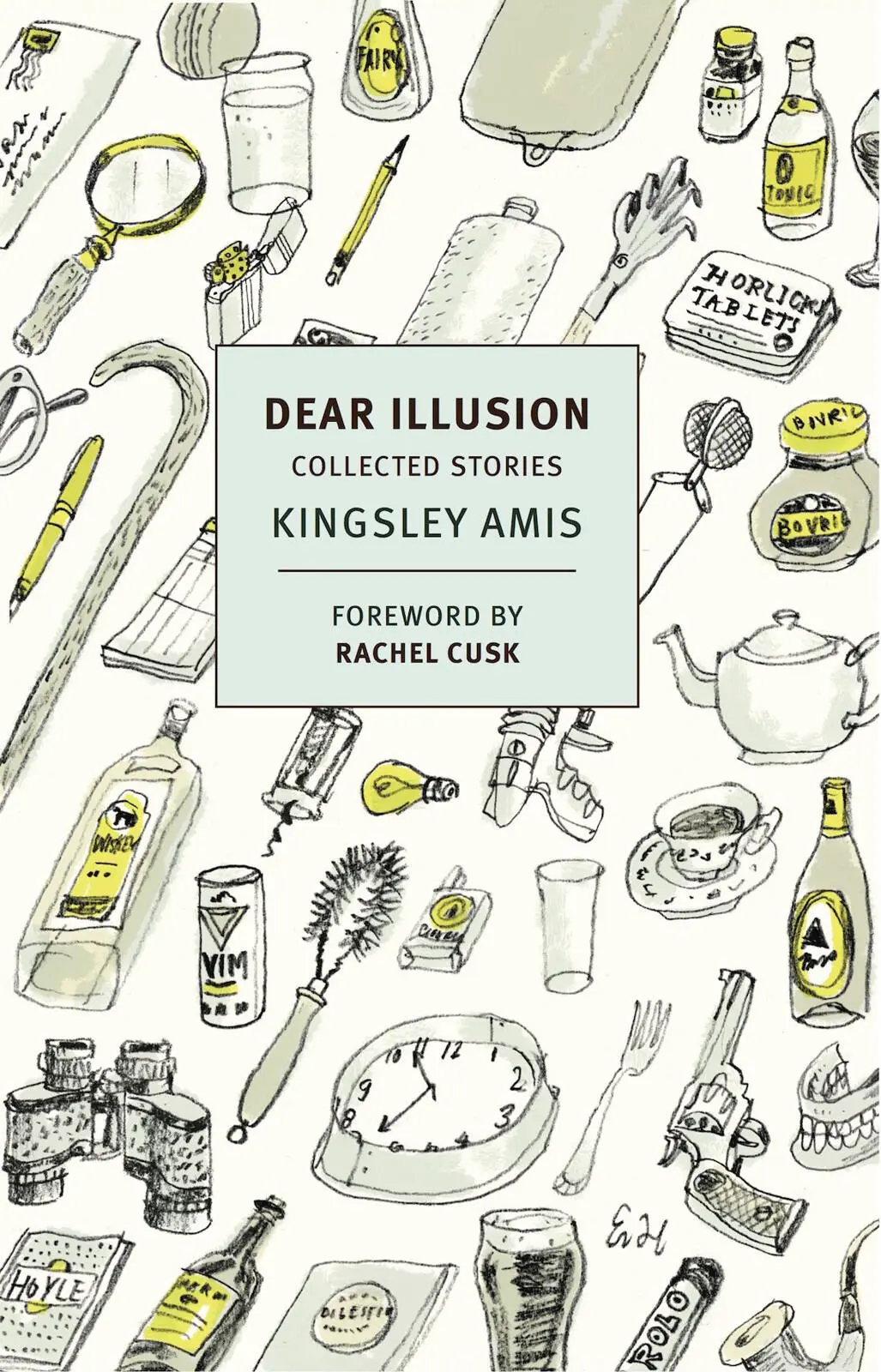
- Название:Dear Illusion: Selected Stories
- Автор:
- Издательство:New York Review of Books
- Жанр:
- Год:2015
- ISBN:нет данных
- Рейтинг книги:4 / 5. Голосов: 1
-
Избранное:Добавить в избранное
- Отзывы:
-
Ваша оценка:
Dear Illusion: Selected Stories: краткое содержание, описание и аннотация
Предлагаем к чтению аннотацию, описание, краткое содержание или предисловие (зависит от того, что написал сам автор книги «Dear Illusion: Selected Stories»). Если вы не нашли необходимую информацию о книге — напишите в комментариях, мы постараемся отыскать её.
Dear Illusion: Selected Stories — читать онлайн бесплатно полную книгу (весь текст) целиком
Ниже представлен текст книги, разбитый по страницам. Система сохранения места последней прочитанной страницы, позволяет с удобством читать онлайн бесплатно книгу «Dear Illusion: Selected Stories», без необходимости каждый раз заново искать на чём Вы остановились. Поставьте закладку, и сможете в любой момент перейти на страницу, на которой закончили чтение.
Интервал:
Закладка:
Some of this occurred to her later; for the moment, all was action of a limited sort. Introductions were made, and Bowes at once ordered Potter out of his own house into its back garden. He did this in a way that showed he thought he knew just how to get people to do what he wanted without their ever feeling any pressure. In the garden, or the fenced-off bit of field where nothing grew but grass, two or three fruit-trees well past the arboreal change of life and a few clumps of tattered dandelions, he started moving pieces of outdoor furniture and other objects about with a photographer’s unconsidering roughness, not out of any apparent impatience but as if all private property not his own were public property. Sue used this (as it proved) considerable intermission to show what was a genuine acquaintance with some of Potter’s work, mentioning a couple of individual poems. Potter showed mild and unfeigned surprise.
‘I didn’t think anybody really read me these days. Nobody under about sixty, anyway. When did you first come across “Drizzle and Thrush”?’
‘When it first appeared. In the New Statesman , wasn’t it?’
‘Not just homework, then. Mind you, I’m all for homework. Did you like it?’
‘I’m not sure.’ Sue discarded without forethought the lying flattery she had been ready with.
‘Neither am I, my dear, neither am I. That’s the problem. My problem, I should say. Would you like some tea or something?’
‘Not for me, thank you,’ she said, wanting to avoid a second bout of delay before the interview could start. Then she caught a mental glimpse of an apple-cheeked, check-aproned wife buttering home-made scones in the kitchen. ‘But if you and Mrs Potter were thinking of…’
‘She’s not here. My wife’s… not here.’
He spoke with great but unspecific force, implying anything from violent death to a grossly whimsical sortie round the shops in the town. Sue, whose thorough self-briefing had indicated a Mrs Potter alive and in residence, responded with a dead bat.
‘You’re on your own for a little while, then.’
‘Yes, I am, and a very unpleasant mode of existence it is too, I don’t mind telling you. I avoid it whenever I can. But the woman who looks after my sister-in-law, who can’t move, fell downstairs on Monday and broke both her legs, so I’ve had to let my wife go until such time as they can find someone else. That’s why I’m glad you don’t want any tea, because I’d have had to go and get it. In my experience, no kind of meal or refreshment is worth a single moment’s preparation. On one’s own part, that is.’
‘What do you live on, then, when Mrs Potter’s away?’
‘Beer and cornflakes mostly. I don’t take sugar on them, the cornflakes, so that’s one bit of bother saved. Of course, there is opening the new packet. I can’t see any way round that.’
Neither could Sue, but she was saved having to admit as much by the intervention of Bowes, who sat Potter down in one of Potter’s garden chairs, a canvas-and-rusted-metal affair, in the manner of an army dentist with a battalion’s worth of extractions and fillings before him. His thrusting of a light-meter to within an inch of Potter’s face was also faintly dental, suggesting a dry run with syringe or drillhead. Sue found herself stationed in a similar chair near Potter at one of the comparatively few angles nobody would naturally choose for any sort of conversation. Not far off, Bowes had thrown together a sort of cairn of stuff he must have found lying about: a couple of metal drums that might once have held paraffin, some cardboard boxes, some flowerpots, some white-painted rocks fit for a past or future rock-garden, a primordial lawn-mower, a half-sized St Francis or related figure in dirty stone. Without any trouble, Sue could visualize the end-product of this arrangement as a fashionable back-to-front portrait, a sprawling, blurred mélange in the foreground with the tiny in-focus shape of Potter in the distance, plus, no doubt, about two-fifths of herself at the edge — whatever fraction would most bore and annoy the beholder. Right up the art editor’s street, and Bowes would know it; but he was not the sort of photographer, nor the sort of man, to have two or three tries at something when two or three hundred would do. Here he was in his ritual dance, approaching, retreating, squatting, on tiptoe, clicking, winding on, now and then standing stockstill to gaze at Potter in evident consternation, only to go twitching back into the measure.
Sue had opened her notepad. ‘Before we begin, Mr Potter, I should tell you that you’ll be sent a proof of the article in advance, so that you can make any alterations or cuts.’
‘I say, that’s jolly decent of you. Not many of you do that.’
‘I think quite a lot of people are more forthcoming if they know they have that sort of control.’
‘Enlightened self-interest, which is very enlightened. Right, then. I was born in Croydon, Surrey in 1899, and educated at the—’
‘Excuse me, Mr Potter: I think I already have really all the obvious known facts about you, what with the Lacey-Jones book, and your publisher…’
‘Good Lord.’ He lifted his glasses above his eyebrows and looked at her as hard as he had done when they first met, but this time not uninterestedly. His eyes were light brown, with darker flecks. ‘This is the first time one of you has ever… But then you’re not really one of you, if I make myself clear. I should have seen that before.’
‘Could we have the glasses up again, please?’ said Bowes in a managerial tone, and fell to bobbing and straightening as he clicked his way round a semi-circle that brought his camera within a hand’s breadth of Sue’s ear. She said to Potter, who was still obediently holding his glasses up in the required position,
‘Can you think while this sort of thing’s going on?’
‘I can think while any sort of thing’s going on, in so far as I can think at all. I wrote my first poems while I was working in a timber yard. But you’ll have read about all that. What there was of that, I mean.’
‘Can I ask you about those first poems? And about what made you write them? I’m sorry, I know that’s a damned silly question, but our readership’s not of a very—’
‘I think it’s a fascinating question, not as regards me personally, but as regards all writers of poems. But before we get on to it, I’ll save you the embarrassment of asking another question I’m sure you’ll quite reasonably want to ask. I write with a pen or a pencil, or anything that makes marks, on any sort of paper. I expect if I had nothing but a blackboard and a piece of chalk I could manage with them. Not a typewriter: I’ve nothing against the typewriter, I just can’t use it, not even for the fair copies — I get my wife to do them, and then she sends them off to my agent without my looking at them again. She keeps a carbon for the files. She does all that, very nicely too.’
‘I see. Why don’t you look at the fair copies before they go off?’
‘No point in it. I write very clearly and my wife’s a very accurate typist.’
‘So in a sense the first you see of the poem in its finished state is when it appears in print.’
Potter glanced over at Bowes, who was doing something technical to one of his cameras, or trying to. ‘Well… it’d be truer to say that the last I see of it in its finished state is when I give the manuscript of it to my wife for her to type it out.’
‘You mean you don’t ever… you don’t normally look at it when it’s originally published? I suppose it is more satisfying to wait until you’ve got a whole collection in front of you, inside hard covers, properly done. The way they lay poems out in magazines and so on is often very… shoddy…’
Читать дальшеИнтервал:
Закладка:
Похожие книги на «Dear Illusion: Selected Stories»
Представляем Вашему вниманию похожие книги на «Dear Illusion: Selected Stories» списком для выбора. Мы отобрали схожую по названию и смыслу литературу в надежде предоставить читателям больше вариантов отыскать новые, интересные, ещё непрочитанные произведения.







Обсуждение, отзывы о книге «Dear Illusion: Selected Stories» и просто собственные мнения читателей. Оставьте ваши комментарии, напишите, что Вы думаете о произведении, его смысле или главных героях. Укажите что конкретно понравилось, а что нет, и почему Вы так считаете.