Kingsley Amis - Dear Illusion - Selected Stories
Здесь есть возможность читать онлайн «Kingsley Amis - Dear Illusion - Selected Stories» весь текст электронной книги совершенно бесплатно (целиком полную версию без сокращений). В некоторых случаях можно слушать аудио, скачать через торрент в формате fb2 и присутствует краткое содержание. Год выпуска: 2015, Издательство: New York Review of Books, Жанр: Современная проза, на английском языке. Описание произведения, (предисловие) а так же отзывы посетителей доступны на портале библиотеки ЛибКат.
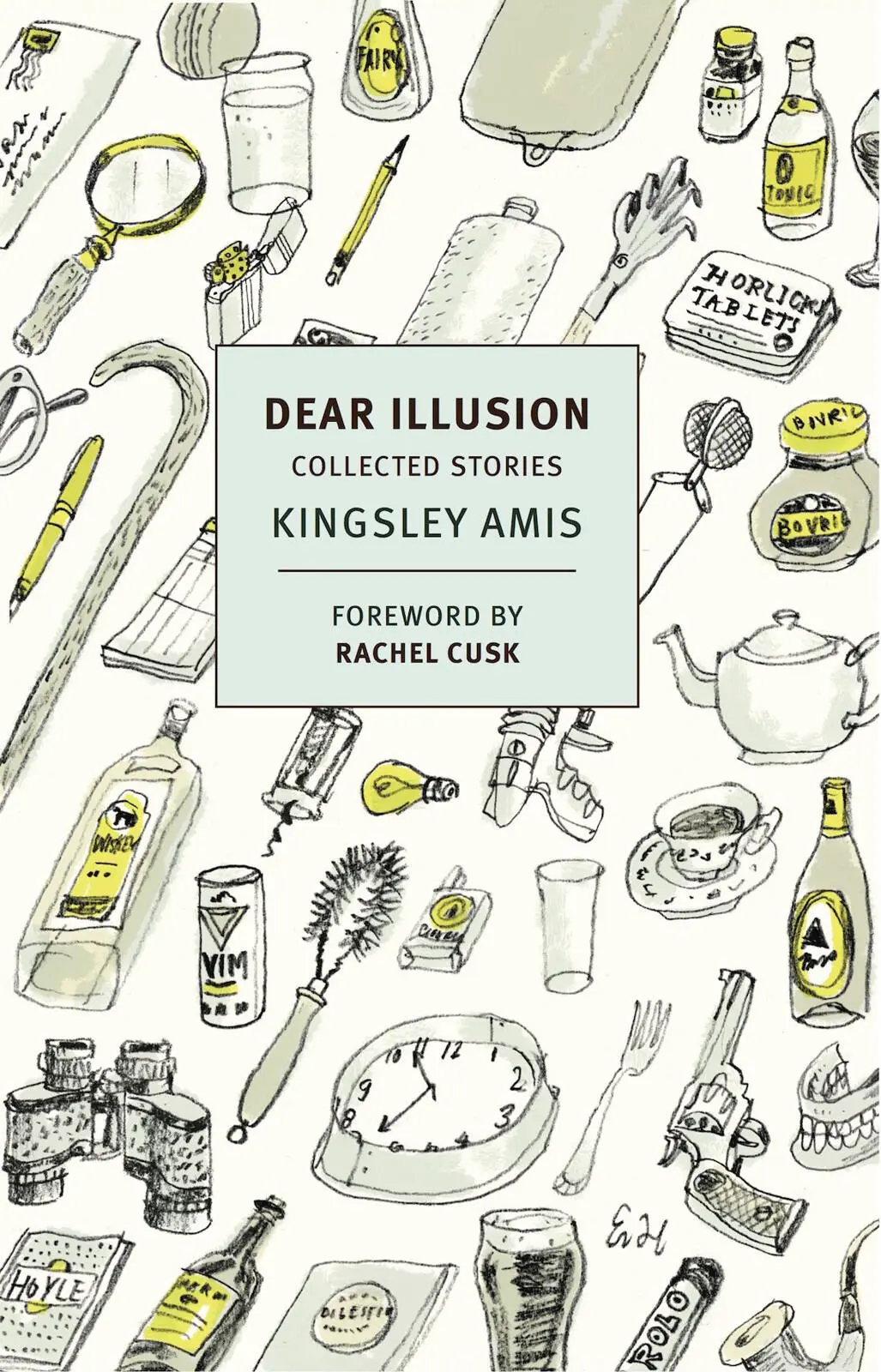
- Название:Dear Illusion: Selected Stories
- Автор:
- Издательство:New York Review of Books
- Жанр:
- Год:2015
- ISBN:нет данных
- Рейтинг книги:4 / 5. Голосов: 1
-
Избранное:Добавить в избранное
- Отзывы:
-
Ваша оценка:
Dear Illusion: Selected Stories: краткое содержание, описание и аннотация
Предлагаем к чтению аннотацию, описание, краткое содержание или предисловие (зависит от того, что написал сам автор книги «Dear Illusion: Selected Stories»). Если вы не нашли необходимую информацию о книге — напишите в комментариях, мы постараемся отыскать её.
Dear Illusion: Selected Stories — читать онлайн бесплатно полную книгу (весь текст) целиком
Ниже представлен текст книги, разбитый по страницам. Система сохранения места последней прочитанной страницы, позволяет с удобством читать онлайн бесплатно книгу «Dear Illusion: Selected Stories», без необходимости каждый раз заново искать на чём Вы остановились. Поставьте закладку, и сможете в любой момент перейти на страницу, на которой закончили чтение.
Интервал:
Закладка:
‘Some — some people probably do find a book of things they’ve written more satisfying than the separate bits typed out or in a magazine. I just find it more frightening.’
‘Frightening?’ Sue was nearly certain that Potter had never publicly talked to this effect before, but the rising excitement she felt (and tried to conceal) was more than journalistic. ‘Why do you say that?’
‘Seven books of my poems have been published, and they all cover, each one covers about five years’ work. Seven fives are thirty-five: I started late. As you know, Mrs Macnamara, but that’s by the way. One book is five years’ work, and five years’ work is roughly between fifty and sixty poems, and that’s all. What I mean by that is that that’s all I do in the five years that I count as doing anything. I worked in the timber yard and then in that factory office, and afterwards for those tinned-fruit people until I’d started making enough money from my poems to retire. As you know. It was work, at the timber yard and the other places: somebody had to do it and I’m not despising it: but I don’t count it. All I count is the books, and unless the books—’
‘We’ll take the break there,’ said Bowes generously, coming down to a stooped position at the mid-point of the triangle formed by Potter, Sue and the heap of properties. ‘Very good, both of you. Now you relax while I go and reload and do a bit of minor surgery on this bit of Jap ironmongery’ — he waved an offending camera — ‘out in the car. Rejoin us in a couple of minutes.’
When he had gone, Sue lit a cigarette and considered, as calmly as possible, how to lead Potter back and round and along and forward again to the point he had reached when interrupted. ‘Could you tell me a little more about how you write? How a poem takes shape, or how you know when it has?’
‘Lots of words and phrases go through a person’s mind all the time without staying there. At least they do through mine. Then, every so often, without the person knowing why, one of the words or phrases, it just sticks there and won’t go away. That’s the beginning. I don’t mean necessarily the beginning of the poem when you see it when you read it, but it can be, quite often it is, but it’s your way into the poem, if that doesn’t sound too silly. I mean it’s the man who’s writing the poem’s way into his poem. Then a lot more words go on going through until another one gets caught, like in a net, and it sticks with the first ones because it belongs with them, you realize, or you realize later that it belongs with them. And so on. Do you fuck?’
‘Yes, but only my husband,’ said Sue with some approximation to the truth.
‘That’s a pity. I mean it’s a pity for me, because I get so few chances these days: I can quite see it’s a jolly good thing for you. And your husband. I’m in the same sort of position myself as a rule, but obviously a good deal less so, if that makes any sense, because I don’t happen to be very attracted to women of sixty-eight. That’s how old my wife is, you see. With her being away, and you being here anyhow, so to speak, I thought it would be silly not to just ask. And then in the end it dawns on you that there’s no more to come, not this time, that’s all there’s going to be of it. The thing’s over and done with and finished. At that point you write it down.’
It was not until now that Sue realized that, for the past quarter of a minute, Potter had been talking about his poetry again. His question had taken her completely by surprise, a gigantic achievement in the face of one so constantly asked if she fucked (in those or other terms) as Sue Macnamara: no preliminary switching-on of casualness, no quick range-estimating glance, no perceptible inner shaping up or squaring of the shoulders, nothing. In the same way, her refusal had evoked not the least hint of pique, mortification, retrospective embarrassment or — what she had noticed as quite common among the over-fifties — ill-dissimulated relief: all this gathered up in his not having bothered to make anything whatever in the way of an as-I-was-saying gesture before he went back to his previous theme, about which something had better be said soon on her own part.
‘I see. You always wait until the poem’s complete in your mind before you put anything on paper.
‘Normally. If I’ve got to go and get on a train or something like that before it’s finished, I write down as much as I’ve done and then think about something else until I can have another go at it. That seems to work.’
‘Sorry about that,’ said Bowes as he approached, expressing sincere regret for having, however unavoidably, let the rest of the company in for a stretch of utter idleness. He went into a prowling circuit of the space where they sat, every few steps snatching his camera up to eye-level, failing to take a photograph and subsiding again: a more intrusive routine, if anything, than the clicking and buzzing it replaced. But at least he was about, and so might deter Potter from asking Sue just how it had come to pass that she only fucked her husband, should it occur to Potter to do so.
‘When the poem’s all there on paper, do you revise it much?’
‘Not at all, ever. I don’t even read it through. I give it straight to my wife to type, or if it’s the middle of the night I leave it face down on my table until I can give it to her.’
‘You were saying you didn’t read it, any given poem, when it’s typed or even when it comes out in a magazine. When do you read it?’
Potter moved the tip of his tongue to and fro between gaps in his teeth. ‘I suppose I must have read all my poems at least once. But it’s not a thing I dwell on, or enjoy at all. The early morning’s the only time. Then I may pick up one of my books and read a few things. To remind myself I’ve done them, more than anything else. I keep a count of how many I’ve done. I’ve just finished number four hundred and twenty-three. I wrote it out just this morning, as a matter of fact.’
‘What do you feel when you read one of your poems?’
‘If I’m lucky, relief that it doesn’t seem any worse than it seems. Often, I wonder what on earth I meant, but I don’t try to remember. Or it just doesn’t register in any way.’
‘No pleasure? Pride in achievement?’
‘Achievement? No, nothing like that.’
Having learnt how easily a revelation of real interest could stem the most torrential flow of confidences or confessions, Sue tried to keep up her bright, nurse-like tone. ‘Another over-simplifying question, I’m afraid, Mr Potter: why do you write poetry?’
‘No, I think it really is a simple question. Or perhaps I just mean the answer I personally would give’s quite simple. I write poetry to be able to go on living at all. Well, not quite at all, but to function as a human being. I’m afraid that doesn’t sound very simple now I’ve said it. I’ll have to risk you putting me down as pompous and sorry for myself. When I was working in that timber yard, my life started being a burden to me. Not just the life in the yard, but the whole of my life. It happened quite suddenly and I’ll never know why. Nothing had gone wrong; I was happily married, in a secure job and earning enough to keep the two of us in reasonable comfort — we’ve never had the luck to have any children, but it wasn’t that either. I stopped being able to enjoy anything or see the point of anything. I felt bad from morning to night every day. Then, after about a month, some words came into my mind and straight away I felt a little better. I forget what they were, but they brought more words with them and they made me feel a little better still. By the time the words stopped coming I felt at peace. I wrote them down on the back of a delivery note — I do remember that — and it was only then I woke up to the fact that what I’d done was write a poem. The moment I’d finished writing the words down I started feeling bad again. Not as bad as just before the words started coming, but still bad. The next day I felt a little worse, and the day after that worse again, and so on for another three or four weeks until another lot of words started turning up. It’s been like that ever since.’
Читать дальшеИнтервал:
Закладка:
Похожие книги на «Dear Illusion: Selected Stories»
Представляем Вашему вниманию похожие книги на «Dear Illusion: Selected Stories» списком для выбора. Мы отобрали схожую по названию и смыслу литературу в надежде предоставить читателям больше вариантов отыскать новые, интересные, ещё непрочитанные произведения.


Обсуждение, отзывы о книге «Dear Illusion: Selected Stories» и просто собственные мнения читателей. Оставьте ваши комментарии, напишите, что Вы думаете о произведении, его смысле или главных героях. Укажите что конкретно понравилось, а что нет, и почему Вы так считаете.