Nicola Gardini - Lost Words
Здесь есть возможность читать онлайн «Nicola Gardini - Lost Words» весь текст электронной книги совершенно бесплатно (целиком полную версию без сокращений). В некоторых случаях можно слушать аудио, скачать через торрент в формате fb2 и присутствует краткое содержание. Год выпуска: 2016, Издательство: New Directions, Жанр: Современная проза, на английском языке. Описание произведения, (предисловие) а так же отзывы посетителей доступны на портале библиотеки ЛибКат.
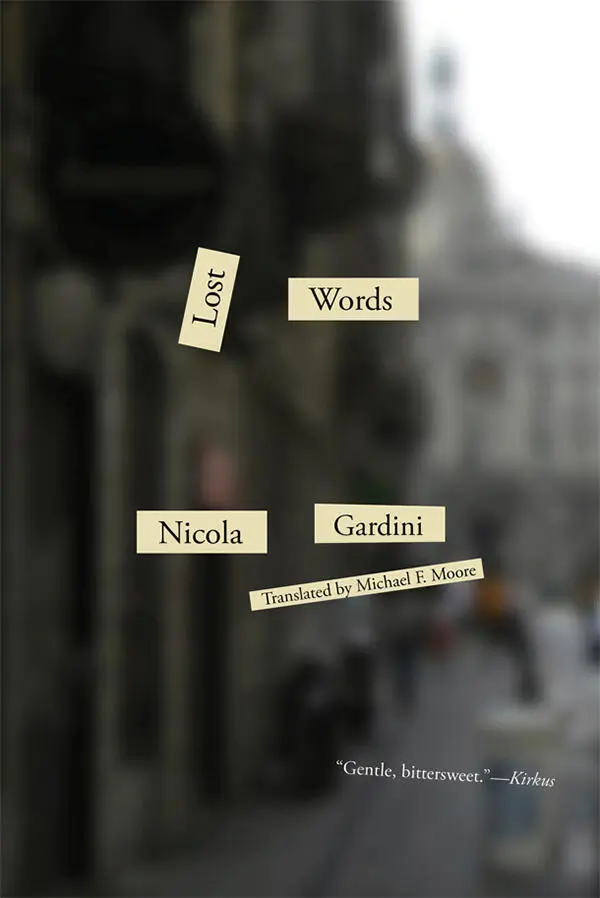
- Название:Lost Words
- Автор:
- Издательство:New Directions
- Жанр:
- Год:2016
- ISBN:нет данных
- Рейтинг книги:5 / 5. Голосов: 1
-
Избранное:Добавить в избранное
- Отзывы:
-
Ваша оценка:
Lost Words: краткое содержание, описание и аннотация
Предлагаем к чтению аннотацию, описание, краткое содержание или предисловие (зависит от того, что написал сам автор книги «Lost Words»). Если вы не нашли необходимую информацию о книге — напишите в комментариях, мы постараемся отыскать её.
Lost Words — читать онлайн бесплатно полную книгу (весь текст) целиком
Ниже представлен текст книги, разбитый по страницам. Система сохранения места последней прочитанной страницы, позволяет с удобством читать онлайн бесплатно книгу «Lost Words», без необходимости каждый раз заново искать на чём Вы остановились. Поставьте закладку, и сможете в любой момент перейти на страницу, на которой закончили чтение.
Интервал:
Закладка:
After a long pause, she related that when she was young, when she lived in India, she had compiled a dictionary of the English language. She revealed this to me almost accidentally, without dramatizing this extraordinary confession, as if it had escaped her. I begged her to tell me more.
“The children of the village needed a study aid…” she started to explain, shrugging her shoulders, “as well as a few ideas …” When she uttered the word “ideas,” she suddenly came alive. “Writing a dictionary even for the ordinary purposes I had assigned myself was an immense enterprise!” she said, jumping to her feet. “A most wonderful enterprise! You have the eyes of the past and the future upon you… I was obviously not the first person to try my hand at one: over the centuries other individuals — not that many, in the end — tried to gather all the words in a book, with only the help of a copyist…” She approached the tall walnut bookshelf and started to flip randomly through her Webster’s. “And, let us not forget, I was a woman, making my enterprise all the more exceptional. A woman who collects and defines words! Unprecedented! Yet a legend tells us that it was a woman who invented the Latin alphabet: Carmenta, the mother of Turnus, Aeneas’ enemy… Sometimes I think the Trojans are like the Jews and the Romans are like the Arabs… The Egyptian god of writing was also a woman. You can’t imagine the kind of people who occupy themselves with gathering the lexical heritage of a nation! You find the strangest characters. Can you believe that one of the most prolific contributors to the Oxford English Dictionary , that monument to British lexicography, the dictionary of all dictionaries, was criminally insane, literally — and what’s more, an American! I won’t tell you his fate… The same fate as Attis, from the poem by Catullus! He was eventually deported to America, where I visited his grave.”
She sat back down and spoke to me about Doctor Johnson, about the hoary-haired James Murray, about a word that was not included in the first edition of the Oxford English Dictionary because a slip of paper — on which the entry had been written — fell behind a pile of books… She told me that she wanted to imitate the style of Doctor Johnson, although her own goals were quite different. In fact, the perpetuation of the English language and its phonetic and semantic stabilization mattered little to her. What mattered to her was the circulation of a few essential ideas , and she knew that once these ideas began to spread, they would make her dictionary perfectly useless, in the same way that a magic formula becomes useless once it has performed the intended transformation.
“And where is it?” I asked her.
“What? My dictionary?… I have no clue… Lost somewhere, I suppose.”
*.
I told her we had read some articles from the “Corriere della sera” at school. Signorina Salma believed that newspapers were even more important than books, because they tell you how life really is.
“Nonsense!” the Maestra thundered. “Journalism is the death of thinking and language, Luca. What do journalists do? They create opinions. Doxa , as the ancient Greeks called it. We shouldn’t listen to them. We don’t need opinions! We need ideas! … We need para -doxa, the opposite of opinions! Are you following me?” Here she paused for an instant, then, smiling, she resumed her explanation as if a revelation was at hand. “I stopped reading newspapers at an early age and, following in the footsteps of my friend Herodotus, I went out into the world to see how it turns and what ideas move it… And I saw what no newspaper could ever report… We need dictionaries, not newspapers…”
She was deep in thought. A shadow passed over her face.
“Dictionaries are everything, Luca,” she resumed, solemnly. “Everything! I’m not exaggerating… What is history if not a collection of words? The words we have been repeating for centuries, or perhaps for only a few years. The important thing is to realize that words do not belong to one person in particular, they belong to everyone. Only the poets, the great writers, have the power to restore the quality of something exclusive to the work — a personal asset. ‘Sempre caro mi fu quest’ermo colle’— So dear to me was this lonely hill. Everyone knows Leopardi’s L’infinito by heart, or at least they should. Let’s take ‘ermo’—was there ever a word that was more typical of him? But Leopardi knew that words weren’t private property. We all borrow them. Even Leopardi. Even Shakespeare, who invented so many of them. Comunque , he took many of his words from the language of the people. The fact that they make their first appearance in the English language in his works does not make them his exclusive property. For example, the word ‘accommodation’ appears for the first time in Othello , but it was already being spoken.” After a short pause, she added, her eyes growing moist, “Dictionaries teach us democracy. They’ve taught you what democracy is at school, haven’t they?”
“Yes…” I answered.
“And what have they taught you?… No one can understand the deeper meaning of the word ‘democracy’ if they don’t love their language. The meaning of democracy grows out of the love of the languages we speak and the languages we learn… ‘To be one of the many’… I wouldn’t know how else to define it… This is what democracy is… Do you understand?”
“Yes…”
“So it means ‘also being one of the others’—‘being another.’ It’s difficult but not impossible. I’ve spent my whole life trying to think of myself as different from what I am, trying to become what I am . Do you understand?”
“Yes…”
I continued to answer yes, although I understood less and less. I mouthed her words to myself, more enthralled by her passion than what she was trying to explain.
“Let me go over this more carefully, I would hate for you to misunderstand. Democracy is the condition that enables us to be ourselves, to experience — without hurting others — all the instincts that are inside us. Men are evil, Luca, this much is certain — may Machiavelli be forever glorified for establishing this truth once and for all — but people can live together in peace, and even pass themselves off as good, if they find that special condition that transforms their instincts into positive energy. Flaubert wrote a beautiful book about the risks of desiring to be someone else, of reshaping yourself according to impossible images of happiness.” She got up to take a volume from the bookshelf. “Madame Bovary would have been a perfect fascist: she wants to be someone else, but not just one of the others. She wants to become someone different from everyone else, different from what she might have become if she had followed her own nature rather that her absurd image of society. Am I making any sense?”
I said yes again, but I could barely find my way through the many contradictory definitions of a single word. Not to mention that I had never read Madame Bovary .
“Let me give you an example.” The Maestra tried to explain. “One day, when I was a little girl, my grandfather took me to visit a wonderful garden in Cornwall. We found an immense aviary for owls. There were owls of every size and color. Although they were in the bright sunlight they didn’t seem to mind: they kept their big yellow or orange eyes wide open, with an air of enigmatic, slightly annoyed wakefulness. Some of them were nesting amid the branches in the far corners of the cage, and you could hardly make them out, those emblems of Olympic indifference. Or wisdom. And — horror of horrors — on the floor of the cage was their meal: piles of dead chicks. But the owls didn’t touch them — they wouldn’t even look at them. They were waiting for the night, I suppose. But the flies were already feasting. And there, standing in front of those poor slaughtered chicks, tossed together in a macabre heap that erased the physical individuality of each one, I tried to picture the scene of the massacre. How did the aviary keepers kill them? With poison? There weren’t any signs of blood or violence. The chicks were simply lifeless, dangling, deflated — hundreds, thousands of chicks if you counted all the cages. I thought: what pleasure can owls get out of gorging on such a mess of carcasses? I imagined legions of soft chirping innocent little chicks scattering to every corner of the cage, running from one part to the other, in search of a non-existent shelter, while the owls swooped down on them. Yes, that’s how I would’ve fed the owls. It’s nature’s way. The owl is a predator: you have to let it live its life. First, don’t lock it in a cage. It’s not right for us to appropriate its place and functions. But man never misses an opportunity to usurp the place of someone, even a neighbor. People have forgotten that everyone has his own life, his own being! Sometimes we ourselves are the first to renounce this and let others speak or decide for us, including our friends. What are friends if not vampires — enemies on a par with parents, husbands, children? Friendly advice !” she snickered. “When I think back to the time in my life when I was drowning in it! And how much it pained me when advice took the form of criticism! But advice is criticism, Luca! No one wants you to be you , Luca. They all expect you to be different. And so we grow up with the idea that the way we’re living is wrong: we don’t even like our own bodies, and yet we come to expect something different from our neighbors — different behaviors, different manners, different words… And maybe it’s right, because in the end we know — yes, however vaguely and uncertainly we soooooooo deeply know — there is no one, no one at all in the world who is completely what he or she is supposed to be… Che tragedia! … But I digress. I only meant to say that we are like owls in a cage, Luca, digestive machines whose nutritional instincts have been removed, and I don’t mean the mere act of feeding ourselves. After that visit I reduced the amount of food I consumed to the bare minimum. That same evening I skipped dinner and the next morning I skipped breakfast. I would have stopped eating entirely if it weren’t for the fact that it would lead to my death. But I wanted to live! Vita : what a wonderful word! So I started to eat the least amount necessary to avoid dying. And that is how I have lived, day after day, one step away from death, seeing it waiting for me on the opposite shore, separated from me by a glass of water, a slender rivulet. I could even give up the tiny amount that I do ingest, why not? All I can say for myself is that I have not lived by virtue of my daily bread… I am a cactus, Luca. A desert plant. Do you know what’s inside a dead cactus?”
Читать дальшеИнтервал:
Закладка:
Похожие книги на «Lost Words»
Представляем Вашему вниманию похожие книги на «Lost Words» списком для выбора. Мы отобрали схожую по названию и смыслу литературу в надежде предоставить читателям больше вариантов отыскать новые, интересные, ещё непрочитанные произведения.
Обсуждение, отзывы о книге «Lost Words» и просто собственные мнения читателей. Оставьте ваши комментарии, напишите, что Вы думаете о произведении, его смысле или главных героях. Укажите что конкретно понравилось, а что нет, и почему Вы так считаете.