Nicola Gardini - Lost Words
Здесь есть возможность читать онлайн «Nicola Gardini - Lost Words» весь текст электронной книги совершенно бесплатно (целиком полную версию без сокращений). В некоторых случаях можно слушать аудио, скачать через торрент в формате fb2 и присутствует краткое содержание. Год выпуска: 2016, Издательство: New Directions, Жанр: Современная проза, на английском языке. Описание произведения, (предисловие) а так же отзывы посетителей доступны на портале библиотеки ЛибКат.
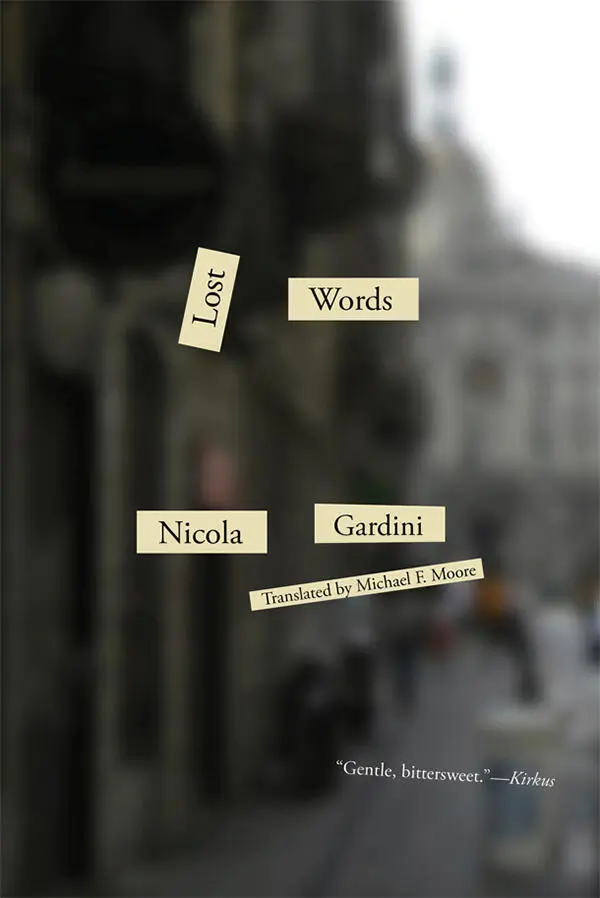
- Название:Lost Words
- Автор:
- Издательство:New Directions
- Жанр:
- Год:2016
- ISBN:нет данных
- Рейтинг книги:5 / 5. Голосов: 1
-
Избранное:Добавить в избранное
- Отзывы:
-
Ваша оценка:
Lost Words: краткое содержание, описание и аннотация
Предлагаем к чтению аннотацию, описание, краткое содержание или предисловие (зависит от того, что написал сам автор книги «Lost Words»). Если вы не нашли необходимую информацию о книге — напишите в комментариях, мы постараемся отыскать её.
Lost Words — читать онлайн бесплатно полную книгу (весь текст) целиком
Ниже представлен текст книги, разбитый по страницам. Система сохранения места последней прочитанной страницы, позволяет с удобством читать онлайн бесплатно книгу «Lost Words», без необходимости каждый раз заново искать на чём Вы остановились. Поставьте закладку, и сможете в любой момент перейти на страницу, на которой закончили чтение.
Интервал:
Закладка:
That same afternoon, at the last minute, Mantegazza called on the intercom and said she’d rather stay home, with Bella. She didn’t feel too well, blame it on digestion.
The message couldn’t be clearer: from now on she would be drinking her afternoon coffee with someone else.
II
Come in, Signor Petillo. If there’s anyone you can trust, it’s me. Admit that you’re going back down south to find a nice girl from your hometown,” my mother teased him. “You men are always going on about us women, but in the end you can’t live without us! Right? Well, better late than never… I can see that a few white hairs have already sprouted on your temples. Of course, older men never lose their appeal… It’s we women who age too quickly…”
By way of saying goodbye, he shook his head and handed her an envelope: “For all that you’ve done for me.”
Two days later, Amelia Lynd finally arrived at Via Icaro 15.
For once the building manager wasn’t exaggerating. Miss Lynd was no old hen, as my mother had feared. Not in the least. She was a noble, multicolored bird with wings to fly.
What made her distinct wasn’t the clear signs of her superior breeding — apart from the two huge diamonds she wore on her left hand, as if to symbolize the excellence of her person, but without affect, without flaunting it — no, there was something superior about her, a light radiating from her skin. Her body was incredibly thin, her clothing a necessary if somewhat studied piece of fabric enveloping an almost immaterial physique. Without her diamonds, she was the embodiment of sobriety. No make-up, no embellishments. Her fine gray hair was combed back tightly against her scalp, revealing her high cheekbones and two small unadorned ears. The shape of her head reminded me of the bust of Nefertiti I had seen in my history book. How old was she? It was hard to say… sixty-five, seventy… maybe eighty? Her forehead was smooth and unwrinkled but she had the transparent, fragile skin of the elderly, and the back of her hands were flecked with dark marks of various sizes. Her features were delicate, aristocratic, refined by age.
The moment my father saw her, he nicknamed her “la Maestra”—the schoolmistress.
My mother, not only to honor her promise to the manager, but out of an instinctive sympathy, gave her a warm welcome and invited her to dinner with us. Miss Lynd thanked her with a broad smile, but it meant she was declining the offer. She smiled easily, laughed easily, and her eyes sparkled, affected by a slight strabismus. Yet she accepted, reluctantly, only a cup of consommé that I brought up to her. She ate with extreme moderation, she told me. In practice she lived on water alone, which took the form of tea or consommé. Sometimes, “out of gluttony,” she allowed herself a glass of milk or shaddock — as she had been accustomed to calling grapefruit since childhood — or a piece of fruit. She spoke with a strange accent that was hard to identify. Her Italian was perfect but it did not sound like her native tongue.
My mother even offered to clean her two-room apartment a couple times a week and to take care of acquiring the few things on which the Maestra sustained herself. Only after a laborious negotiation did she accept the proposal, and they agreed on a fee, which mother would have gladly foregone. For her it was a privilege to help a woman like that, especially after having debased herself by serving someone like old Mantegazza.
The appearance of the Maestra sent the signore into a tizzy. All of their fantasies were overwrought at the sight of such a pure and elegant reality. Look at her posture! A real duchess! Did you see those diamonds? And hear her manner of speaking — so distinguished! You could tell she was educated. Yes, but not every aspect was in keeping with the stature of such a personage. She dressed too simply, for example. “Obviously,” Signora Dell’Uomo intoned, “she’s a foreigner. Foreign women don’t care as much about fashion as we Italians. In that field, let’s face it, we’re unbeatable. Mind you, her skimpy little sweaters aren’t made out of wool: they’re pure cashmere!”
More than one of the signore tried to invite her over for coffee or sought to ingratiate themselves through small acts of kindness, hoping to learn a little bit about her life and get a peek inside her apartment. But she proved immune to their flattery, not to suggest that she was ever discourteous. To keep them at arm’s length, all she had to say, in English, was “No, thank you.” Not even the seamstress succeeded in gaining entry, though she was convinced she had won her over with an offering of her famous bread pudding. Miss Lynd uttered her kind refusal through an opening in the door. To the no, thank you ’s by which she became known, the Maestra enjoyed adding a bizarre allusion, a literary quotation, in English or Latin. So in a very short time, one week at the most, she had been demoted from the rank of duchess to that of oddball, and indeed a genuine crackpot, who had something bizarre to say every time she opened her mouth.
“For me she’s the type that likes to have a sip…” Terzoli speculated.
*.
At my mother’s demand I offered to help Miss Lynd unpack the last of her boxes. For once, she accepted without protest.
“ Thank you, my boy ,” she said, “ thank you, indeed! Otherwise, chi sa , who knows, how long they would have sat here unopened!”
Novels, poetry collections, dictionaries in different languages, colored-glass vases, ancient statuettes, and black-and-white photographs passed through my hands… How could I not compare that refined private museum — which condensed a lifetime of travels and encounters — to the knick-knacks that occupied the shelf of my foldaway bed, the horrendous souvenirs that the signore brought back to us from their annual vacations? The Tirolese baby-doll, the old man with the pipe, the gondola music box, the little chest covered with seashells, the Sicilian wagon, the Sardinian nuraghe, the plastic Alpine star: an Italian menagerie that shook every time I got into bed.
The Maestra described to me the provenance of a small Lalique vase, the life of Flaubert or Cicero, the travels of Herodotus, Bouvard et Pécuchet, Middlemarch, Anna Karenina … How the hours flew by! Never before had I spent such beautiful, wondrous afternoons…
Of the various photographs in her possession, I was most taken by the portrait of a very serious bearded man. I asked if he was her husband. “Oh, no,” she laughed, “that’s Sigmund Freud!” She explained that Dr. Freud was the father of psychoanalysis, and that he had been her neighbor in London many years earlier. They used to have tea together and converse about any number of subjects, although he was gravely ill and had to struggle to form words.
“He disliked his own face. That’s why you never saw him smile. But he had such an interesting face, don’t you agree?”
Before going back downstairs, I was rewarded with a nice bowl of custard. She didn’t even try a spoonful. It was an exquisite custard, saffron yellow, into which she’d crumbled a cinnamon stick with her bony fingers. I adored it. I adored her . Her every gesture, even the way she beat the milk and eggs and stirred the wooden spoon in the dented old pan, had something incomparable that transcended the act itself and elevated her above anyone I’d ever known. There was no one like her on any of the maps where I had lived my life till that day.
By the end of the week the Maestra’s one-bedroom apartment was ready, but that didn’t end my visits upstairs to see her. She wanted to have me there regularly for afternoon tea, she said. When I arrived, the kettle would already be on the stove, the smell of cookies filling the air. Sometimes I might even find the delicious custard again, steaming in the blue and white bowl from India.
Читать дальшеИнтервал:
Закладка:
Похожие книги на «Lost Words»
Представляем Вашему вниманию похожие книги на «Lost Words» списком для выбора. Мы отобрали схожую по названию и смыслу литературу в надежде предоставить читателям больше вариантов отыскать новые, интересные, ещё непрочитанные произведения.



Обсуждение, отзывы о книге «Lost Words» и просто собственные мнения читателей. Оставьте ваши комментарии, напишите, что Вы думаете о произведении, его смысле или главных героях. Укажите что конкретно понравилось, а что нет, и почему Вы так считаете.