Nicola Gardini - Lost Words
Здесь есть возможность читать онлайн «Nicola Gardini - Lost Words» весь текст электронной книги совершенно бесплатно (целиком полную версию без сокращений). В некоторых случаях можно слушать аудио, скачать через торрент в формате fb2 и присутствует краткое содержание. Год выпуска: 2016, Издательство: New Directions, Жанр: Современная проза, на английском языке. Описание произведения, (предисловие) а так же отзывы посетителей доступны на портале библиотеки ЛибКат.
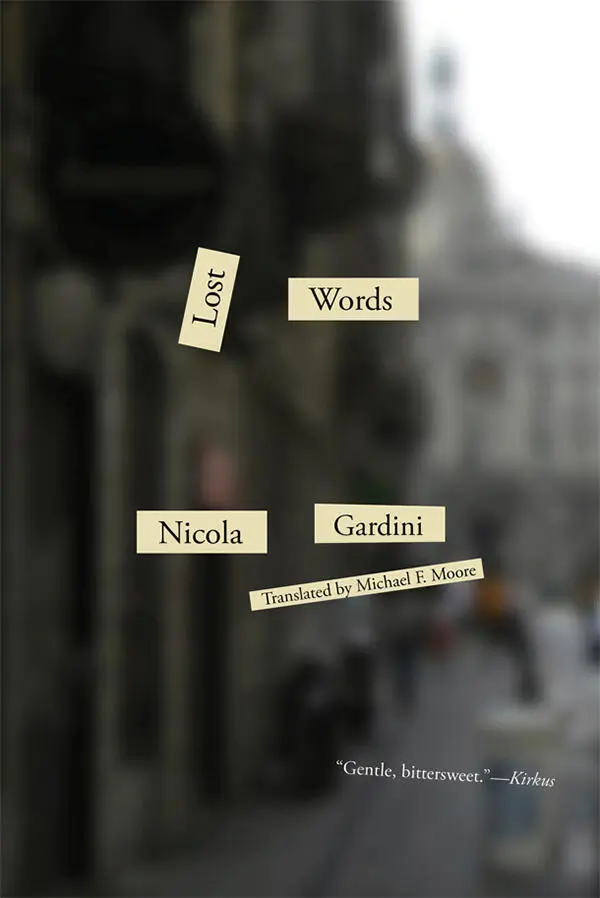
- Название:Lost Words
- Автор:
- Издательство:New Directions
- Жанр:
- Год:2016
- ISBN:нет данных
- Рейтинг книги:5 / 5. Голосов: 1
-
Избранное:Добавить в избранное
- Отзывы:
-
Ваша оценка:
Lost Words: краткое содержание, описание и аннотация
Предлагаем к чтению аннотацию, описание, краткое содержание или предисловие (зависит от того, что написал сам автор книги «Lost Words»). Если вы не нашли необходимую информацию о книге — напишите в комментариях, мы постараемся отыскать её.
Lost Words — читать онлайн бесплатно полную книгу (весь текст) целиком
Ниже представлен текст книги, разбитый по страницам. Система сохранения места последней прочитанной страницы, позволяет с удобством читать онлайн бесплатно книгу «Lost Words», без необходимости каждый раз заново искать на чём Вы остановились. Поставьте закладку, и сможете в любой момент перейти на страницу, на которой закончили чтение.
Интервал:
Закладка:
The seamstress welcomed me with open arms, making a big fuss over me. She was alone. Her daughter Rosi had gone to the zoo with her father, as she did every Sunday.
“Come in, come in, Chino, you handsome boy,” she cooed, “I’ve made you some nice zeppoles.”
Following the trail of fried food, we went into the kitchen, where, on the table, as sticky and greasy as a skillet, a tray of piping hot zeppoles was waiting for me.
“Eat, eat! Not even your mother makes zeppoles this good. Have you seen the nice hole in the middle? They’re all for you. Eat, you handsome boy!”
I obeyed, knowing it was some kind of trap. I didn’t have the “Our Lady’s braids” on my head, in any case. What in the world did she have up her sleeve?… Death by poisoning?
The zeppoles were exquisite: aromatic, soft, dripping with oil that trickled onto my chin and fingers. For a napkin the seamstress handed me one of the many fabric remnants lying all over the kitchen floor. Everywhere you looked there were traces of her work, mixed in with household items: threads, scraps, pieces of tracing paper… The rest of her apartment was a junkyard. The sink overflowed with trash. The floor was speckled with rotting vegetables.
The seamstress observed me with satisfaction and encouraged me to eat to my heart’s content. She was sitting in her chair, near the window, next to a dress dummy whose torso was pierced with pins. Like us, in the winter she used as much natural light as possible.
“Handsome boy, do tell me,” she asked with a feigned nonchalance, while measuring a length of thread. “Does old Mantegazza visit you every day?”
Almost against my will, I answered yes. A part of me wanted to punish the seamstress. Another part wanted to compensate her for the zeppoles. I hated her maliciousness, but in that moment I was grateful to her for having prepared me one of the best snacks I had ever eaten.
“And she stays for a few hours, right?…”
“Yes.”
“Does the old woman like coffee? Does your mother make it for her?”
“Yes.”
“Does she have a cookie?”
“No… all she has is coffee…”
“And what does she talk about?…”
“She talks about when she was young… She was in love with Mussolini…”
“She doesn’t talk about her daughter?”
“No.”
“What else does she talk about? Come on, you can tell me…”
Sick of this line of questioning, I told her we couldn’t stand old Mantegazza, that we would be happy to get rid of her, but unfortunately she kept coming downstairs. The seamstress’s face lit up. She said if my Mom wanted to get rid of the old woman so much, she could. If she didn’t, it meant that she was getting something out of it… Yes, of course, I admitted after a brief reflection, while the seamstress held her breath, as alert as a cat watching a sparrow. “Yes, Mom is getting something out of it,” I admitted, “but we have also lost our freedom…” I wanted to see how far the seamstress’s curiosity would take her. She let out an exclamation as if to say, “So I wasn’t wrong after all!” And how much did she get for it? How much did my mother pocket?… Chewing the last zeppole, I said Mantegazza had promised to leave all her worldly possessions to my mother.
“Everything!” she shrieked. “What does the old woman own? I can’t believe it! The estate should go to the daughter … ”
“Millions and millions,” I embellished, more and more amazed at the power of my words. “And a house on the Riviera. The daughter agrees…”
“A house on the Riviera … ” she repeated.
She was flabbergasted by the news. She remained speechless, frozen in her chair, with the needle suspended in the air.
“But my mother isn’t asking for anything,” I added. “She doesn’t want anything from anyone. The only thing she wants is a little freedom…”
The conversation was coming to an end. I wiped my mouth and went back home triumphantly, certain that I had finally put her in her place.
My mother was crocheting, very slowly, since her wrists were still bothering her. I sat near her and told her the seamstress had asked me a lot of questions. She frowned. What kind of questions? What did she want to know? “She should be trying to keep her house clean rather than worrying about hiding money under the mattress!”
I told her that the seamstress wanted to know whether Mantegazza had given us any money. “I said that we’ve gotten something, but in exchange we’ve lost our freedom…” I tried to embellish my account as much as possible, using words like “victim,” “slavery,” and “prison,” so my mother would be overwhelmed with gratitude.
As soon as I finished my tidy little report, her whole expression changed. Her eyes narrowed into slits and her mouth hung open without uttering a sound. For a second I didn’t know how to interpret her transformation, but it soon became clear — a scream erupted from her mouth and her fists rose in the air. Her work fell from her hands, the yarn was pulled, and the crocheting began to unravel, row by row, devoured by an invisible set of teeth. I had never seen her so enraged. She jumped to her feet and tripped over the blanket. Terrified I would have to pick up the mess, I ran to lock myself in the bathroom. She kept on screaming: Why did I have to go sticking my nose into things? By now the seamstress had told half the world the doorwoman was making money off the flesh of that old woman! And they already had it in for doorwomen ! The last thing she needed was for them to start accusing her of being a mercenary!..
I thought I had gotten the better of the seamstress, and instead she had gotten the better of me. All for a plate of zeppoles!
I was filled with loathing, an abyss opened beneath my feet. Amid my tears I wished death on the seamstress, on all the tenants… I wanted to die, too. My mother was right, this was no life. I bent over the toilet and stuck two fingers down my throat. At least I wouldn’t owe anything to the seamstress.
*.
The seamstress appeared in the morning, as usual, a few minutes before eight, holding her daughter by the hand. Sensing the approaching danger, she quickened her step. My mother blocked her path.
“Signora Bortolon,” she said, her voice emphasizing the “Signora.” “Can I have a word with you?… What in the world were you thinking? If you want to know my business, why don’t you ask me directly?”
The seamstress batted her eyes.
“I don’t know what you’re talking about… What’d I do?”
“You know very well… Let’s not beat around the bush… He ”—she pointed to me—“is a witness. You gave him the third degree, that’s what you did!.. But if you must know, I don’t get one cent from Signora Armanda, so you can wipe that thought from your head.”
The seamstress dropped her act.
“That’s not what the boy told me.”
My mother was not about to be bullied.
“He lied to you,” she lied. “I don’t get money from anyone. My son was just playing games with you! How could you think I would take money from that poor old woman! My family gets by with the money we make — through our own hard work! Understood?”
Bortolon gave her a long, nasty, and skeptical look, as if to say, Do you really expect me to believe you?
“And besides, the loge isn’t supposed to be a café.”
“No. In fact, it’s my home. And I only let in the people I want.”
“Not during working hours.”
“Signora Bortolon, I think it’s fair to say I have never neglected my duties. Am I wrong? You tell me, when have I done a bad job?”
And with that she began a long litany of services, renunciations, and sacrifices that I’d heard a thousand times before.
Читать дальшеИнтервал:
Закладка:
Похожие книги на «Lost Words»
Представляем Вашему вниманию похожие книги на «Lost Words» списком для выбора. Мы отобрали схожую по названию и смыслу литературу в надежде предоставить читателям больше вариантов отыскать новые, интересные, ещё непрочитанные произведения.



Обсуждение, отзывы о книге «Lost Words» и просто собственные мнения читателей. Оставьте ваши комментарии, напишите, что Вы думаете о произведении, его смысле или главных героях. Укажите что конкретно понравилось, а что нет, и почему Вы так считаете.