Nicola Gardini - Lost Words
Здесь есть возможность читать онлайн «Nicola Gardini - Lost Words» весь текст электронной книги совершенно бесплатно (целиком полную версию без сокращений). В некоторых случаях можно слушать аудио, скачать через торрент в формате fb2 и присутствует краткое содержание. Год выпуска: 2016, Издательство: New Directions, Жанр: Современная проза, на английском языке. Описание произведения, (предисловие) а так же отзывы посетителей доступны на портале библиотеки ЛибКат.
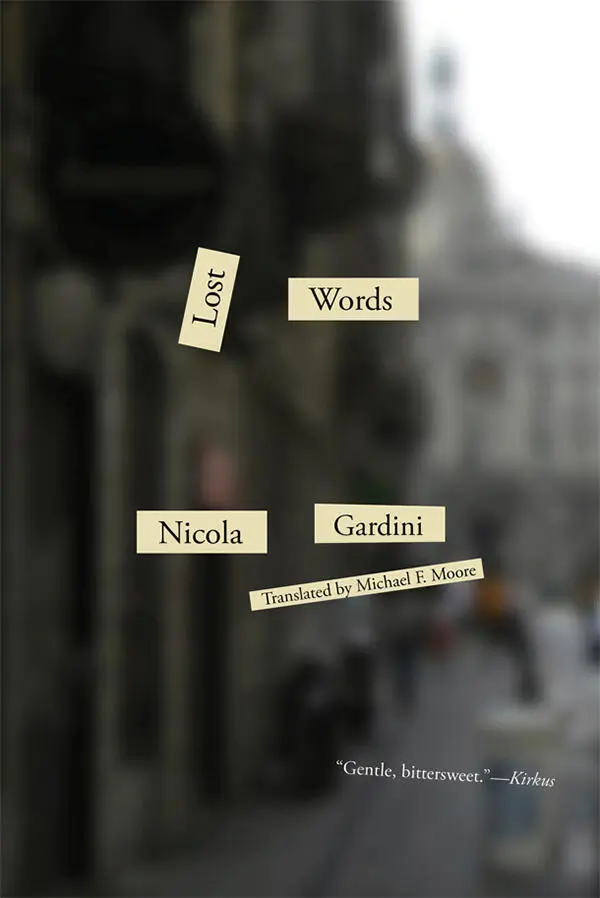
- Название:Lost Words
- Автор:
- Издательство:New Directions
- Жанр:
- Год:2016
- ISBN:нет данных
- Рейтинг книги:5 / 5. Голосов: 1
-
Избранное:Добавить в избранное
- Отзывы:
-
Ваша оценка:
Lost Words: краткое содержание, описание и аннотация
Предлагаем к чтению аннотацию, описание, краткое содержание или предисловие (зависит от того, что написал сам автор книги «Lost Words»). Если вы не нашли необходимую информацию о книге — напишите в комментариях, мы постараемся отыскать её.
Lost Words — читать онлайн бесплатно полную книгу (весь текст) целиком
Ниже представлен текст книги, разбитый по страницам. Система сохранения места последней прочитанной страницы, позволяет с удобством читать онлайн бесплатно книгу «Lost Words», без необходимости каждый раз заново искать на чём Вы остановились. Поставьте закладку, и сможете в любой момент перейти на страницу, на которой закончили чтение.
Интервал:
Закладка:
At home I talked about her all the time, like someone in love: the Maestra knew everything, had read everything, had original opinions about everything… “ Lies! ” is how she would rail against the false truths spread by “clerics,” the generic term she used to indicate politicians, teachers, and priests. “All lies! ”
She had her own ideas about the books Signorina Salma assigned us to read. The Last Letters of Jacopo Ortis was a patriotic manifesto, according to my teacher — but it was just the opposite for the Maestra. She saw it as an attack on false faiths, and thus one of the few Italian novels really worth the trouble of reading. Manzoni made her sick to her stomach. His Adelchi ? Nonsense! The Betrothed ? Bad, if not worse. But the sanctimonious prig was right about one thing: a dictionary was needed to create the Italians. Luckily he was not the one to write it. Otherwise can you imagine the definitions that might have come from the pen of a man who would dare to interpret the plague as a form of divine providence? The nineteenth-century Minister of Education who made The Betrothed required reading was a disgrace. The only part of the novel she would save was Renzo’s vineyard (“a slip of the pen by an addled mind”), because it expressed a negative vision of human history and demonstrated a rare lexical competence.
When she learned that Silvio Pellico’s My Prisons was on the reading list for my exams, she flew into a rage. “What a revolting book!.. It doesn’t even mention imprisonment!.. All I can see in it is an account of daily sacrifices that concludes with a hymn to providence. Every page wallows in Catholicism! Unbelievable! Pellico had a grudge against Voltaire, the man who would have erased torturers from the face of the earth. And the style! Let’s not even talk about the style! All those exclamation points! All those prayers!.. the writing of Luigi Settembrini is far superior!”
I didn’t have the courage to tell her that, under the influence of Signorina Salma, I actually loved Pellico’s book. But she and I loved it for different reasons: she for its patriotism, I because I identified with the author’s suffering, which was so similar to my mother’s. I loved the pages where Pellico wrote about how in his isolation he fraternized with the ants that appeared on his windowsill: like him, I had once fed sugar to ants on the windowsill of the loge.
Of all the books I had to read for my middle-school exams, the only one the Maestra liked was Verga’s The House by the Medlar Tree . But that, too, she read in her own way. She couldn’t have cared less about the family’s misfortunes, over which Signorina Salma shed tears of compassion. No, Miss Lynd was looking for something else, the drama of language. “Poor Verga!” she would exclaim, as if she were grieving for an unfortunate friend. “I’ve never seen a writer who placed so much trust in his technique and so little in his words. A tragedy , don’t you think?” Among the Italians, her favorite authors were the ones who plundered the dictionary, like Pascoli, Gadda, or Landolfi. She also liked Leopardi immensely, for his powerful brilliant criticism. Thanks to the Maestra I discovered his Zibaldone and its pages on the garden of diseased plants. Out of love for her I learned these passages by heart. Among the non-Italians her favorites were Flaubert and a few English writers — she often spoke of Hazlitt, Stevenson, and Henry James. The masterpiece of English prose, for her, was Doctor Johnson’s introduction to his Dictionary . Among the ancients, to whom she owed her education, her favorites were the orators and the historians. She read and reread Herodotus and Thucydides.
When I told her that in history class I was studying Italian unification she burst into laughter. “But my dear, there is no such thing!.. Let me explain, Chino. Now listen carefully.” She took a deep breath, searching for the right words. “The Italians never did unite! Ci hanno provato —They tried but failed! And the signs of their failure are everywhere. Can’t you see them? The only people who talk about unification are priests and fascists. If there really were an Italy, would the Italians be so divisive, so egotistical, so deplorably vain? Dov’è il popolo —Where is il popolo ? The Italians have no idea what they’re doing! They have no idea where they’re going!”
All she saw was a mass of individuals struggling and barely managing to speak the same language. She saw a population , not a popolo. Please, please, please! — let’s not confuse the country with the state. There never was a state. It’s nothing but fumo— smoke and mirrors! Back then some imbeciles went around waging war on the state, planting bombs, but they didn’t realize they were attacking a phantom. Instead there was a country. The country had a geographic grandeur. With bombs you could only hope to destroy the soil of Italy. She thought it was appropriate that Italy, the land of the downtrodden, was shaped like a boot. The so-called Italians were the inhabitants of this spectacular boot, just like lice or other parasites that nest in discarded shoes in the attic. What I needed to understand — she stressed — was that Italy, unlike France or England, did not recognize a true connection between the political constitution and the people. The 1948 Constitution, in literary terms, was excellent. But the people? Awful! Why? Because the Constitution was a gift to them from a minority of thinkers who had fought against the war and against fascism. The Italians themselves didn’t really earn it. The Italian Constitution was an ideal, something to hope for, but not something real. And this awful population would never live up to this ideal. They would only get worse. What kind of future could you expect when the fascist party still managed to be the fourth largest political party in 1972? What will the boot look like in twenty, thirty, forty years? Ah, she wouldn’t be around to see. But I would. And what would I see? A mass of idiots, materialists, and mangioni —parasites! A freak show. Corruption would be rampant, fascism would come to dominate hearts and minds once again. People would forget how to think. Well, not everyone, and the few who were still capable of thinking would be forced to leave the country, or assimilate, if they wanted to get anywhere. Those who stayed would become cynical social-climbers, betraying their own intelligence. So let the school keep spinning its lies. One day I would get it.
And although I didn’t understand everything she said, with all those English words scattered here and there, hearing the foreign sounds gave me an immense pleasure, even more than the already great pleasure of discovering such a different way of reasoning and understanding things. English made me feel refreshed, or rather uplifted, into the true dimension in which the Maestra had made me believe my life was destined to unfold.
I threw myself headlong into studying the vocabulary and rhetoric of Shakespeare’s language, which was taught very badly at school, if at all. Every day I tried to memorize dozens and dozens of expressions, often repeating them to myself over and over, even in bed, reciting them with my prayers before falling asleep. After a while I started using them around the house, to answer my mother — who would look at me with perplexity and irritation — or to translate her responses into English. I began to punctuate my speech with expressions like “of course,” “well,” and “indeed.”
At my request, tea with the Maestra became a language class: not without occasional digressions. She strove to correct not only my grammar and pronunciation but also my way of seeing the world. She would sit in the low armchair while I was at the table, in front of my India bowl filled with yellow custard. “Let’s begin,” she would say. And we would begin.
Читать дальшеИнтервал:
Закладка:
Похожие книги на «Lost Words»
Представляем Вашему вниманию похожие книги на «Lost Words» списком для выбора. Мы отобрали схожую по названию и смыслу литературу в надежде предоставить читателям больше вариантов отыскать новые, интересные, ещё непрочитанные произведения.
Обсуждение, отзывы о книге «Lost Words» и просто собственные мнения читателей. Оставьте ваши комментарии, напишите, что Вы думаете о произведении, его смысле или главных героях. Укажите что конкретно понравилось, а что нет, и почему Вы так считаете.