Nicola Gardini - Lost Words
Здесь есть возможность читать онлайн «Nicola Gardini - Lost Words» весь текст электронной книги совершенно бесплатно (целиком полную версию без сокращений). В некоторых случаях можно слушать аудио, скачать через торрент в формате fb2 и присутствует краткое содержание. Год выпуска: 2016, Издательство: New Directions, Жанр: Современная проза, на английском языке. Описание произведения, (предисловие) а так же отзывы посетителей доступны на портале библиотеки ЛибКат.
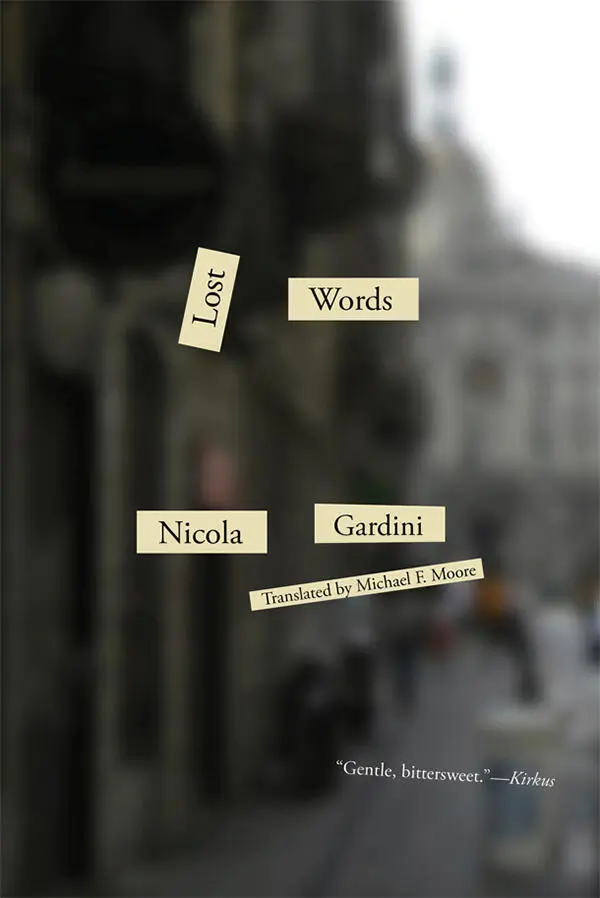
- Название:Lost Words
- Автор:
- Издательство:New Directions
- Жанр:
- Год:2016
- ISBN:нет данных
- Рейтинг книги:5 / 5. Голосов: 1
-
Избранное:Добавить в избранное
- Отзывы:
-
Ваша оценка:
Lost Words: краткое содержание, описание и аннотация
Предлагаем к чтению аннотацию, описание, краткое содержание или предисловие (зависит от того, что написал сам автор книги «Lost Words»). Если вы не нашли необходимую информацию о книге — напишите в комментариях, мы постараемся отыскать её.
Lost Words — читать онлайн бесплатно полную книгу (весь текст) целиком
Ниже представлен текст книги, разбитый по страницам. Система сохранения места последней прочитанной страницы, позволяет с удобством читать онлайн бесплатно книгу «Lost Words», без необходимости каждый раз заново искать на чём Вы остановились. Поставьте закладку, и сможете в любой момент перейти на страницу, на которой закончили чтение.
Интервал:
Закладка:
She suddenly turned pale. She realized she had said too much.
She opened the book, in which she had kept her finger the whole time, read a few lines in silence, and out of her mouth came the words: “ Ridicula sum .”
*.
The last envelopes came in, along with a few more Christmas cakes. The package from the landlord, Signor Spinelli, arrived right on time, and true to a long tradition, it contained a bottle of Prosecco, a pandoro, and a card that read, “Merry Christmas and a Happy New Year to you and your family.”
While my mother counted her haul, my father and I started decorating the Christmas tree in the lobby. Until last year trimming the tree had been one of my favorite things, but now it had lost its appeal and actually irritated me. In a single move I managed to shatter three ornaments. My father yelled at me to go away — I was only making a mess. Mother, too busy with her calculations to reprimand me, said to look through the top drawer and replace the three ornaments I had broken with some old woolen pom-poms. As the finishing touch, we hung two strings of flickering Christmas lights over the doorframe and around the window.
At two o’clock sharp we closed up.
My father went out for a walk. My mother started to make the pasta, folding the eggs into flour.
“When I was a little girl, Christmas was a real holiday!” she started reminiscing. “A holiday for the stomach! All we ever got every other day was a boring meal — a plate of spaghetti or vegetables — that was supposed to keep us going until we went to bed at night. But on Christmas we would stuff ourselves. On Christmas Eve we would eat zeppoles, eel, and roasted cod with cooked greens. On Christmas Day we would have tagliolini or raviolini in brodo, and lamb or pork roast. We never touched cow — like Indians — cows were needed for milk. There was a mountain of sweets: torrone, dried figs, chocolate cookies, almond cookies, chickpea cookies… For a few days our misery would vanish. Never again have I seen such abundance, not even in Milan, when I started working for the Oreficis. The only thing those cheapskates fed me was bread and water! When I think about it… Well, Chino, your mother was always unlucky. As a child and a teenager I was stuck with my father, that old drunk, and in Milan I learned how mean the rich can be. At least my father was illiterate, poor devil. But the Oreficis? Did I ever tell you about the time…”
Of course she had, not once but three, four, ten times, and not just on Christmas.
Encouraged by my silence, she started. “He was a doctor and she was a teacher. At least they taught me how to speak properly…” (in the meantime she kept feeding the dough into the pasta machine). “The lady of the house had decided that she wanted her husband to go to bed with me… they wanted a child, but she was well along in her years. Every night he tried to get into my room, but I locked the door. At one point I saw the door handle rotating downward. And then he would call out to me, pleading. It was awful. He would go on for half an hour — as if I was the master and he was the servant! But I never gave in. The next day he would act as if nothing had happened and ignore me completely… Can you believe it? He destroyed me with indifference, while she treated me like a slave, constantly humiliating me… and she gave me nothing to eat.”
She took the pastry wheel and started to cut the ribbons of pasta dough into squares.
“Did you hear that!”
Suddenly we could hear a loud rumbling of voices.
We went up to the second floor. A cluster of people were gathered in front of the Malfitanos’ door.
“What happened?” my mother asked.
“Signora Malfitano was attacked by the parrot and is fighting with her husband,” Signorina Terzoli reported.
The parrot wouldn’t stop screeching, “You were asking for it! You were asking for it!”
“On Christmas Eve of all days!” exclaimed Signora Rovigo. “They don’t even have respect for the holidays!”
Vezzali took Malfitano’s defense. Ever since that damn bird arrived, the poor woman hasn’t had a moment’s peace — it was hardly the first time she’d been attacked by the parrot.
My mother was worried about the marble floors. All of those people were destroying her hard work. “Wouldn’t you know it, I’ll have to go over the whole thing again with the buffer — on Christmas Eve of all days!”
I looked up but she wasn’t there. Not even all this screeching had induced her to come out. No, the Maestra remained in her retreat, alone in her apartment, high above, sovereign. As Olympian as the owls in her story.
*.
The snow had already blanketed the stairs and the pine grove. It fell at a regular pace, thick and dry.
My father had on a blazer and tie, my mother a dark dress that Signora Dell’Uomo had given her a few years ago, with a smattering of sequins around the hem and the neckline. “How does it look on me?” she asked. It was the first time she was wearing it.
“You look like a real signora,” my father teased her.
We picked up the baking dishes full of food and headed to the building next door. My mother struggled to walk in the snow. She held onto me, afraid she might fall, and shivered from the cold because her dress was too light and her overcoat wasn’t long enough. “What the hell is going on back there?” my father exclaimed while we were going through the gate.
“I’ll wait for you at Gemma’s,” she said, without turning around.
At the other side of the garden, some of the tenants had assembled around the fountain to pray. Each of them held a lit candle in their left hand, while their right was cupped around the flame to keep it from being snuffed out by the snowflakes. Pale, motionless, with their faces illuminated from below, they looked like a gathering of the dead. The seamstress was there, too. Signora Dell’Uomo’s husband officiated. On behalf of the whole apartment complex he invoked the name of Christ the Savior, beseeching him to protect those present and their loved ones, granting health and prosperity to everyone, and easing the difficult road that lay ahead. “Blessed be the day that Christ the Savior was born!” he intoned. And the others behind him repeated, “Blessed be the day that Christ the Savior was born!”
“Clowns!” my father jeered. “I’ve got a better idea, Chino, let’s go eat.”
In addition to us, Gemma had also invited Carmen and her husband. Her boss had granted her the use of the conference room on the ground floor for this special occasion. We occupied only one end of the long table, which was barely covered by the tablecloth.
I wasn’t hungry. Instead of eating, I looked through the big picture windows at the falling snow and thought about the Maestra. How much more I wanted to be with her! Although I tried hard not to cry, my cheeks were moist with tears. Luckily no one noticed. My parents and their friends were only paying attention to the food and the conversation. The women complimented each other’s recipes and gossiped about the other people in the buildings. The men told dirty jokes freely, as if I couldn’t understand.
Once the first course was over, I stood up with the excuse that I had to go to the bathroom. I went to the end of the hall and snuck down the cellar staircase. The lights were off, but from outside, the reflection of the streetlights shone through the high grating. I was terrified, but I had no intention of returning, of sitting back down, of pretending to be cheerful. I curled up between two piles of boxes and, after having a good cry, fell asleep.
I was awoken by music. I didn’t know how much time had passed. Maybe an hour. I went back upstairs and into the conference room. The table had been pushed against the wall and the men were in the middle of the room, dressed up like women and dancing. Leaning against the opposite wall, the women were clapping their hands. My father seemed to be enjoying himself the most. He wiggled his ass and the fake breasts, twirling around and around. The other two men aped his movements. What embarrassed me the most, even more than my father’s dancing, was my mother’s enthusiasm. She pointed at his naked thighs and laughed so hard she had to hold her sides. Gemma and Carmen were also gesturing toward their husbands’ hairy legs and almost competing, breathlessly, to see who could laugh the loudest. Roaring with laughter, they threw orange peels and twisted napkins at their husbands’ crotches. I thought to myself, “If the Maestra could see us now…”
Читать дальшеИнтервал:
Закладка:
Похожие книги на «Lost Words»
Представляем Вашему вниманию похожие книги на «Lost Words» списком для выбора. Мы отобрали схожую по названию и смыслу литературу в надежде предоставить читателям больше вариантов отыскать новые, интересные, ещё непрочитанные произведения.


Обсуждение, отзывы о книге «Lost Words» и просто собственные мнения читателей. Оставьте ваши комментарии, напишите, что Вы думаете о произведении, его смысле или главных героях. Укажите что конкретно понравилось, а что нет, и почему Вы так считаете.