Nicola Gardini - Lost Words
Здесь есть возможность читать онлайн «Nicola Gardini - Lost Words» весь текст электронной книги совершенно бесплатно (целиком полную версию без сокращений). В некоторых случаях можно слушать аудио, скачать через торрент в формате fb2 и присутствует краткое содержание. Год выпуска: 2016, Издательство: New Directions, Жанр: Современная проза, на английском языке. Описание произведения, (предисловие) а так же отзывы посетителей доступны на портале библиотеки ЛибКат.
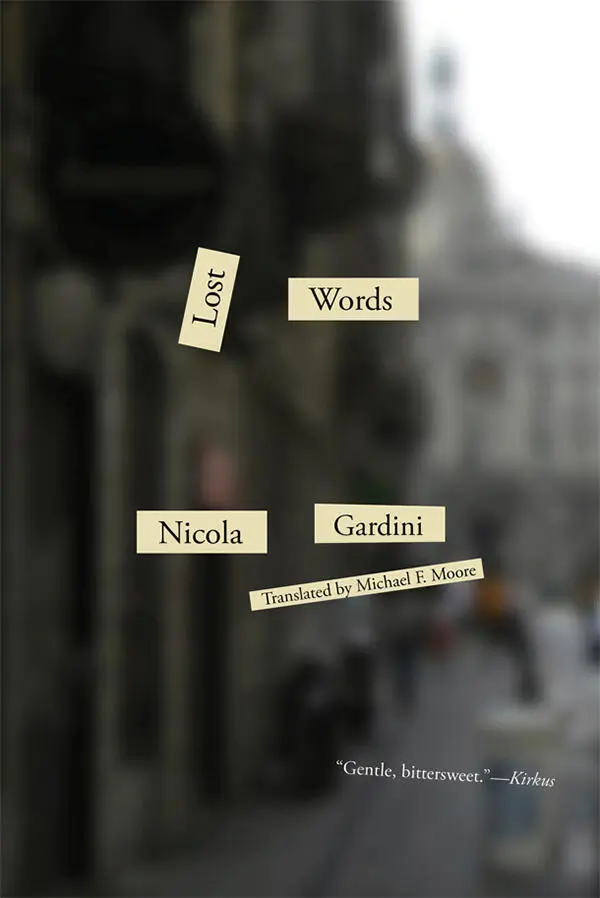
- Название:Lost Words
- Автор:
- Издательство:New Directions
- Жанр:
- Год:2016
- ISBN:нет данных
- Рейтинг книги:5 / 5. Голосов: 1
-
Избранное:Добавить в избранное
- Отзывы:
-
Ваша оценка:
Lost Words: краткое содержание, описание и аннотация
Предлагаем к чтению аннотацию, описание, краткое содержание или предисловие (зависит от того, что написал сам автор книги «Lost Words»). Если вы не нашли необходимую информацию о книге — напишите в комментариях, мы постараемся отыскать её.
Lost Words — читать онлайн бесплатно полную книгу (весь текст) целиком
Ниже представлен текст книги, разбитый по страницам. Система сохранения места последней прочитанной страницы, позволяет с удобством читать онлайн бесплатно книгу «Lost Words», без необходимости каждый раз заново искать на чём Вы остановились. Поставьте закладку, и сможете в любой момент перейти на страницу, на которой закончили чтение.
Интервал:
Закладка:
At Mantegazza’s request, my mother also handled the funeral arrangements. She took care of every detail, from the floral wreaths to the vestments to the transportation. Meanwhile the dog sniffed at her feet and, growling, bared its few remaining teeth.
*.
The body remained in the house for almost a week, laid out on the bed just as my mother had arranged it. To get rid of the smell, Mantegazza smoked like a chimney. At night she slept on a sofa in the living room, although she deeply regretted — so she said — leaving her poor mother all alone in that big bed.
Early in the afternoon of the 31st, the coffin was closed and loaded into the hearse. The undertakers had wanted to lay the coffin out on a bier in the lobby, but my mother said absolutely not. The signore would’ve taken it as a bad omen — on the last day of the year, no less!
Besides the seamstress and her daughter Rosi, only my mother and I went to the church. No one else from the apartment complex came. The minibus that Signora Mantegazza had rented for the tenants was sent back to the garage, unused. Not even her relatives were there, unless you considered the dog a relative. It took up a post right below the head of the coffin, and was a little more vigilant than usual. Next to the coffin were wreaths from the other tenants, from Mantegazza herself, and from the director of the swimming pool where she worked.
The seamstress wore a mangy raccoon coat that we had seen, years earlier, on the old woman. Her gestures and expressions reeked of servility: she was clearly counting on getting a share of the deceased’s estate. And while enticing the old lady with cups of coffee, she must have discovered that the coat hadn’t been left to us.
During the religious service, Rosi couldn’t sit still for a minute. She kept running from one end of the church to the next, throwing the pews into disarray, and snuffing out the candles. My mother watched her, stifling her laughter. Mantegazza, despite her annoyance, tried to pay attention to the words of Padre Aldo, who had the good sense to keep the service down to the essentials. At the moment of benediction, the seamstress faked a sob. Mantegazza did not even deign to look at her. My mother was seized by an uncontrollable euphoria. To avoid bursting into laughter, she had to bend herself in two and groan. Not to be outdone, the seamstress unleashed another torrent of tears. Mantegazza continued to ignore her, while my mother seemed to be overwhelmed with grief.
Outside the church, Mantegazza asked if we wouldn’t mind following her to the cemetery. The question, which sounded more like a command, caught both my mother and the seamstress off-guard. For the first time they looked each other in the eye, as if they were both wondering how they could escape this unexpected burden and, calling a momentary truce, came to a mutually beneficial agreement: in the end, without a sound, they both got into the big black Mercedes.
We rode through streets I had never seen, sad and gloomy, impervious to the Christmas lights. Until then I had imagined the city was more beautiful beyond the fields surrounding Via Icaro, beyond the gates enshrouded in fog. I was wrong.
Because of the cold, the priest at the cemetery also limited himself to the essentials. A moment before the gravediggers started to cover the grave, the seamstress told her daughter, “Rosi, take a clump of dirt and throw it on nonna .” The little girl, figuring nonna was the older woman standing in front of her rather than the one lying in the grave, grabbed a handful of soil and threw it at Mantegazza. “Good God!” the woman shouted, jumping to one side. “Signora Bortolon, a little respect! Don’t you realize I’m burying my mother?”
My mother giggled, and I giggled with her. The seamstress gave Rosi a slap across the face. “Apologize to Signorina Mantegazza!” she hollered. The only thing you could hear in the cemetery was her strident voice. The little girl fled through the deserted gravestones, which were dappled with the remaining snow. Handfuls of dirt were scattered onto the casket. Without thinking, Mantegazza, after a long final drag, tossed her cigarette butt into the pit.
“How old was Signora Armanda?” asked the seamstress, unremitting in her gall. Mantegazza blew smoke through her nostrils and chewed on her lower lip with an absent look while the gravediggers finished their work. I thought she hadn’t heard the question. “It was a secret,” she said after a long pause, staring into space. “Momma was against anyone knowing — but what’s the sense of secrets anymore? She was ninety.”
“What a woman!” crowed the seamstress, “to make it all the way to ninety. That I should be so lucky!”
*.
“She was here not even ten minutes ago,” my father remarked, “the Maestra — and what a character! She can’t weigh more than eighty pounds.”
The gift-wrapped packages were placed on top of the television set. From their shape you could tell they were books. I could imagine which ones. The biggest package was her Webster’s. The second was her copy of Madame Bovary , in French. On the title page she had written, “For Luca, Happy New Year!” Her holiday wish for me was a warning, not to lose my bearings amid the myriad false idols I would encounter.
“Can I go upstairs to thank her?” I asked my mother.
“You’ll thank her later, she knows you’re spending the holidays with your parents…”
We had nothing planned for the evening. Gemma and Carmen were going to a pizzeria with their husbands. My mother didn’t have the least intention of wasting her money, especially since her own pizza was so good. Nor, for that matter, did she feel like leaving the building unguarded on the last night of the year, with fireworks going off everywhere and a bunch of drunk men on the prowl. “If anything happens, you know who they’re going to blame.”
We turned on the television and sat down to eat. The front door kept slamming as people came and went as if it were a regular work day — a constant reminder that everyone was out merrymaking except us. Even the Vignolas were having fun.
We made the dinner last for as long as possible so it would look as if we, too, were celebrating New Year’s. The menu was elaborate. My father had requested chicken soup, pig’s feet and lentils, an assortment of side-dishes, and gorgonzola with walnuts, one of his favorites. My mother let a few minutes go by between one course and the next, and she asked us to eat slowly. How would we make it to midnight, otherwise?
By ten o’clock, my father was so tired he could barely keep his eyes open. My mother was sleepy, too, but she forced herself to stay awake. There was still the dried fruit and the canned peaches. And the coffee… to be capped off by a toast, with the bottle of Prosecco the landlord had sent, and the panettone. But my father wanted to eat the panettone right away, and then have a cup of coffee. My mother, following the order she’d established, opened the can of peaches and served them to him. He still wanted panettone, so she dropped a rough wedge onto his plate. She and I would have our servings later.
The feast was over.
My father disappeared into the bedroom. After washing the dishes and helping me to open up the bed, my mother joined him. She set the alarm clock for eleven fifty-five so we could all get up to toast the New Year together. Otherwise our wishes wouldn’t come true.
I closed my eyes and pressed Flaubert’s novel to my chest. In that position, with a book I still couldn’t read, I was finally able to survey the room more serenely: the gas meter, the window, the sliding bolt lock, the key drawer, the intercom, all the knickknacks you wouldn’t find in a normal home, and all the protrusions that hindered our movements and freedom. Suddenly they no longer felt oppressive, wrong, and unsightly, but rather provisional, as provisional as the people carousing upstairs and the fireworks going off in the fields.
Читать дальшеИнтервал:
Закладка:
Похожие книги на «Lost Words»
Представляем Вашему вниманию похожие книги на «Lost Words» списком для выбора. Мы отобрали схожую по названию и смыслу литературу в надежде предоставить читателям больше вариантов отыскать новые, интересные, ещё непрочитанные произведения.









Обсуждение, отзывы о книге «Lost Words» и просто собственные мнения читателей. Оставьте ваши комментарии, напишите, что Вы думаете о произведении, его смысле или главных героях. Укажите что конкретно понравилось, а что нет, и почему Вы так считаете.