Nicola Gardini - Lost Words
Здесь есть возможность читать онлайн «Nicola Gardini - Lost Words» весь текст электронной книги совершенно бесплатно (целиком полную версию без сокращений). В некоторых случаях можно слушать аудио, скачать через торрент в формате fb2 и присутствует краткое содержание. Год выпуска: 2016, Издательство: New Directions, Жанр: Современная проза, на английском языке. Описание произведения, (предисловие) а так же отзывы посетителей доступны на портале библиотеки ЛибКат.
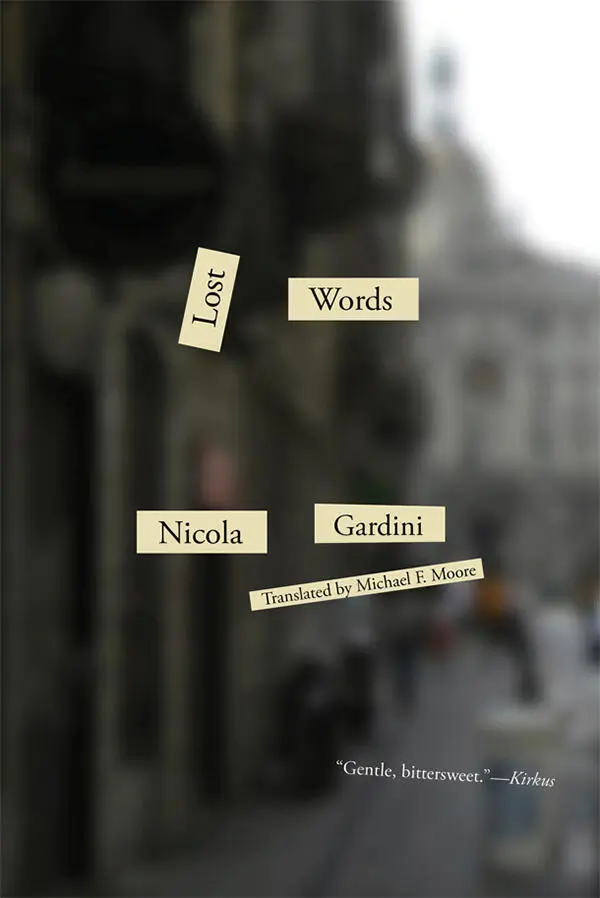
- Название:Lost Words
- Автор:
- Издательство:New Directions
- Жанр:
- Год:2016
- ISBN:нет данных
- Рейтинг книги:5 / 5. Голосов: 1
-
Избранное:Добавить в избранное
- Отзывы:
-
Ваша оценка:
Lost Words: краткое содержание, описание и аннотация
Предлагаем к чтению аннотацию, описание, краткое содержание или предисловие (зависит от того, что написал сам автор книги «Lost Words»). Если вы не нашли необходимую информацию о книге — напишите в комментариях, мы постараемся отыскать её.
Lost Words — читать онлайн бесплатно полную книгу (весь текст) целиком
Ниже представлен текст книги, разбитый по страницам. Система сохранения места последней прочитанной страницы, позволяет с удобством читать онлайн бесплатно книгу «Lost Words», без необходимости каждый раз заново искать на чём Вы остановились. Поставьте закладку, и сможете в любой момент перейти на страницу, на которой закончили чтение.
Интервал:
Закладка:
Much of the lesson was dedicated to learning vocabulary. The Maestra would look up words I didn’t know in one of her many dictionaries and read me the definition. I quickly learned how to tell her in English what had happened that day at school, describing my teachers and classmates, or talking about my parents, the only people the Maestra never allowed herself to criticize. Nevertheless, by her very nature she represented a complete, radical critique of everything I had learned from them.
She often interrupted me to comment, to probe — without the least malice — to correct me, or to ask me for an explanation when I expressed myself poorly. If I didn’t understand something, she would say, “Would you like me to repeat the question?” with delicacy and grace, savoring the honeyed tones of her own voice. And that honey blended like wildflowers in a spring meadow with all the adventures and encounters of her mysterious life, in an indefinable accent that was both foreign and familiar, and actually more than familiar, dripping from my ears down into my heart. And I prayed that the Maestra would continue to speak with me like that forever, while I jotted down in my notebook every detail of a life I hadn’t lived, a life she was bequeathing to me through her words.
“What’s your name?” she asked me one afternoon. I thought I had misunderstood the question. The Maestra already knew my name. But she insisted: “Do tell me your name. What is your name?” Although I was used to her unpredictability, I was completely confused.
“My name is Chino,” I reminded her.
“Are you sure? Chino must be a nickname. I’d love to know your real name…”
I had to admit that my real name was different. It was Luca. But no one ever called me that. Satisfied, she explained to me that Chino literally pulled you down. It meant “bent toward the ground.” Chino — and to explain this she shifted to Italian — and it was the posture of a farmhand. Chino was the head of an old man who had received bad news… “Go ahead, look it up in the dictionary…” She preferred Luca. She said that, although the etymology was different, my name was similar to luck.
“Luca,” she repeated, “The Son of Luck.”
*.
My mother didn’t know what to say — only, with a somber air: “Go upstairs to see Riccardo. He needs you.” For the first time I wasn’t allowed to go to the Maestra. I conveyed the news to her over the intercom. “How disappointing,” she sighed. “I’ll see you tomorrow, then.”
The Lojaconos’ apartment was a corner unit with one bedroom. I knocked softly and right away they opened the door. It was the first time I had been inside. In the doorway I was greeted by three embroidered flowers enclosed in a frame, and a porcelain dish with the words, “Guests are like fish. After three days they stink,” and a trout painted in the middle. The wall around the telephone was decorated with postcards. The air was stagnant with the smell of hot soup and damp laundry hanging to dry.
Signora Lojacano was perfectly still. She appeared wet and shriveled from head to toe, as if she had just emerged from a flood of tears. She had the face of someone with a bad cold. I noticed for the first time that she had two beautiful blue eyes, which she had passed on to her son Riccardo, but right now she looked more like his grandmother. “Go on in,” she encouraged me.
I went down the hall and stopped at the door to his bedroom. Riccardo’s voice invited me in. The room was sunken in darkness — the shutters were closed. I made my way to his big bed. “Can you see me?” he asked. I could barely make out his profile, his naked arms on the bed-sheets, the shape of his head against the pillow. His eyes and other facial features remained in the darkness. I lowered my gaze to the tassels of the satin bedcover, which were illuminated by the yellow light coming in from the hall, and I prayed to God to get me out of there as quickly as possible.
“Man did I ever take a beating,” he muttered.
I could hear him fumbling with the light switch hanging next to the crucifix. Before turning it on he warned me, “Try not to get upset.” He flicked the switch and in the cone of light you could see two half-closed eyes, all black-and-blue, a mouth covered with cuts, a broken nose… He was unrecognizable. I couldn’t even reconstruct his ruined features into a human face… His lips were swollen into a weird smile. One of his front teeth was missing. His split upper lip was stained with fresh blood.
“They hit me everywhere, Chino. My head, my back… it went on and on. At one point they even used a crowbar…”
“Who did this to you?” I found the strength to ask. He started coughing and couldn’t stop. “The fascists!” he said, in a strangled voice. “They nabbed me in Piazza Medaglie d’Oro, in broad daylight. They jumped in my car when I was stopped at a traffic light and pointed a gun at me. Where the fuck are the police when you need them?… I felt like I was having a nightmare. We drove out of Milan. I don’t know which road we took… I was shitting my pants… The only thing I remember is at one point, after I’d been driving for a while, we got off the highway and were in the open countryside… We turned down a dirt road…”
He stopped speaking. His eyes filled with tears and his upper lip shook, puffy and red. Slowly and with great difficulty, he pulled the covers off all the way down to his legs. His naked body was covered with marks from the beating. His right side was as black as coal, his upper body a patchwork of purple bruises. My eyes came to rest on his hairy crotch and I immediately looked away. But Riccardo wanted me to see.
“Take a good look,” he insisted.
He lifted his scrotum. Some punches had even been landed down there. He pulled the sheet back up very slowly and started coughing again. His mother ran in with a glass of water. “Drink, drink…” she said, lifting his head from the pillow. She sat next to him on the bed.
“Are you ready for your medicine?” she asked him quietly. She patted his forehead and left us alone again. I stared at his face the way you might look at a lifeless object, an expressionless mask. Riccardo understood my repulsion. “You’re shocked, huh? Don’t worry. It’ll go away…”
Signora Lojacono came back holding a small brown bottle. “People are crazy, Chino,” she explained. “Don’t listen to anyone! Not a soul! Look at what they did to my son… Now be a good boy and get along home to your mother.”
*.
“I spent my youth convinced that if I knew the exact meaning of words, it would unlock my understanding of things. I loved difficult words, obscure words, foreign words. Not neologisms, which aren’t real. I had my own cult for dictionaries. Maybe all young people, whether they realize it or not, love dictionaries — I’d go so far as to say that children are the ideal lexicographers. They don’t know the language of the community very well because they still think that meanings exist independently of people. You could write a fairy tale about it: Once upon a time there was a meaning… and then? What happens to this meaning?… Let’s say it meets a little girl. And the little girl misunderstands it, that is to say, she believes it. A while later she discovers that the meaning doesn’t only signify what it claims. One night she sees it in the company of a few adults and realizes that it behaves in a questionable manner —like a mother who says she’s only your mother but later turns out to be the mother of many other children, and as a matter of fact, the meaning wasn’t a meaning at all. It was a word . Meaning, by itself, doesn’t exist! A word is a meaning that comes into contact with people and assumes a variety of appearances. Everyone sees a little of themselves in it, everyone understands what they can or what they want to understand. Bello, ma…! A mother can be the mother of many children, even if each of them will say that she’s his or her mother … I know — it’s a bad fairy tale … One day I realized that I was the hero of this fairy tale. Yet there are people who have a lifelong belief in the absolutely perfect correspondence between words and meanings. Lucky them! — I don’t, I’m sorry — some writers are that way, whether they express themselves in prose or poetry. In Italy, Pascoli, Gadda, and Landolfi are writers of meanings . For them, the word serves to indicate a precise meaning, and is indeed the meaning itself, which by itself is indescribable, undefinable. If you seek to define it you end up destroying it, as Shelley said about the rose, which, ‘if blighted, denies the fruit and the seed.’ Writers of words are of a different breed: they think in sentences . The meaning stems from the sum of the words, the relations that words establish with each other: taken individually they say very little, because they need the others to signify. For other writers — Woolf, Stendhal, T.E. Lawrence — the meaning emerges from the chain of relations between words, from the discourse, and these writers, unlike the others, require a listener. They require answers. For the first type, the meanings themselves are answers! Every word, for writers of words, has meaning because it is connected to another word — and not to just any word. Every word has a predisposition to sympathize with one word rather than another. Every word has its own destiny, which is fulfilled in the sentence. And a word doesn’t function only in the construct of the sentence. It also functions in relationship to certain hidden words that are not written down, invisible words like ghosts, impalpable but as present as shadows: words that have already been written by someone else and now are evoked by the words that we put down on paper. There are sentences, chains of words that ripple beneath the surface of the page and descend into remote depths where our conscience is unable to plunge, even in moments of great acuity. The writers of words are actually readers. The writers of meanings are more similar to scientists, anatomists, or botanists. They catalog. The others collect and forget to classify their findings, because they prefer to scatter around the house whatever they come up with, even at the risk of losing something — what an enviable freedom! If only I… ”
Читать дальшеИнтервал:
Закладка:
Похожие книги на «Lost Words»
Представляем Вашему вниманию похожие книги на «Lost Words» списком для выбора. Мы отобрали схожую по названию и смыслу литературу в надежде предоставить читателям больше вариантов отыскать новые, интересные, ещё непрочитанные произведения.

Обсуждение, отзывы о книге «Lost Words» и просто собственные мнения читателей. Оставьте ваши комментарии, напишите, что Вы думаете о произведении, его смысле или главных героях. Укажите что конкретно понравилось, а что нет, и почему Вы так считаете.