T. Boyle - Water Music
Здесь есть возможность читать онлайн «T. Boyle - Water Music» весь текст электронной книги совершенно бесплатно (целиком полную версию без сокращений). В некоторых случаях можно слушать аудио, скачать через торрент в формате fb2 и присутствует краткое содержание. Год выпуска: 1983, ISBN: 1983, Издательство: Granta Books, Жанр: Современная проза, на английском языке. Описание произведения, (предисловие) а так же отзывы посетителей доступны на портале библиотеки ЛибКат.
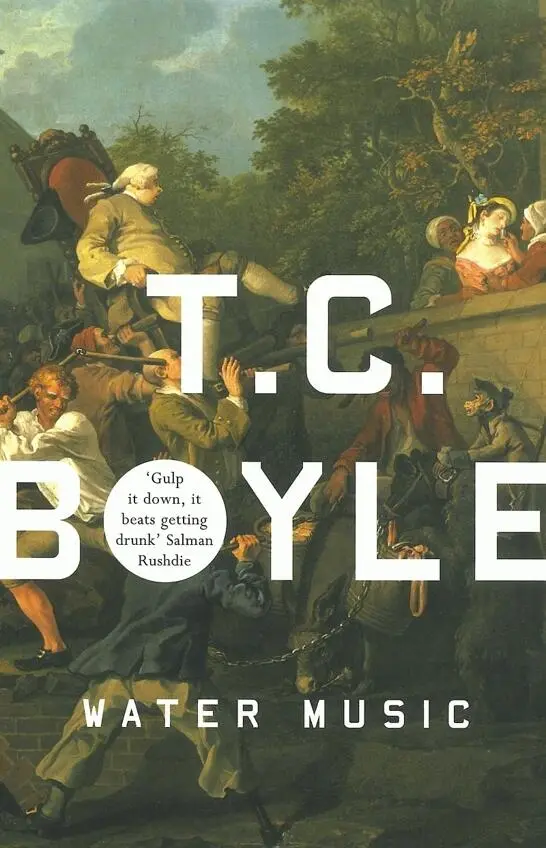
- Название:Water Music
- Автор:
- Издательство:Granta Books
- Жанр:
- Год:1983
- ISBN:9781862071551
- Рейтинг книги:3 / 5. Голосов: 1
-
Избранное:Добавить в избранное
- Отзывы:
-
Ваша оценка:
Water Music: краткое содержание, описание и аннотация
Предлагаем к чтению аннотацию, описание, краткое содержание или предисловие (зависит от того, что написал сам автор книги «Water Music»). Если вы не нашли необходимую информацию о книге — напишите в комментариях, мы постараемся отыскать её.
Water Music — читать онлайн бесплатно полную книгу (весь текст) целиком
Ниже представлен текст книги, разбитый по страницам. Система сохранения места последней прочитанной страницы, позволяет с удобством читать онлайн бесплатно книгу «Water Music», без необходимости каждый раз заново искать на чём Вы остановились. Поставьте закладку, и сможете в любой момент перейти на страницу, на которой закончили чтение.
Интервал:
Закладка:
♦ ♦ ♦
It took him six days to get there. He traveled by night, holing up in the forest during the day, drinking from puddles, chewing at roots, picking leeches from his skin. He was startled awake on the afternoon of the second day by the clatter of hoofs, and peered out from his cover to observe One-Eye and his companion hurrying up the road. At dawn on the fourth day he came across a tiny cluster of huts beside the road. He hadn’t eaten in days: what little strength he had was ebbing. Desperate, he woke the Dooty and offered to write charms in exchange for a bite to eat. The Dooty said that there was no food in town for the likes of him, a common thief. “All right,” the explorer said, squatting outside the door. “I’ll sit here until I’ve starved to death. And I’ll curse you and your crops and your descendants and their crops through all eternity and in the name of Mansa King George III of England.” Twenty minutes later the Dooty ’s wife appeared in the doorway with a bowl of kouskous.
At Kamalia he traded a half-written letter to Ailie for a cup of milk and a platter of boo , a dish which was made from corn husks and tasted like sand. When he asked his host about the possibility of joining a slave coffle for the coast, the man directed him to Karfa Taura’s house on the far side of town. The month was September. Mist rose from the streets and everywhere there was the insidious clank of chains as slavers gathered their wares against the end of the rainy season and the march to the sea. The explorer kept his head down.
Taura’s house, a four-or five-room affair built of clay and stone, dominated a hill in the center of town. There was a well, a shade tree or two and an expanse of muddy red earth pocked with goat tracks. Out back were a number of cane huts and a corral fenced round with thorn. The explorer presented himself at the door, suffering from fatigue, starvation, mental duress, emaciation, jungle rot, blisters, hemorrhoids, various local infections, hepatitis, diarrhea and a febrile body temperature of one hundred and one degrees. His toga had degenerated to a web of knotted strips, his hat looked like a byproduct of cat-skinning, and he was barefooted. Twenty-five years old, he could easily have passed for sixty. “Tell your master,” he croaked at the incredulous black face at the door, “that I am a white man desirous of traveling to the Gambia with one of his slave coffles. Tell him. .” here he lost his train of thought, “tell him. . I. . I failed Greek but could kick a football the length of the field.”
A moment later he was led through the house to the baloon , a large airy room reserved for guests. There he found Karfa Taura sharing a pipe of tobacco with a number of slatees [4] who had come to join his coffle. Taura was wearing a tarboosh and a lustrous blue robe. A gray parrot perched on his shoulder, peeling a berry. “So,” he said, “you claim to be a white man from the west. I have never seen a white man, though as a boy I once saw two Portugee in Medina.” Taura was Mandingo by birth, Muslim by conversion. He was also filthy rich. “It’s funny,” he continued after a pause, “but you don’t look white. I expected something, well — brighter. Like the belly of a frog.”
One of the slatees spoke up. He was a murderous-looking character with corrosive eyes. “He’s no white man.”
“Never,” spat another. “I’ve seen white men at Pisania and Goree, and their skin is as white as the pages of this book.” He held up a copy of the Koran.
The explorer felt woozy. He found it difficult to remain standing. “Give me a football,” he shouted, lapsing into English, “and I’ll show you who’s white.”
This outburst seemed to startle his interrogators for a moment, and they stared up at him with renewed interest. “What’s that he said?” But then the first slatee growled, “Aaaah, he’s just a pariah Moor down on his luck, coming round here on false pretenses in the hope of getting a handout.”
“Mad is what he is,” his cohort said. “Mad as a hyena. Look at his rags — and that hat!”
Karfa Taura held up his palm. “Suleiman,” he said to the man with the book, “give the newcorner your book.”
Suleiman handed the book to the explorer.
“Can you read the Koran?” Taura asked.
Mungo tried, straining to remember Ouzel’s Grammar and how those arcane dots and slashes related to letters and words. After staring at the book a moment he raised his head and mumbled, “No, I can’t read it.”
“Illiterate!” shouted the first slatee .
“Kafir!” muttered another.
Taura whispered something to his servant and the man left the room to return again in a moment with a second book in his hand. As the servant handed it to the explorer, Taura’s voice, calm and patient, purred over the prickling silence: “Perhaps you can read this?”
The leather binding was splotched with mold, there were fingerprints in the dust on the cover. The explorer opened the book and tried to concentrate on the black printed letters that swam before his eyes like sunspots. He couldn’t focus. The slatees were shouting out insults. “You cannot?” Taura asked.
Then all at once the letters came into focus and he was reading, reading like a man at the breakfast table with a copy of The Monthly Review spread out before him:
Good Christian People, I bid your prayers for Christ’s Holy Catholic Church, the blessed company of all faithful people. .
It was The Book of Common Prayer .
“Niyazi,” Taura called out to the servant, “sweep out the back hut for the white man.”
♦ ♦ ♦
The next time the explorer became fully cognizant of his surroundings it was November, and the sere harmattan winds had begun to sweep in off the desert. In the interval, he had tossed on his pallet in the back hut, sweating and hallucinating. Karfa Taura had seen him through the worst of it, spoon-feeding him chicken broth and hot milk and garlic, rubbing his body with healing herbs, letting blood. During one of his lucid moments Mungo had promised Taura the value of one prime slave in return, deliverable upon reaching Pisania and the factory of Dr. Laidley. Taura thought it a pretty good deal, as he would have nursed the explorer in any case, fascinated as he was by this strange mythical being whose hair grew blonder and skin whiter by the day.
At Taura’s table one evening, as they were sharing a bowl of kouskous and mashed chickpeas, the explorer brought up the subject of the slave coffle: when would it depart for the Gambia? Outside, the crickets suddenly left off their cheeping. A host of faces looked first at the explorer, and then at Taura, seated at the head of the mat which served as a table. (There were many more slatees present now, most of them dependent upon Taura for their current expenses — he would be reimbursed when the slaves were sold at Medina.) Taura smiled at the explorer as he might have smiled at a six-year-old who’d asked why the stars didn’t fall from the sky. “Well, my friend,” he began, “I’ll tell you. There are six swollen rivers to cross between here and Dindikoo on the far side of the Jallonka Wilderness. In between there are seas of grass, taller than a man’s head. If we wait a month or so — till late December or early January — the rivers will have subsided and the villagers will have burned away much of the grass. I know you are anxious to get back to Tobauho doo , but to travel now would be impossible.”
On December nineteenth Taura collected all his local debts and set out up the Niger to the town of Kancaba, in order to purchase slaves for the trip to the Gambia. He returned a month later with a new wife (his fourth) and thirteen reasonably marketable slaves, all of whom had the requisite number of limbs and eyes. The explorer was overjoyed when his benefactor stepped through the door. He’d been counting the days, impatient, his every waking moment devoted to thoughts of Ailie and the African Association. He pictured himself dressed to the nines in a sparkling muslin cravat and a new sergdusoy jacket, lecturing Sir Joseph Banks and Durfeys and the rest, a legend in his own time. The suffering and privation were over. In two months he’d be the toast of London. Karfa Taura wrapped an arm around his shoulder. “The rivers are down,” he said, “the grass burned off, the slatees have gathered their wares. We depart on the first of February.”
Читать дальшеИнтервал:
Закладка:
Похожие книги на «Water Music»
Представляем Вашему вниманию похожие книги на «Water Music» списком для выбора. Мы отобрали схожую по названию и смыслу литературу в надежде предоставить читателям больше вариантов отыскать новые, интересные, ещё непрочитанные произведения.







Обсуждение, отзывы о книге «Water Music» и просто собственные мнения читателей. Оставьте ваши комментарии, напишите, что Вы думаете о произведении, его смысле или главных героях. Укажите что конкретно понравилось, а что нет, и почему Вы так считаете.