T. Boyle - Water Music
Здесь есть возможность читать онлайн «T. Boyle - Water Music» весь текст электронной книги совершенно бесплатно (целиком полную версию без сокращений). В некоторых случаях можно слушать аудио, скачать через торрент в формате fb2 и присутствует краткое содержание. Год выпуска: 1983, ISBN: 1983, Издательство: Granta Books, Жанр: Современная проза, на английском языке. Описание произведения, (предисловие) а так же отзывы посетителей доступны на портале библиотеки ЛибКат.
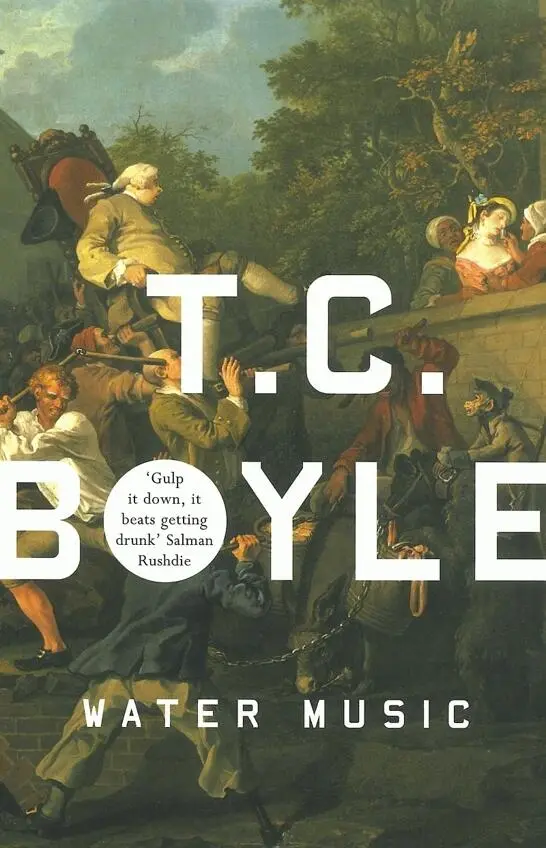
- Название:Water Music
- Автор:
- Издательство:Granta Books
- Жанр:
- Год:1983
- ISBN:9781862071551
- Рейтинг книги:3 / 5. Голосов: 1
-
Избранное:Добавить в избранное
- Отзывы:
-
Ваша оценка:
Water Music: краткое содержание, описание и аннотация
Предлагаем к чтению аннотацию, описание, краткое содержание или предисловие (зависит от того, что написал сам автор книги «Water Music»). Если вы не нашли необходимую информацию о книге — напишите в комментариях, мы постараемся отыскать её.
Water Music — читать онлайн бесплатно полную книгу (весь текст) целиком
Ниже представлен текст книги, разбитый по страницам. Система сохранения места последней прочитанной страницы, позволяет с удобством читать онлайн бесплатно книгу «Water Music», без необходимости каждый раз заново искать на чём Вы остановились. Поставьте закладку, и сможете в любой момент перейти на страницу, на которой закончили чтение.
Интервал:
Закладка:
On the afternoon of the third day Mungo thanked his host, scribbled off a final blessing, and limped down to the river, where he found a number of ferrymen perched like water spiders in the prows of their canoes. He struck a bargain with a sloe-eyed Bobo whose skin was the color of a Concord grape: six lines of inspired calligraphy in exchange for passage to Sibidooloo, on the far side of the river. The explorer felt that something out of Virgil might be appropriate — inscribed to the Charon of the Niger — but he couldn’t remember a word of Latin and wound up giving him an abridged version of “The Owl and the Pussycat” instead.
There were four goats, a parrot and a cage full of monkeys in the canoe, in addition to six other passengers and a dozen earthenware jars of produce. When Mungo asked what the monkeys were for, the ferryman grinned to display a gleaming mouthful of teeth. “Bake them,” he said. “Make monkey bread.”
♦ ♦ ♦
Sibidooloo lay directly across the river from Frookaboo. It was, according to the ferryman, a trading town of about a thousand people. From there, he said, it was perhaps seventy-five miles to Kamalia, a slave market situated on the edge of the Jallonka Wilderness. If the explorer could make Kamaha he might be able to hook up with a slave coffle heading for the coast. It was a hope. He would have preferred a coach and four back to Pisania, but at least now he knew that there was a way back. The explorer landed at Sibidooloo in high spirits. His plan was to spend the night and leave the next morning for Kamalia. If the fever held off and the road wasn’t too muddy, he should be able to make it in three or four days.
But first to the business at hand: finding some shelter for the night. The sky had begun to darken, clouds scudding low and smoky over the thatched roofs and whitewashed walls of the town. Thunder rumbled in the distance, and the air had suddenly cooled. It was probably raining in Frookaboo already. The explorer hurried up a narrow street of well-kept mud-and-wattle huts, occasionally looking in at a doorway and asking for shelter. After two or three rebuffs, he stopped before a hut where a woman in kerchief and hoop earrings was suckling an infant and preparing kouskous with bits of akeena . He greeted her, then pulled a slip of paper from his hat, dashed off a couple of lines from Abercrombie’s Art of Divine Converse , and handed it to her. She glanced up suspiciously. “You a marabout ?’’
He didn’t know what to say. Marabouts were Moslem holy men who traveled from town to town, dispensing learning. It seemed like a good thing to admit to, yet why the strange look? He opted for insincerity. “That I am,” he said.
She put the infant down, and called to someone in the hut. “Flancharee,” she said. “Come here.”
A tall Mandingo in a pair of baggy shorts stepped from the hut, flanked by two Moors. Mungo’s heart sank. The Moors were dressed in dirty white jubbahs and tagilmusts . Somehow, one of them looked familiar.
“This man claims to be a marabout ,” the woman said. “Look what he wrote on this paper.”
Flancharee and the Moors squinted at the quotation from Abercrombie. Then one of the Moors looked the explorer dead in the eye and said something in Arabic. Mungo didn’t know what to answer. The Moor repeated himself. It sounded as if he were saying “Your mother eats pig.”
“He’s no marabout ,’’ Flancharee said in Mandingo.
The second Moor stepped forward. His skin was baked to leather, his nose twisted like a scythe — but worst of all, the explorer realized with a cold shock of recognition, his left eye socket was empty. “No Mussulman,” the Moor hissed in broken Mandingo. “ Nazarini !”
“Imposter!” rumbled the woman.
Flancharee took hold of the explorer’s arm.
“He’s a thief,” the first Moor said. “He stole from Ali and crawled off in the night like a dog. Dassoud is offering four prime slaves for him, enough to make a man rich.”
“ Nazarini! ” shrieked One-Eye.
Flancharee looked at the explorer as he might look at a snake that had just lashed out at his ankle. “Chain him up,” he said.
♦ ♦ ♦
That night the rain came like an explosion in a glass factory. It tore the leaves from the trees, the trees from the ground. Light fractured the sky, thunder thrashed the hills like an open hand. The explorer was not without shelter through all of this, though it was less than he could have hoped for. His cage sat in the middle of a square of sorts, exposed on all sides to the violence of the storm. Sometime during the night there was a sudden heart-stopping crack as of a hundred muskets fired in unison, and a raffia palm, its leaves the size of canoes, slammed down beside the cage, lifting the wooden box three feet in the air and startling the explorer from a despondency that bordered on the catatonic. After all his triumphs, narrow escapes and quickening hopes, falling back into the hands of the Moors has been too much for him. He’d gone into shock.
He sat up and looked round him. What he saw was no cause for joy: wooden bars, insects, a crazed sky, and a dark silent bank of huts. The cage in which he found himself had been built of hardwood and bamboo to accommodate a rogue lion that had burst through the roof of a hut, killed and devoured the occupants, and then apparently found himself too bloated to abscond. The villagers found him sleeping atop a pile of half-eaten corpses the following morning. While a pair of daredevils stood at the door with their spears, others hastily constructed the cage, which was then forced against the opening. On awakening, the lion had breakfasted briefly and then lumbered out the door and into the cage before he realized that something was amiss. For a month or so the man-eater had been the drawing card of Sibidooloo, but had recently been presented to Moosee, King of Gotto, as a peace offering. When One-Eye and Flancharee found that all the irons available were already employed in restraining slaves collected for the trek to Kamalia, they hit upon the cage as a convenient place to shut up the explorer. And so he had spent the evening there, in a heap of lion dung, thinking the blackest thoughts.
The collapse of the tree came as something of a blessing. It jolted him from his torpor, and he began to probe the enclosure for a means of escape. He crept round on his hands and knees in the dark as dry scuttling things backed away from his fingers and the rain slashed through the bars to awaken the dormant odor of lion piss. Smelling salts couldn’t have cleared his head more effectively. He gasped and gagged, his eyes tearing, hands frantically pawing over every nook and joint of his cell. The first time round he found nothing — the native joiners had done their work well. But then, on closer examination, he discovered a rough spot in the upper right-hand corner where the planks of the ceiling met the cornerpiece. The wood was abraded where the lion had persistently gnawed at it during the weeks of his captivity. Mungo’s blood pressure rose: here was a chance! But how to take advantage of it? Instinctively he applied his teeth to the gnawed wood, but managed only to collect the odd splinter in his lips. Then he gouged at it until his fingernails began to bleed. Still nothing. Finally, he frisked the ground outside the cage until he came up with a sliver of stone that chewed away at the weak spot like a saw.
Three hours later the first of the bars gave way with a snap of protest. He held his breath and glanced round. The rain beat down with a steady mechanical roar. There was no light anywhere. He went back to work, bent over the wooden struts like a huge sedulous rodent. It took him two hours more to carve himself free. The final bar snapped and he slipped out into the deluge, working the hat down over his brow. Nothing stirred in Sibidooloo — not even a dog — as he leaned into the storm and headed up the road for Kamalia.
Читать дальшеИнтервал:
Закладка:
Похожие книги на «Water Music»
Представляем Вашему вниманию похожие книги на «Water Music» списком для выбора. Мы отобрали схожую по названию и смыслу литературу в надежде предоставить читателям больше вариантов отыскать новые, интересные, ещё непрочитанные произведения.





Обсуждение, отзывы о книге «Water Music» и просто собственные мнения читателей. Оставьте ваши комментарии, напишите, что Вы думаете о произведении, его смысле или главных героях. Укажите что конкретно понравилось, а что нет, и почему Вы так считаете.