T. Boyle - Water Music
Здесь есть возможность читать онлайн «T. Boyle - Water Music» весь текст электронной книги совершенно бесплатно (целиком полную версию без сокращений). В некоторых случаях можно слушать аудио, скачать через торрент в формате fb2 и присутствует краткое содержание. Год выпуска: 1983, ISBN: 1983, Издательство: Granta Books, Жанр: Современная проза, на английском языке. Описание произведения, (предисловие) а так же отзывы посетителей доступны на портале библиотеки ЛибКат.
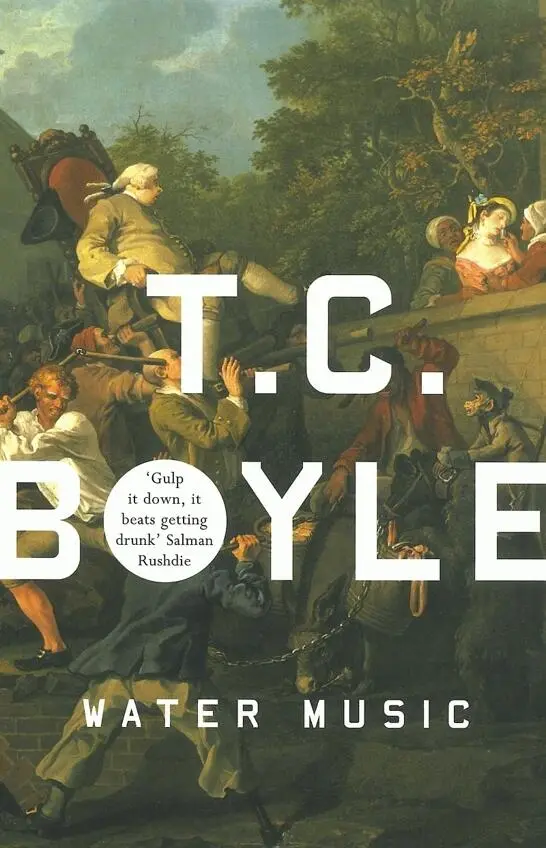
- Название:Water Music
- Автор:
- Издательство:Granta Books
- Жанр:
- Год:1983
- ISBN:9781862071551
- Рейтинг книги:3 / 5. Голосов: 1
-
Избранное:Добавить в избранное
- Отзывы:
-
Ваша оценка:
Water Music: краткое содержание, описание и аннотация
Предлагаем к чтению аннотацию, описание, краткое содержание или предисловие (зависит от того, что написал сам автор книги «Water Music»). Если вы не нашли необходимую информацию о книге — напишите в комментариях, мы постараемся отыскать её.
Water Music — читать онлайн бесплатно полную книгу (весь текст) целиком
Ниже представлен текст книги, разбитый по страницам. Система сохранения места последней прочитанной страницы, позволяет с удобством читать онлайн бесплатно книгу «Water Music», без необходимости каждый раз заново искать на чём Вы остановились. Поставьте закладку, и сможете в любой момент перейти на страницу, на которой закончили чтение.
Интервал:
Закладка:
But the first of February came and went. Suleiman had gone off to Sibidooloo to collect some trifling debt; Hamid and Madi Konko didn’t have their dry provisions ready; the moon was in the wrong corner of the sky. Excuses. The month wore away with them. And now, with March coming on, the slatees argued that they should postpone traveling until Rhamadan was over. March became April, the fast moon prevailed. Then one night in the middle of the month all of Kamalia turned out at the open-air mosque to watch for the new moon, the appearance of which would signal the end of the Rhamadan fast and offer an auspicious omen for travelers. The explorer stood amidst the throng of chanting Mandingoes and looked up with disgust at the clouded night sky. Hours passed. A number of villagers gave up and returned to their huts, determined to fast another day. But then, at midnight, the clouds began to pull back in shreds and the new moon poked its horns through to a chorus of hoots, cheers and pistol shots: Rhamadan was ended.
Like everyone else, Karfa Taura was caught up in the excitement. He threw dignity to the wind, jogging up and down like a cheerleader. Fires lit the sky, pandemonium crested like a wave. Karfa took the explorer by the arm and shouted in his ear: “We leave at dawn tomorrow!”
♦ ♦ ♦
Light was working its way across the night sky in a series of barely perceptible leaps when the coffle began to gather outside Karfa Taura’s house. Seventy-three people and six asses shuffled their feet in the dust, waiting for the sun to break over the hills. Thirty-five of these were slaves, bound for sale on the coast. The rest were itinerant merchants, slatees , their wives and domestic servants. Rounding out the group were Mungo and six jilli keas (singing men), whose vocalizing came in handy as a diversion from the hardships of the road and in smoothing the coffle’s reception at villages along the way. As the first pale rays illuminated the treetops there was a flurry of cinching and uncinching, coughing into fists, rechecking of final details and idle ear-pulling. Then they were off, leaving Kamalia in an orderly line of march, preceded by Karfa Taura, Suleiman and the singing men. When they reached the summit of a hill two miles from town, all the travelers were ordered to sit down, half the group facing westward, half looking back on Kamalia. Suleiman then delivered a solemn, nasal and interminable prayer, after which two of the other slatees circled the coffle three times, making impressions in the earth with the butts of their spears and muttering something uninteUigible by way of a traveling charm.
When they got under way again, the explorer noticed that some of the slaves were having trouble walking. They staggered under their loads, bow-legged and uncertain, tottering from foot to foot like worn-out drunks. Karfa Taura shook his head. It was a pity, he said, but some of them had been in shackles for years, and the unwonted exertion of taking a full stride wrought havoc on disused muscles, tendons and joints. It was a pity, he repeated, but an accident of the trade. Slaves had a tendency to run off, and so the accepted manner of confining them was to bind the ankles of two of them together, making it impossible for either to move independently. In order to merely scrape about like the losing entry in a threelegged race, one of the slaves had to raise the heavy shackles above the ankles by means of an attached chain. Then, with mincing deliberate steps, the pair would rattle forward. While traveling to market the leg shackles were removed, and the slaves were bound together in fours by a rope looped round their necks. A man armed with a spear marched between each group of four, to discourage any thoughts of wandering. When the coffle settled down for the night the leg irons were refastened, along with a heavy-link chain that replaced the rope round each slave’s neck.
‘‘But these are human beings,” the explorer said.
Karfa Taura adjusted his tarboosh. “True,” he said. His tone was matter-of-fact, as if he were discussing nuts and bolts or a herd of sheep. “But they are also trade goods.”
Despite the limping and groaning of the slaves (which was lessened from time to time by the application of the lash), the coffle made the walled village of Marraboo by midafternoon, rested briefly, then marched on to Bala, where they spent the night. The following day’s trek brought them to Worumbang, on the border of Manding and Jallonkadoo. It was the last outpost of civilization for a hundred miles — beyond Worumbang lay the Jallonka Wilderness.
The Jallonka Wilderness was an atavism — ten thousand square miles of uninhabited jungles, hills and grasslands, as pristine and primitive as the worid before man. Within its reaches were six rivers that had to be forded, three of them upper tributaries of the Senegal. There was no food to be had along the way, nor any shelter. Predators roamed the brakes and forests as they had for eons, and bandits lay in wait along the borders. It was a dangerous and inhospitable place — a place of shadow and legend, of bad luck and sudden death — and Karfa Taura, his fingers crossed, was anxious to get through it as expeditiously as possible.
Accordingly, the coffle left Worumbang at dawn and marched until nightfall without a break. The slaves carried bundles of trade goods on their heads, the sun was like a whip, the whip like a bad dream. One of them, a middle-aged woman whose facial cicatrices indicated that she had once aspired to a higher station in life, constantly fell out of line. At one point she lay down and refused to go any farther until Suleiman applied the lash to the soles of her feet and she staggered up and continued on in a sort of trance. The explorer was appalled — but knew he was powerless to do anything about it. He was excess baggage himself, and besides, given his debilitated condition it was all he could do to keep up with even the weakest of the slaves.
When the coffle stopped at a stream called Co-meissang for the night, Mungo shuffled over to where the slaves had been confined and looked for her among the sullen black faces. He found her at the end of the queue, stretched out on her back. Her eyes were wide, staring up at nothing, and she was breathing as if she’d just broken the tape in a footrace. The explorer bent over her and offered her a drink of water. She said nothing. Just lay there, staring at the sky, breathing hard. He asked her name, his voice hushed and sympathetic. Somehow he felt a need to comfort her, tell her it would all work out, though he knew it wouldn’t.
“Her name is Nealee,” whispered the slave beside her. A crude iron band pinched his ankle to hers. “She’s got a sickness, her blood won’t warm her feet.”
Nealee. The explorer looked down at her. Where had he heard that name before?
“You going to eat her?” the voice rasped.
“Eat her? What do you mean?”
The man’s lips were cracked. There was a rope burn across his adam’s apple. “ Maddummulo, ” he said. “The black man puts his slave to work, the white man eats him.”
Mungo was astonished at the misconception, offended by the accusation. “Nonsense.”
“No one ever comes back.”
“Well that’s because they put you in a boat to take you to another land, a land like this one, where you work in the fields and—”
“ Tobaubo fonnio ,” the slave said, “a white man’s lie.” His voice was flat and emotionless. “There is no other land. They take you to where the water goes on forever and hack you to pieces. The fires flare through the night, the kettles boil. They pick at your bones.”
♦ ♦ ♦
Nealee wouldn’t eat the following morning. It was cold, gray, half an hour before sunrise. Quick piliginous things flashed through the undergrowth, birds nattered, a breath of stagnation soured the air. Karfa Taura intoned a general benediction, after which everyone in the party was given a cup of watery gruel. Nealee sat up painfully, took the cup from Suleiman’s domestic, and flung it in his face. When Madi Konko laid into her with his switch, she rolled over and began vomiting. Someone cursed. She’d been eating clay. “Eating clay?” the explorer said.
Читать дальшеИнтервал:
Закладка:
Похожие книги на «Water Music»
Представляем Вашему вниманию похожие книги на «Water Music» списком для выбора. Мы отобрали схожую по названию и смыслу литературу в надежде предоставить читателям больше вариантов отыскать новые, интересные, ещё непрочитанные произведения.











Обсуждение, отзывы о книге «Water Music» и просто собственные мнения читателей. Оставьте ваши комментарии, напишите, что Вы думаете о произведении, его смысле или главных героях. Укажите что конкретно понравилось, а что нет, и почему Вы так считаете.