T. Boyle - Water Music
Здесь есть возможность читать онлайн «T. Boyle - Water Music» весь текст электронной книги совершенно бесплатно (целиком полную версию без сокращений). В некоторых случаях можно слушать аудио, скачать через торрент в формате fb2 и присутствует краткое содержание. Год выпуска: 1983, ISBN: 1983, Издательство: Granta Books, Жанр: Современная проза, на английском языке. Описание произведения, (предисловие) а так же отзывы посетителей доступны на портале библиотеки ЛибКат.
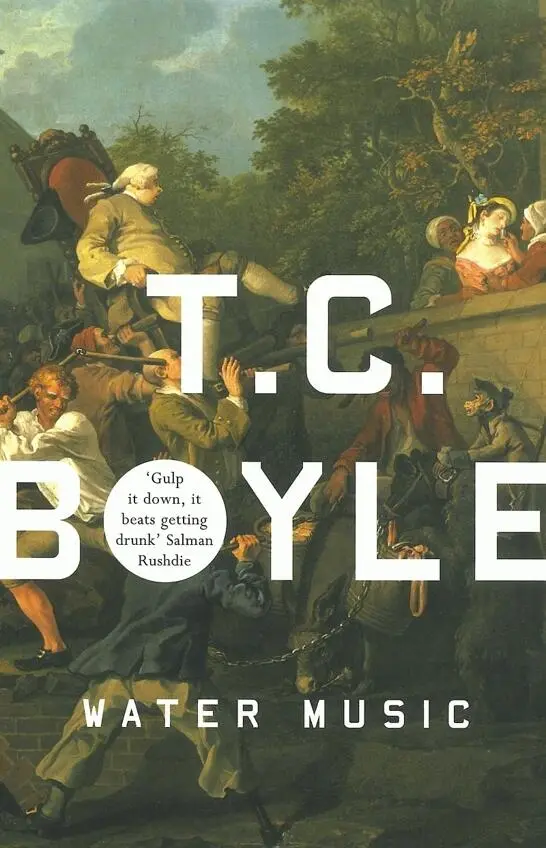
- Название:Water Music
- Автор:
- Издательство:Granta Books
- Жанр:
- Год:1983
- ISBN:9781862071551
- Рейтинг книги:3 / 5. Голосов: 1
-
Избранное:Добавить в избранное
- Отзывы:
-
Ваша оценка:
Water Music: краткое содержание, описание и аннотация
Предлагаем к чтению аннотацию, описание, краткое содержание или предисловие (зависит от того, что написал сам автор книги «Water Music»). Если вы не нашли необходимую информацию о книге — напишите в комментариях, мы постараемся отыскать её.
Water Music — читать онлайн бесплатно полную книгу (весь текст) целиком
Ниже представлен текст книги, разбитый по страницам. Система сохранения места последней прочитанной страницы, позволяет с удобством читать онлайн бесплатно книгу «Water Music», без необходимости каждый раз заново искать на чём Вы остановились. Поставьте закладку, и сможете в любой момент перейти на страницу, на которой закончили чтение.
Интервал:
Закладка:
Mid-September! He couldn’t believe it. Three months more in this pest-ridden hole, three months more bobbing in a rotten berth off of a last-chance garrison maintained by the dregs of London. He may as well have stayed at Pisania, with Dr. Laidley. There at least he could have had a glass of wine, some intelligent conversation, a room to himself. Here he had convicts for companions, a hold full of moribund black faces, cockroaches longer than a man’s finger, and the incessant creeping rot that made Goree one of the world’s more pestilential spots. So near and yet so far. He gave way to depression, lay in his berth and watched the ship rot around him.
The Charlestown finally set sail on October first, the explorer having been pressed into assuming the role of the late surgeon. He hadn’t made much use of his medical knowledge in the interior, but summoned up all Dr. Anderson had taught him in order to deal with the frightening conditions aboard ship. The American slavers, because their crews were smaller, were far less humane than the British. For fear of mutiny the slaves were kept in irons throughout the voyage. They lived in the dark, damp and cold, wallowing in their own waste, prey to consumption, typhus, hepatitis, racked with malarial fevers. The irons wore the flesh from wrists and ankles; maggots hatched in the wounds. Mungo did his best. He let blood, applied leeches, forced vinegar down their throats. Eight died at Goree, eleven more at sea. The stiffened corpses were dragged from their irons and tossed into the spume, where quick pelagic sharks fought over the remains.
The crew didn’t fare much better. Three died at Goree, another two at sea. But as it turned out, this was the least of the Captain’s worries. A far more pressing problem was the leaks that had developed in the hull while the ship sat at anchor off Goree. Now, on the high seas, these leaks had become critical. So critical in fact that the most able-bodied slaves were released from their irons in order to man the pumps. Fourteen-hour shifts, the whip cracking over their heads. They pumped, fainted from exhaustion, were lashed to consciousness, and pumped again. Still, the boat was taking on so much water it became clear that it would never make South Carolina. It became clear to some, that is.
“Cap’n — you’ve got to make for the West Indies or before you know it we’ll be treading water in the company of them sharks out there.”
“You’re an educated man, Mr. Frip. Take a look over the gunwale and read me what’s writ along the bow: I think you’ll find that it says The Charlestown , does it not? Well, Sir, that’s where I’ve been paid to take her and that’s where she’ll go.”
“Begging your pardon, Cap’n, Sir, but me and the crew has been talking amongst ourselves, Sir, and we’ve unanimously decided to break out our seamen’s dirks and ventilate your domineering hide till you look like one of them fountains in downtown Richmond, Sir, if you don’t change course for Antigua within thirty seconds by my pocketwatch, with all due respect, Sir.”
♦ ♦ ♦
From Antigua, the explorer was able to catch the Chesterfield Packet, which had stopped at St. John’s for the mail on the return voyage from the Leeward Islands. The ship sailed on the twenty-fourth of November, and drew within sight of Falmouth on the morning of December twenty-second, 1797. Shorebirds wheeled in the sky, the wind flung spray over the decks. There was ice on the rail, and a thin watery snow added sting to the gusts. The crew was invisible, the Captain in bed, the cook’s terrier huddled beneath the stove. But Mungo Park, after two years and seven months in exile, stood beside the helmsman with a grin on his face as the distant rocky isle rode up over the waves.
♦ COLD FEET ♦
A year is nothing: a feather in the breeze, a breath of air. Turn around and it’s gone. Ice, bud, leaf, twig. Geese on the pond, stubble in the field. Three hundred sixty-five mornings, three hundred sixtyfive nights. Minor lacerations, a sprained ankle, runny nose, the death of a distant relative. There’s a squirrel in the attic, a tree down in a storm. The clock in the hallway cranks round seven hundred and thirty times. Windows are raised, shades drawn, dishes, cups and spoons dirtied and scrubbed, dirtied and scrubbed. Thunder hits the hills like a mallet, snow climbs the fenceposts, sunlight burnishes the windows like copper. A year. One of how many: fifty? sixty? The days chew away at it, insidious.
♦ ♦ ♦
Ailie huddles in the corner of her bed, head buried in her hands. The window is gray with dawn and the cold slashing rain that began just after dark. Katlin Gibbie lies beside her, breathing easily, her nine-month-old boy curled into her breast. Betty Deatcher, a cousin from Kelso, snores on a pallet in the corner. The coals in the fireplace have turned to ash.
Christmas morning, but Ailie feels no leap of the spirit or good will toward men. The year is out, and today she redeems her promise: by nightfall she’ll be Ailie Gleg. Something tightens in her at the thought of it. She never imagined she’d have to live up to her vow, never doubted that Mungo — like some galloping cavalier out of a medieval romance — would turn up to save her from the dragon. A year had seemed so far off — he could have been back by New Year’s or Easter. How was she to know? She had settled in and waited. Waited with a sinking in the pit of her stomach, through spring planting, Whitsuntide, Midsummer’s Eve, through Michaelmas, Martinmas, the harvest ball, and right on up until the night before Christmas, when she finally gave in and let the bridesmaids stain her feet with henna and throw the traditional cow’s hide over her and Georgie. But even now, at the eleventh hour, she’s still not resigned to it. And she still hasn’t given up hope. She’s got till three p.m., hasn’t she? Maybe he’ll burst through the door as she stands before the altar, tall and commanding, his face sunburned, a wild look in his eye. .
But stop. How could she even think it? She’s given her word, her father has killed a calf and a pig and sent out the invitations and white kid gloves, her friends and relations have come miles through bitter winds, ice and sleet — how could she rob them of their pleasure? Worse: how could she steal Georgie’s heart and run off with it? No: she should prepare herself, wake up, accept the way of the world. One man has been taken from her, and another offered in his place. So what if he isn’t perfect? So what if he’s lop-eared, oafish, as sexless as a plucked rooster? He loves her, that’s all that counts. And he’s got a good heart. .
Her reverie is suddenly broken by the sound of whistling: pitched high and lively, it echoes eerily through the still house. The tune drifts in and out of hearing, she can’t be certain, but yes — yes, it’s a tune Mungo used to sing to her years ago, the words as much a part of her memory of him as the drift of his voice:
Now a’ ye that in England are,
Or are in England born,
Come ne’er to Scotland to court a lass,
Or else ye’ll get the scorn.
They haik ye up and settle ye by.
Till on your wedding day,
And gie ye frogs instead of fish,
And play ye foul, foul play.
Could it be? Mother of God, could it? She leaps from the bed, still in her dressing gown, her feet the color of Valencia oranges, blood beating quick, the whistling louder now, just outside the door, oh Mungo, Mungo, Mungo, she whispers, flinging the door back in a paroxysm of blind hope — and there he is — Georgie Gleg. In fresh linen, top hat, silk coat. His eyes are butter-soft. “Good morning, love,” he says, handing her a holly wreath molded in the shape of a heart. “Today’s the big day.”
Читать дальшеИнтервал:
Закладка:
Похожие книги на «Water Music»
Представляем Вашему вниманию похожие книги на «Water Music» списком для выбора. Мы отобрали схожую по названию и смыслу литературу в надежде предоставить читателям больше вариантов отыскать новые, интересные, ещё непрочитанные произведения.












Обсуждение, отзывы о книге «Water Music» и просто собственные мнения читателей. Оставьте ваши комментарии, напишите, что Вы думаете о произведении, его смысле или главных героях. Укажите что конкретно понравилось, а что нет, и почему Вы так считаете.