T. Boyle - Water Music
Здесь есть возможность читать онлайн «T. Boyle - Water Music» весь текст электронной книги совершенно бесплатно (целиком полную версию без сокращений). В некоторых случаях можно слушать аудио, скачать через торрент в формате fb2 и присутствует краткое содержание. Год выпуска: 1983, ISBN: 1983, Издательство: Granta Books, Жанр: Современная проза, на английском языке. Описание произведения, (предисловие) а так же отзывы посетителей доступны на портале библиотеки ЛибКат.
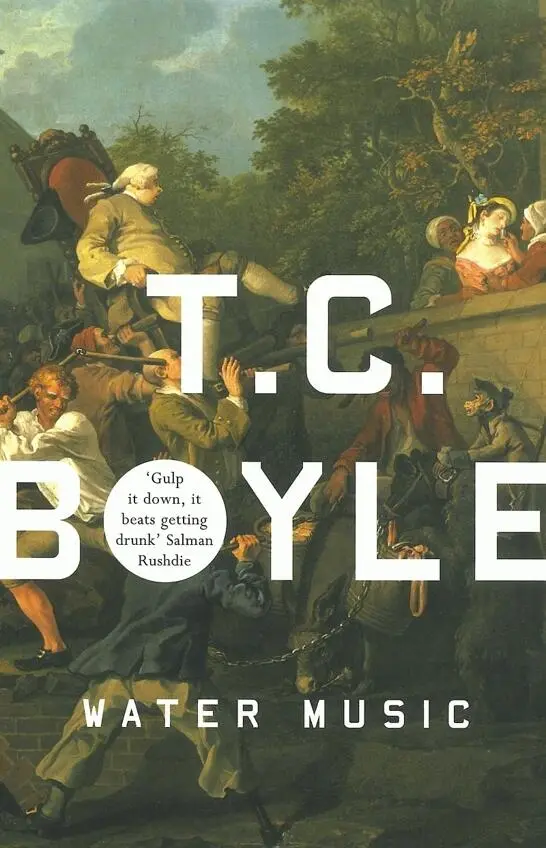
- Название:Water Music
- Автор:
- Издательство:Granta Books
- Жанр:
- Год:1983
- ISBN:9781862071551
- Рейтинг книги:3 / 5. Голосов: 1
-
Избранное:Добавить в избранное
- Отзывы:
-
Ваша оценка:
Water Music: краткое содержание, описание и аннотация
Предлагаем к чтению аннотацию, описание, краткое содержание или предисловие (зависит от того, что написал сам автор книги «Water Music»). Если вы не нашли необходимую информацию о книге — напишите в комментариях, мы постараемся отыскать её.
Water Music — читать онлайн бесплатно полную книгу (весь текст) целиком
Ниже представлен текст книги, разбитый по страницам. Система сохранения места последней прочитанной страницы, позволяет с удобством читать онлайн бесплатно книгу «Water Music», без необходимости каждый раз заново искать на чём Вы остановились. Поставьте закладку, и сможете в любой момент перейти на страницу, на которой закончили чтение.
Интервал:
Закладка:
♦ ♦ ♦
A spotty crowd is gathered outside the wall for the executions — mainly hyenas and degenerates, and agents for dissectors hoping to claim the corpses. There is a small contingent of the gentility as well, fronted by Sir Joseph Banks and the Countess Binbotta. They sit in coaches parked along the street, or stand discreetly in the rear, lured from their hearths and wassail bowls by the grim logic of an eye for an eye. If any of them see any incongruity in attending an execution on Christmas Day, their faces — stern and wire-jawed — don’t show it.
By now the snow is coming down in earnest: nearly two inches of fine white powder smooths the muddy earth, softens the harsh lines of the gallows. The empty nooses are frosted like cakes, liveried footmen hurry to throw blankets over the backs of their masters’ horses, the spectators pull shawls and mufflers tight round their throats and close in on the gallows for better visibility. Thick as paste, the big wet flakes swirl out of the sky.
His elbows pinioned and knees unsteady, Ned stands at the main gate waiting for the ceremony to begin. Beside him, dressed in rags, are the two thieves condemned to hang with him. One of them is a tall, brutal-looking character, his hair cropped close, nose broken. There are tears on his face and he seems to be muttering prayers under his breath. He clutches a prayerbook in his sweaty fist as if it were a life preserver. The other unfortunate, Ned realizes with about as much surprise as a prospective hangee can muster, is a dwarf. Three feet high, with a carroty mass of hair flaming round his cheeks and crown like a brushfire. Without warning the dwarf suddenly turns and delivers a vicious kick to the lower leg of his companion.
“Cut yer blubberin’ and ‘ail Maryin’, arse’ole. Die like a man.”
“Lay off me, Ginger,” the big man pleads. “Ye’ve ‘ounded me into a life of crime — ain’t that damage enough?”
The dwarf turns his head away to spit on the cold stone floor. “Me ‘ounded you, eh? And ‘oo was it wanted to roll Lord Lovat when ‘ee come out of White’s gamblin’ ‘ouse, eh? And wot about the brilliant idea of peelin’ the gold-leaf paper off the inside of the Duke of Bedford’s coach? I don’t ‘ear you, pea brain,” the dwarf snarls, kicking the tall man a second time.
“Ye twisted little ‘omunculus!” the big man explodes, dropping his prayerbook and snatching at the dwarfs coiffure with both hands, “I’ll show ye ‘oo corrupted ‘oo.” Though the pinions severely restrict his maneuverability, he manages to come up with two fistfuls of bright orange hair, one on each side of the dwarfs head. “Son of a bitch!” he roars, shaking the little man as if he were a sack of feathers, while the dwarf in his turn tries to get a purchase on his antagonist’s groin.
At that moment however the gates draw back with an apocalyptic screech and the two combatants go limp, looking sheepish as the chaplain appears from a back stairway to lead the solemn procession out into the blue-white glare of the street. The driven snow rakes at Ned’s face, harsh and stinging, but he doesn’t turn his head or narrow his eyes, welcoming this little prick of sensation, this wonderful automatic quirk of the organism. In a few minutes there will be a final and absolute end to all sensation — to pleasure and pain, taste and smell, the soft pressure of Fanny’s lips, to hunger, bitterness, cold. Behind him the thieves have fallen silent, absorbed in their own reflections, awed by the shadowy prospect of death. As soon as they’d opened their mouths a corresponding channel had opened in Ned’s brain, and he recognized them as the bastards who’d robbed him and Boyles after the Bartholomew Fair. Somehow, the fact that they’ll soon get what’s coming to them seems a small consolation.
The sight of the three gibbets looming up out of the storm is a shock: save me, Ned prays, save me. I haven’t lived yet. Give me one more chance — just one more chance. But then he focuses on the immense black-hooded figure standing silent beneath the apparatus, and he knows it’s no use praying. The hangman’s grip is like a vise as he helps Ned up onto the box, center stage. A special high-rise platform has been built to accommodate the dwarf — he curses when the hangman hoists him under the armpits and sets him atop the box as if he were a mannequin. The big man is whimpering like a puppy: at the first sign of his weakness the rabble comes alive, spewing taunts and epithets. He has to be prodded before he’ll mount the box, and when the hangman secures the noose he cries out as if he’s been burned. The spectators seem to find this amusing, and a nervous titter works its way through their ranks.
“You men, poor sinners,” begins the chaplain, “bow your heads and beg forgiveness of Jesus Christ Our Lord. You will soon appear before the judgment seat of your Creator, there to give an account of all things done in this life, and to suffer eternal torment for your sins committed against Him, unless by your hearty and unfeigned repentance you obtain mercy—”
The chaplain’s words are lost on Ned. They’re nothing but random noises that prolong his life a precious moment more: he doesn’t even hear them. Nor does he have any clear perception of the crowd before him. He doesn’t notice Banks, Mendoza or Smirke, nor Billy Boyles, Adonais Brooks’ footman or the old harridan who’s haunted him since he drew his first breath in a cold crib of straw. He is looking back at his tracks in the snow, the last physical evidence of his willed existence, already filling with fresh white powder.
“—through the merits and death and passion of Jesus Christ—”
Ned closes his eyes, fighting for control. He thinks of Fanny, Barrenboyne, the clarinet. Music, color and movement. Of running, bursting his bonds, leaping a horse and charging off down the street, the wind in his hair. .
“—Lord have mercy upon you, Lord have mercy upon you all.”
. . where is he now? They’ve cut the horse down, their hands round his throat, but Boyles — yes, Boyles — fires into the crowd and Ned is up again, legs pumping, carrying him up and away from the dismal walls of Newgate and the shadow of the gibbet. .
But Ned Rise is not running. He is hanging. Choking on his own vomit as it rises, catches in his throat and drops back to constrict his lungs. Below him, sorrily, futilely, Billy Boyles swings from his legs, crying like a baby, while somewhere off to the left the dwarf shouts out: “Fuck the Virgin Mary!” And then all is calm, and all is dark.
♦ WATER MUSIC ♦
Christmas, 1797.
It’s been a year of victory and defeat, of bold offensives and timely retreats. Thus, Napoleon has whipped the Austrians and annexed the major part of Italy, while Walter Scott has thrown in the towel with Williamina Belches and nuptialed Margaret Charpentier on the rebound. In Hampshire, Jane Austen, disappointed by the rejection of “First Impressions” (should she retitle it?), has churned out a gothic tale, “Northanger Abbey,” and begun a little didactic romance called “Eleanor and Marianne.” Horatio Nelson has been knighted and promoted to the rank of admiral for his part in the crippling of the Spanish fleet at Cape St Vincent, and John Wilkes, the fire breather, is succumbing to the weight of the world and will be dead inside of twenty-four hours. The Dutch have been prevented from landing a French army in Ireland, but the Irish are insurrecting nonetheless, and Pitt, desperately trying to effect a consolidation of England and Ireland, is exciting his monarch’s ire over the question of Catholic emancipation. In the midst of all this, Coleridge and Wordsworth are quietly putting together a book that will break the back of neoclassicism as neatly as a gourmand breaks a breadstick.
Читать дальшеИнтервал:
Закладка:
Похожие книги на «Water Music»
Представляем Вашему вниманию похожие книги на «Water Music» списком для выбора. Мы отобрали схожую по названию и смыслу литературу в надежде предоставить читателям больше вариантов отыскать новые, интересные, ещё непрочитанные произведения.









Обсуждение, отзывы о книге «Water Music» и просто собственные мнения читателей. Оставьте ваши комментарии, напишите, что Вы думаете о произведении, его смысле или главных героях. Укажите что конкретно понравилось, а что нет, и почему Вы так считаете.