T. Boyle - Water Music
Здесь есть возможность читать онлайн «T. Boyle - Water Music» весь текст электронной книги совершенно бесплатно (целиком полную версию без сокращений). В некоторых случаях можно слушать аудио, скачать через торрент в формате fb2 и присутствует краткое содержание. Год выпуска: 1983, ISBN: 1983, Издательство: Granta Books, Жанр: Современная проза, на английском языке. Описание произведения, (предисловие) а так же отзывы посетителей доступны на портале библиотеки ЛибКат.
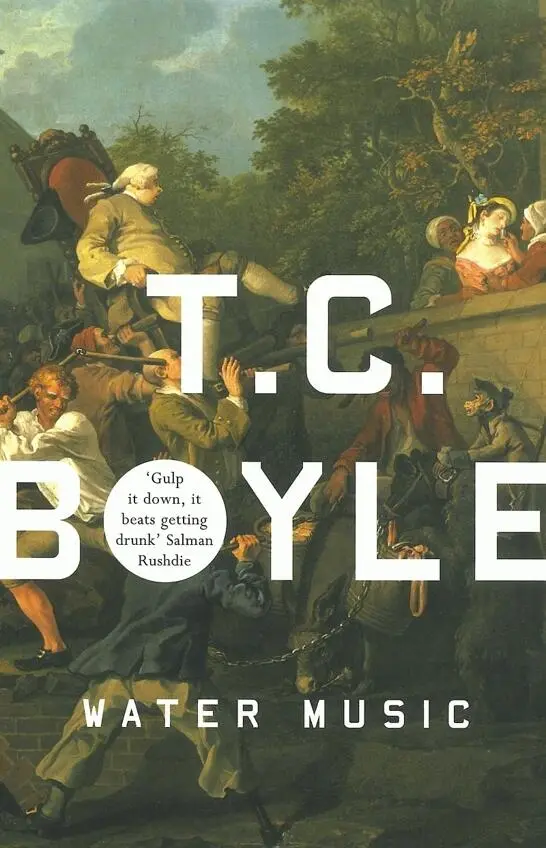
- Название:Water Music
- Автор:
- Издательство:Granta Books
- Жанр:
- Год:1983
- ISBN:9781862071551
- Рейтинг книги:3 / 5. Голосов: 1
-
Избранное:Добавить в избранное
- Отзывы:
-
Ваша оценка:
Water Music: краткое содержание, описание и аннотация
Предлагаем к чтению аннотацию, описание, краткое содержание или предисловие (зависит от того, что написал сам автор книги «Water Music»). Если вы не нашли необходимую информацию о книге — напишите в комментариях, мы постараемся отыскать её.
Water Music — читать онлайн бесплатно полную книгу (весь текст) целиком
Ниже представлен текст книги, разбитый по страницам. Система сохранения места последней прочитанной страницы, позволяет с удобством читать онлайн бесплатно книгу «Water Music», без необходимости каждый раз заново искать на чём Вы остановились. Поставьте закладку, и сможете в любой момент перейти на страницу, на которой закончили чтение.
Интервал:
Закладка:
“Doc-Doctor—” Quiddle stammers.
Delp swings around on a fountain of blood, the drained face of his assistant, and worst of all the trembling eyelids and fitfully clenching fists of the corpse on the table. His mouth falls open, the pointer drops to the floor. With the clear unreasoning instinct of a hunted animal he staggers back, turns, and bolts for the door.
“Stop! Stop! Stop!” screams Abernathy, leaping the rail and springing to the floor like a geriatric acrobat. “He’s alive! The fellow’s alive! Stop that blood, man!”
Quiddle is the first to come out of it. Corpses don’t spring to life, he tells himself. Vampires, zombies, ghouls — a patient is bleeding to death. No time for thought, surprise, terror, his fingers are at the wound, pinching off the sheared vessels, and now Abernathy and Delp are at his side, trembling with the urgency of it, shouting for ligature and cautery.
In the gallery, the shock is not so easily overcome. Freischütz has fainted dead away, the students from Leyden are under the seats, the society gentlemen on their feet, as mad and uncertain as horses caught in a burning barn. Beside them, the lady sits rooted to her seat, eyes glazed with shock and incomprehension. But then a new look creeps into her face, a look of certainty and joy. Silently, reverently, she slips to her knees and clasps her hands in prayer. “Blessed be the Lord,” she murmurs. “It’s a miracle.”
Down on the floor, in the midst of the flurry round the slate-topped table — hands and instruments and terse panting commands — Ned Rise lifts his head and opens his eyes on Resurrection Day and the shifting lights and colors of life.
♦ THE LOTOS-EATER ♦
“We thought you were dead,”
“Yes, old boy, sorry to say it, we did.”
“Well, I mean, no word in two years’ time— and then that devastating news from Laidley about your Moorish captivity. . Tell me, confidentially now, do they really take their women from behind?”
Another reception, another round of drinks, another bank of faces. As best the explorer can ascertain, this is the twentieth bash thrown in his honor since he got back a month ago — or is it the twenty-first? The pace is killing. But exhilarating. He goes from one lecture to the next, one drawing room to another. One night he meets a duchess, the next an earl. Mungo Park, son of a crofter, rubbing elbows with the high and mighty — and not twenty-seven yet. Heady, is what it is.
No. 12, St. James’s Place
The Baroness von Kalibzo requests the
honor of your presence at a reception for
Mr. Mungo Park, geographical luminary and
discoverer of the River Niger.
9:00 P.M.
28 January, 1798
Sir Joseph, who isn’t much for these affairs, had warned him about the Baroness. Though she was cousin-german to the King, and of the highest rank and precedence in her own country, her reputation in London was somewhat unsavory. Sir Joseph would only say that she had been “guilty of excess,” and he advised the explorer to decline the invitation. But when it became apparent that Mungo was to be the guest of honor. Sir Joseph agreed that he should attend, if only for an hour or two.
So here he is, basking in the adulation of his social superiors, sipping at his fourth glass of wine, munching crackers smeared with Russian caviar and experiencing the distinct sensation that all is right with the world. Blackamoor servants in periwigs and Cluny lace scurry about, bare-bosomed statuary and portraits by Bonifacio, Titian and Fra Bartolommeo line the walls, a nine-piece orchestra softens the atmosphere. And what’s more, every time he opens his mouth, people in evening dress crowd round him. Is this paradise, or what?
At the moment, Sir Ralph Sotheby-Harp and two other wealthy subscribers to the African Association have worked him into a corner beside a potted fern. They are excited, their faces lambent with the ardor of pure and disinterested scientific inquiry as they press him for details pertaining to the sexual preferences of the various tribes, while the explorer, usually reticent in such situations, finds himself waxing glib under the influence of the wine. “The Foulahs, so I’m told, often have sex while mounted on their camels, and the Serawoolis—” here he lowers his voice while a blackamoor servant refills his glass and his auditors lean forward, “—the Serawoolis actually prefer prepubescent ewes to their women—“
“How unutterably dull.” The Baroness has appeared from nowhere, her head a mass of curls, neckline plunging to the point of no return. “To reduce so vital and transcendent an act as luff to mere lubricity, I mean. Don’t you tink, Mr. Park?”
“I–I—uh. .”
“Come,” she says, locking arms with him, “I haff some odder guests you maybe would like to meet. Gentlemen, you’ll excuse us pleese?”
♦ ♦ ♦
A few hours later the explorer is three sheets to the wind and leading the Baroness through a vigorous and semispastic reel while the other dancers clear the floor and the violin strains away at the upper end of the fingerboard. Chandeliers flash by overhead, plants, statues, paintings and astonished faces melding in a vertiginous blur, the Baroness looming and receding like a vision in a dream. She kicks up her heels, spins like a dervish, hair falling down her back in loops, bosoms jogging, petticoats aflutter. Inspired, the explorer attempts a sort of grand jeté, springing across the room like an antelope, leaping a writing desk and spinning toward his partner in a series of widening spirals. He feels so good he could shout for joy, roar like a lion, beat his chest and howl like some elemental force of nature. Unfortunately, he loses his balance at the last moment and pitches headlong into the Baroness, driving her back against a Pembroke table and blasting it to splinters. She lies there a moment, pinned beneath him, forty years old and feeling twenty. “You’re quite a dancer, Mr. Park,” she murmurs finally, her long-fingered hands spread across his back.
A moment later the two terpsichoreans are back on their feet, grinning, a knot of anxious guests crowding round to survey the damage. “More champagne!” calls the Baroness. “Strike up the orchestra!”
Dutifully, the musicians launch another tune, and a few couples edge timidly out onto the floor. Someone is telling a joke in the corner, the wave of chatter swells again, the incident already forgotten. The Baroness smooths her bodice, plumps her bosoms and adjusts the ruffles of her skirt, while the explorer brushes at his frock coat, momentarily at a loss for words. “Mein Gott, dat was fun,” she says finally. And then: “May I offer you anodder glass of champagne, Mr. Park?”
“Yes — yes, of course. And please: call me Mungo.”
While the servant refills their glasses, she looks up at him in a wide-eyed, cattish sort of way. “Iss dere anyting else at all you might want of me — Mungo?”
The explorer stands there, swaying back on his heels, grinning like an idiot, lost in contemplative admiration of the front of her dress.
“Maybe you would be interested to see the rest of the house — the sitting room, library. . my bedchambers?”
He watches her sip at her wine, the tip of her tongue like a bud, rich and pink and moist “And uh,” he stammers, fighting for nonchalance, “the Baron. . uh, I don’t believe I’ve had the pleasure yet—”
“Ach!” she says, taking his arm. “Didn’t I tell you? The poor man succumbed t’ree years ago.”
♦ DOWN AND UP AND DOWN AGAIN ♦
It’s been a shattering month. A month of trial and vindication, doubt giving way to certainty, crisis to resolution. And then this sudden deflation, the rush of joy and affirmation superseded by a new and malignant sense of incomprehension and hurt, lingering, persistent, dull. Like having a tooth pulled, the same tooth, twenty-four hours a day, thirty days running.
Читать дальшеИнтервал:
Закладка:
Похожие книги на «Water Music»
Представляем Вашему вниманию похожие книги на «Water Music» списком для выбора. Мы отобрали схожую по названию и смыслу литературу в надежде предоставить читателям больше вариантов отыскать новые, интересные, ещё непрочитанные произведения.









Обсуждение, отзывы о книге «Water Music» и просто собственные мнения читателей. Оставьте ваши комментарии, напишите, что Вы думаете о произведении, его смысле или главных героях. Укажите что конкретно понравилось, а что нет, и почему Вы так считаете.