T. Boyle - Water Music
Здесь есть возможность читать онлайн «T. Boyle - Water Music» весь текст электронной книги совершенно бесплатно (целиком полную версию без сокращений). В некоторых случаях можно слушать аудио, скачать через торрент в формате fb2 и присутствует краткое содержание. Год выпуска: 1983, ISBN: 1983, Издательство: Granta Books, Жанр: Современная проза, на английском языке. Описание произведения, (предисловие) а так же отзывы посетителей доступны на портале библиотеки ЛибКат.
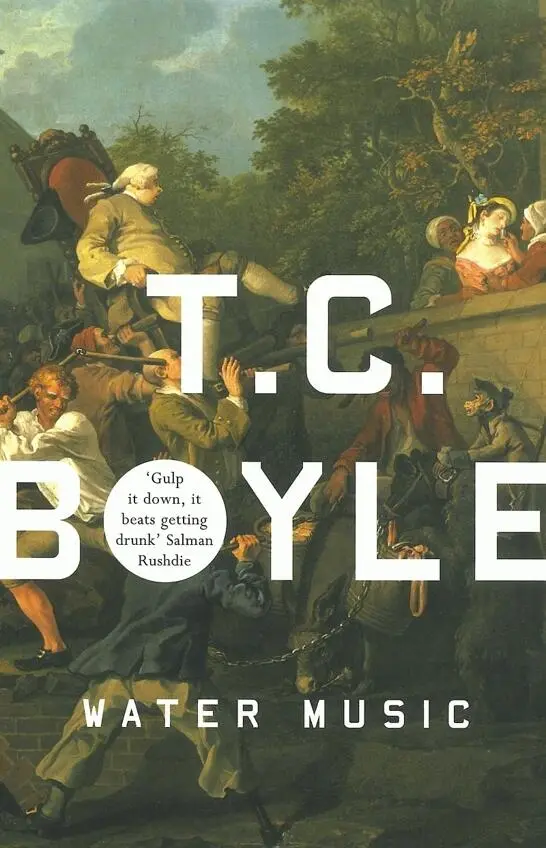
- Название:Water Music
- Автор:
- Издательство:Granta Books
- Жанр:
- Год:1983
- ISBN:9781862071551
- Рейтинг книги:3 / 5. Голосов: 1
-
Избранное:Добавить в избранное
- Отзывы:
-
Ваша оценка:
Water Music: краткое содержание, описание и аннотация
Предлагаем к чтению аннотацию, описание, краткое содержание или предисловие (зависит от того, что написал сам автор книги «Water Music»). Если вы не нашли необходимую информацию о книге — напишите в комментариях, мы постараемся отыскать её.
Water Music — читать онлайн бесплатно полную книгу (весь текст) целиком
Ниже представлен текст книги, разбитый по страницам. Система сохранения места последней прочитанной страницы, позволяет с удобством читать онлайн бесплатно книгу «Water Music», без необходимости каждый раз заново искать на чём Вы остановились. Поставьте закладку, и сможете в любой момент перейти на страницу, на которой закончили чтение.
Интервал:
Закладка:
Yrs., Et Cetera,
Mungo
A few months’ time? She’s waited an eternity already. Badgered and beleaguered, fighting off the wide world for faith in him. And now he’s too busy to see her? Too involved with his book to come up to Selkirk for a week and tell her he’s missed her as she has so painfully and vitally missed him? She crumples the letter in disgust, suddenly filled with remorse for what she’s done to Georgie Gleg. It hits her like an epiphany: poor Georgie, he must feel as hurt and bewildered as I do now.
But that’s another story.
♦ GLEG’S STORY
(BORN UNDER A BAD SIGN) ♦
Georgie Gleg was born at Galashiels, second son of the local laird. As the moment of parturition approached, a golden eagle coasted down out of the haze, flapped its great dark wings a time or two, and settled lightly on the weathervane atop the Gleg house. The locals were astonished. People came running from shops and fields to stand in the courtyard and gawk at it.
“It’s a sign,” someone said.
“Aye,” said another, “but is it auspicious or no?”
A debate started up, right there beneath the windows of <���“he laird’s house, Georgie’s mother crying out in pain, the eagle preening its wings as calmly as if it were perched high in its aerie.
“It’s the devil’s own hand laid on, I tell you,” insisted a man in an oversized hat.
“You’re a blatherin’ fool,” countered another. “It’s a benediction out of the heavens is what it is.”
Almost immediately a fistfight erupted. Women screamed, horses whinnied, someone broke out a bottle of whisky. Factions were already forming, and there were indications that the controversy could develop into a full-scale brawl, when suddenly Davie Linlithgow put an end to it. He raised his musket and took the bird’s head off in a blast of fire and smoke. Spastic, the big-feathered torso pitched forward and slathered the tiles with blood.
The crowd fell silent, the combatants held their punches. Upstairs, thin and harsh as a penny whistle, the voice of Georgie Gleg was heard for the first time on earth.
♦ ♦ ♦
If there were any doubts as to the meaning of the events surrounding Gleg’s birth, they were unequivocally dispelled as he grew into boyhood. Without question the appearance of the great bird had been ominous, its slaying a disaster: misfortune settled on the boy’s shoulders like a winged apparition. When he was six his father was killed in a hunting accident, and his sister Effie — the darling of the family — was kidnapped by gypsies and nailed to a tree in the wood beyond the north pasture. Anthrax decimated the flocks that year and three of five milch cows went dry. Inexplicably, the hens began laying yolkless eggs. There was a fire in the barn. Hailstones the size of goiters wiped out the wheat crop, and Georgie’s elder brother was struck by lightning. Poor Simon. They found him laid out in the heather as limp as some soft boneless thing washed up out of the sea.
Two years later Georgie’s mother remarried. Tyrone Quaggus, the new man of the house, was a gambling fool. Skeet shooting, tea drinking, a stroll in the garden — any human activity was occasion for a wager. I’ll bet you can’t put away twenty cups of tea in half an hour, vicar, he would say. Ten pund says I can make it around the garden in two minutes flat. See that jay out in the hedge? Five’ll get you ten he raps on this windowpane before noon. By the time Gleg was twelve, Quaggus had squandered the boy’s patrimony and three quarters of the estate as well. The family was in deep trouble.
But as if that weren’t enough, the blight touched Georgie in a far more subtle and insidious way: it made him a pariah. People shied away from him as if he were a leper, dogs snarled at him, his coevals kept him at a distance with sticks and stones. He was a toad, a worm, a freit — not fit for human company. And what made matters worse is that Gleg so clearly looked the part. He grew thin and ribby, with narrow shoulders and a breast like a plucked chicken. His feet were huge, his hands chapped. Talk had it that the high arched beak of his nose was the mark of the bird on him. His eyes too — they were tiny and close-set, flecked with yellow and red, pushed far back in his head and rimmed with flesh the color of liver. Bird’s eyes.
At school he was the object of taunts, epithets, practical jokes, inhuman pranks, outright mockery and patent disdain. He was ten years old, homely as a horse, and the best Latin scholar in the Selkirk grammar school. This last was the kiss of death as far as his classmates were concerned. If they could forgive him his strangeness, his flapping ears and lack of coordination, they could never forgive the way the declensions rolled off his tongue, effortlessly, while they sat agonizing over the ratlike scrawlings in their battered copybooks. The older boys were particularly incensed. They’d been at it, day and night, for four years — only to be shown up by a sniveling little wimp of a bejan. They decided to get even.
As school let out one evening, four of the older scholars — the Park brothers, Finn Macpherson and Colin Raeburn — took a detour on their way home and met at Ballindalloch Glen. The air was crisp and dry, the snow crepitated under their feet. Adam and Mungo had a fire going by the time the others arrived, uncertain shadows emerging from the black screen of the woods. They greeted each other silently, grimly; Finn slipped the jar of whisky from his pocket as if it were a dirk. No one mentioned Meg Munro. There was no talk of football or shinty, there were no jokes. This was serious business. This was a council of war.
Gleg had done the unthinkable — he’d won the Hogmanay prize for accomplishment in the scholarly tongue by outdoing his classmates in a sight translation from the Eclogues . The prize was half a crown, donated each year by Mrs. Monboddo, a widow with an enormous bosom and a taste for culture. Never before had a first-year boy won the prize.
“This is the straw that broke the camel’s back,” Adam said. “We’ve got to teach the little bastard a lesson.”
Finn passed the jar to Mungo, wiped his mouth with the back of his hand and assented. “I’m for layin’ his ears back.”
“No, no. We’ve got to be more subtle, trip him up with the old man. ” Adam, at fourteen, was the leader among them, though Mungo and Colin were a year older and set to graduate at the end of the term. Mungo, in fact, wasn’t much interested in the whole affair — he’d come along merely to show solidarity. It wasn’t so much that he liked or disliked Gleg — of course he disliked him — it was simply that he couldn’t be bothered with such petty concerns. At fifteen, Mungo was something of a golden boy: an average scholar, but the best athlete in school, despite a tendency toward clumsiness. He was already six feet tall, and he had the musculature of a grown man. “I’m with Finn,” he said.
Adam took his turn at the jar. “Hear me out,” he said, and leaned forward to outline his plan. It was fiendish in its simplicity, and what’s more it involved Gleg in a major transgression of school discipline: Since the raison d’être of the local grammar school was to inculcate an understanding of Latin, all students were interdicted from speaking Scots — at work or play — during the hours that school was in session. This rule was enforced through the use of spies or “private clandestine captors,” who would report violations to the schoolmaster. The first offense was punishable by a public upbraiding and a fine of two shillings, the second by a whipping before the class. The older boys, of course, knew who the spies were and bought their silence in one way or another. Of the six or seven finks operating in a class of thirtyseven, Robbie Monboddo was the most dependable. They’d simply have him give the schoolmaster a false report on his star pupil. Mr. Tullochgorm. I’ve a boy to report, Sir. Young Gleg. Profaning the Lord — and in broad Scots, Sir.
Читать дальшеИнтервал:
Закладка:
Похожие книги на «Water Music»
Представляем Вашему вниманию похожие книги на «Water Music» списком для выбора. Мы отобрали схожую по названию и смыслу литературу в надежде предоставить читателям больше вариантов отыскать новые, интересные, ещё непрочитанные произведения.






Обсуждение, отзывы о книге «Water Music» и просто собственные мнения читателей. Оставьте ваши комментарии, напишите, что Вы думаете о произведении, его смысле или главных героях. Укажите что конкретно понравилось, а что нет, и почему Вы так считаете.