T. Boyle - Water Music
Здесь есть возможность читать онлайн «T. Boyle - Water Music» весь текст электронной книги совершенно бесплатно (целиком полную версию без сокращений). В некоторых случаях можно слушать аудио, скачать через торрент в формате fb2 и присутствует краткое содержание. Год выпуска: 1983, ISBN: 1983, Издательство: Granta Books, Жанр: Современная проза, на английском языке. Описание произведения, (предисловие) а так же отзывы посетителей доступны на портале библиотеки ЛибКат.
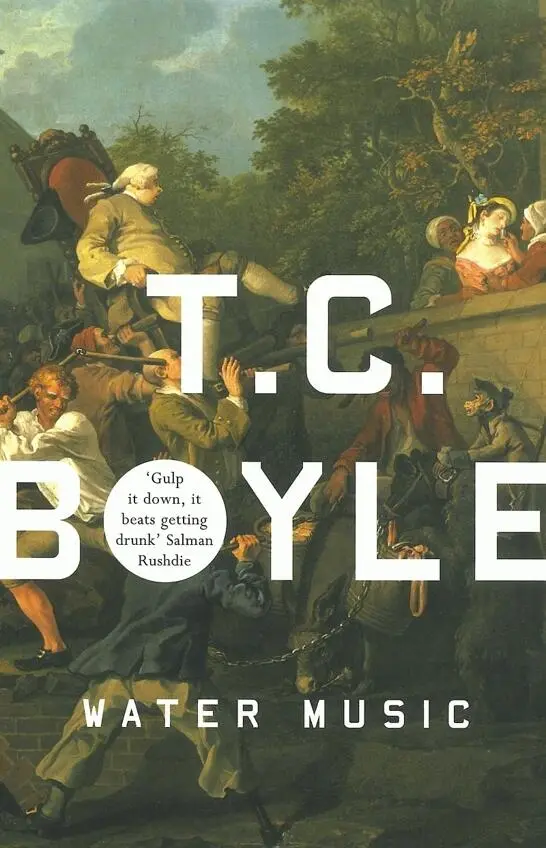
- Название:Water Music
- Автор:
- Издательство:Granta Books
- Жанр:
- Год:1983
- ISBN:9781862071551
- Рейтинг книги:3 / 5. Голосов: 1
-
Избранное:Добавить в избранное
- Отзывы:
-
Ваша оценка:
Water Music: краткое содержание, описание и аннотация
Предлагаем к чтению аннотацию, описание, краткое содержание или предисловие (зависит от того, что написал сам автор книги «Water Music»). Если вы не нашли необходимую информацию о книге — напишите в комментариях, мы постараемся отыскать её.
Water Music — читать онлайн бесплатно полную книгу (весь текст) целиком
Ниже представлен текст книги, разбитый по страницам. Система сохранения места последней прочитанной страницы, позволяет с удобством читать онлайн бесплатно книгу «Water Music», без необходимости каждый раз заново искать на чём Вы остановились. Поставьте закладку, и сможете в любой момент перейти на страницу, на которой закончили чтение.
Интервал:
Закладка:
The doctor pauses by the bust of Vesalius to blow out a long sigh of resignation, the columns and cornices of Bath and his children’s disappointed faces already receding into the far corners of his consciousness and the problem at hand emerging like a coach hurtling out of the mist. You’ve got to take them when you can get them, he knows that. Christmas, anniversaries, the first golden day of spring — if Quiddle comes round and says he’s got a corpse on ice, then it’s an operating day. No two ways about it. There’s been a real dearth of cadavers these past few years, and the competition has been fierce for the few clean and unmutilated specimens that do turn up. Everybody’s getting into the act. The Royal College of Physicians, Oxford University, St. Thomas’s Hospital, St. George’s, Guy’s, Westminster, Middlesex. The earth doesn’t even have time to settle over half the churchyards in London before someone’s dug up the late dear departed and sold off his moldering remains to the highest bidder. But what’s a man of science to do? Look at Philpott, over at the Royal College. He was so hard up for bodies he dissected his own three-year-old son, dead of the whooping cough, before a class of unsuspecting anatomy students.
“Decius!” Quiddle is waiting for him outside the door of the amphitheater. “How are you this morning? Have a good holiday?”
Delp fixes his assistant with a fishy stare. “What do they look like?”
“The one’s a beauty, laid out like a dead angel. The other—”
“Yes?”
“The other’s a dwarf.”
“A dwarf? Damnation. He came cheap I suppose?”
“Thirty-five quid for the sound one, twenty for the dwarf. Agent for Middlesex Hospital beat me to the first one — a pity too. He was a real corker, that one. A giant. Six-two or — three, at least.”
Delp, absorbed in the process of unbuttoning his greatcoat and ducking out of his muffler, looks up sharply. “You mean that son of a bitch Crump is selling them off to Middlesex now — after all the business we’ve given him?”
“ ‘They goes to the ‘ighest bidder,’ that’s what he told me.”
The doctor shrugs angrily out of his coat, tears off the muffler, fumbles for a match and then throws the whole box of them down in disgust. The corridor is haunted with shadows, early morning, underlit, a cold wind humming at the walls. “Well, let’s have a look at them then.”
♦ ♦ ♦
In his garret on Paternoster Row, Dirk Crump warms his hands over the grate and counts through the pile of coins on the table before him — nearly a hundred pounds. Not bad for a day’s work. The real stroke was to get that old hag in there to claim the murderer’s body. What hangman is going to deny the poor unfortunate’s dear old mom? The dwarf was up for grabs, of course — where would you find a hoary old midget to play the bereaved father anyway? But the big one, he was easy. Just hand over five shillings to Tall Bob, the apothecary’s assistant, and have him run over his lines twenty or thirty times: I’m Will’s brother, come over from Southwark. Da’ sent me to fetch ‘im ‘ome in the cart.
Bob blew his lines, but there was nobody there to care much about it, and the old lady — she was perfect. Absolutely deranged with grief. He’ll have to see if she wants to work for him on a regular basis. There were two or three friends or relatives or whatever pressing the hangman to give up the body to them, but the old lady shoved her way through the throng, screeching and blubbering like the mother of Christ come to haul him down from the cross. The only problem was she didn’t want to give up the body once she’d got it into her cart and hustled round the corner. Even now it makes him shudder to think of the look in her eyes as she sat perched atop the donkey cart in her black tatters like a ghoul or zombie or something. “Eeeeeeeeee!” she shrieked, “ ‘ee’s sleepin’ sound now I’ll warrant. Five pund and ‘ee’s yours.”
She had him over a barrel: he knew he could get thirty easy. He counted the coins out into her twisted claw, tossed the corpse in with the other two and trundled up Paternoster Row. Then settled down in a chair by the grate and waited for Quiddle and Babbo and the rest of them to come round and bid up the price. What am I bid? he asked Quiddle, leering across the table. Eh? What am I bid?
♦ ♦ ♦
The operating theater is close and warm. The two students from Leyden are there, bent over drawing pads and notebooks; behind them Delp recognizes Freischütz, the serious young German with the long nose and frazzled hair. Dr. Abernathy is there of course, seated in the front row, ever curious about the mysteries of the organism. In the back: four strangers, one of whom is a lady. Quiddle had arranged it. Society people with a scientific bent and a pocketful of guineas. They’ve come for the frisson.
Delp bows curtly to his audience before drawing on the calfskin gloves he customarily dons when delving into the body corporeal. He then clears his throat and fixes his gaze on Dr. Abernathy’s stockings; “Today we will begin with an examination of the principal sanguiferous conduits of the leg. . Quiddle?”
Quiddle, in white smock and cravat, strides briskly to the center of the room, where the two cadavers, large and small, lie side by side on a massive slate-topped table. With a flourish, he uncovers the smaller of the two. There is a murmur from the back row, tailed by a soft ladylike gasp. The doctor turns to the corpse, pointer in hand, and frowns. One of the dwarfs hands, rigid as a claw, is frozen at the neck, his body the size of a child’s, his face an accusation — twisted with rage and agony, eyes locked, lips drawn back from the teeth in a wild desperate grin — monstrous and absurd all at once. “No, no,” Delp whispers, “let’s begin with the other one.”
Obedient and efficient factotum that he is, Quiddle pulls the sheet up over the dwarfs ears and the audience breathes a sigh of relief. As he bends to expose the second cadaver, the apprehension is palpable — the lady’s fingers dart to her mouth, ready to stifle a cry, the students from Leyden are suddenly struck with the architecture of the ceiling, young Freischütz sucks at his pen until his lips turn black. But as it turns out, there’s no cause for alarm: the body is at rest, arms at its sides, face clear and untroubled, a white towel swaddling the groin. If it weren’t for the rope burns and broken blood vessels discoloring the throat, one would never guess that the fellow had died an agonizing and premature death — he could be sleeping, playacting, posing for a diorama of Adonis slain by the boar. A hush falls over the room, all eyes fixed on the limp and pallid form on the operating table.
The dry cutting voice of Dr. Delp is almost an intrusion. “As I was saying, today we will begin with an investigation into the blood vessels of the leg. . ah. . Quiddle, if you please?”
As Quiddle’s scalpel deftly lays open the dermis of the lower leg in order to expose the anterior tibial artery, a strange and wonderful thing happens: a rush of blood — forceful as a geyser — leaps up from the incision to spatter his chest, face and hands, coloring the smock as if it were a canvas.
“The anterior tibial artery,” Delp intones, his back to the table, “branches off at the patella from the posterior tibial artery, which in turn branches off to form the peroneal artery—” He cuts off in midsentence, wondering what has gone wrong. Abernathy is on his feet, speechless, the students from Leyden have dropped their notebooks with a clatter, the faces of the society people are ashen. . and then, as chilling as a summons from beyond the grave comes the groan at his back, subhuman, riveting, terrible.
Читать дальшеИнтервал:
Закладка:
Похожие книги на «Water Music»
Представляем Вашему вниманию похожие книги на «Water Music» списком для выбора. Мы отобрали схожую по названию и смыслу литературу в надежде предоставить читателям больше вариантов отыскать новые, интересные, ещё непрочитанные произведения.





Обсуждение, отзывы о книге «Water Music» и просто собственные мнения читателей. Оставьте ваши комментарии, напишите, что Вы думаете о произведении, его смысле или главных героях. Укажите что конкретно понравилось, а что нет, и почему Вы так считаете.