T. Boyle - Water Music
Здесь есть возможность читать онлайн «T. Boyle - Water Music» весь текст электронной книги совершенно бесплатно (целиком полную версию без сокращений). В некоторых случаях можно слушать аудио, скачать через торрент в формате fb2 и присутствует краткое содержание. Год выпуска: 1983, ISBN: 1983, Издательство: Granta Books, Жанр: Современная проза, на английском языке. Описание произведения, (предисловие) а так же отзывы посетителей доступны на портале библиотеки ЛибКат.
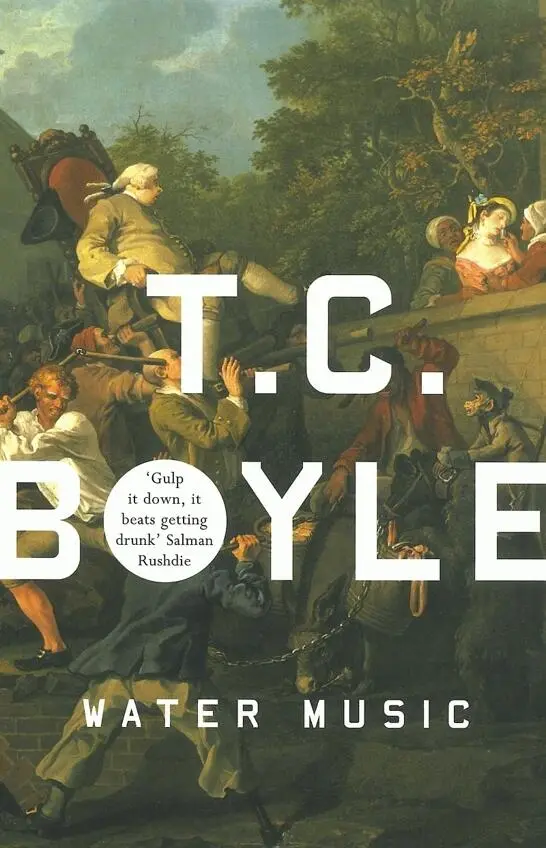
- Название:Water Music
- Автор:
- Издательство:Granta Books
- Жанр:
- Год:1983
- ISBN:9781862071551
- Рейтинг книги:3 / 5. Голосов: 1
-
Избранное:Добавить в избранное
- Отзывы:
-
Ваша оценка:
Water Music: краткое содержание, описание и аннотация
Предлагаем к чтению аннотацию, описание, краткое содержание или предисловие (зависит от того, что написал сам автор книги «Water Music»). Если вы не нашли необходимую информацию о книге — напишите в комментариях, мы постараемся отыскать её.
Water Music — читать онлайн бесплатно полную книгу (весь текст) целиком
Ниже представлен текст книги, разбитый по страницам. Система сохранения места последней прочитанной страницы, позволяет с удобством читать онлайн бесплатно книгу «Water Music», без необходимости каждый раз заново искать на чём Вы остановились. Поставьте закладку, и сможете в любой момент перейти на страницу, на которой закончили чтение.
Интервал:
Закладка:
But this evening, despite the turmoil of the times, the beau monde has gathered at Covent Garden for a Christmas concert featuring selections from Handel’s Messiah . Outside, the snow lies thick on the cobblestones, in the gutter, in the branches of the trees; inside, the nobs of London bask in the glow of their own sunny faces. King George is there of course, accompanied by Queen Charlotte and their daughters. He has not been looking well of late, and his ministers fear that he may once again be falling prey to the madness that put him out of commission in ‘88 (a madness that prompted him at one point to attempt to throttle the Prince of Wales over the question of succession to the throne). In another box, the Prince is entertaining one of his father’s greatest antagonists, Charles Fox, and the young arbiter of fashion, Beau Brummell. Behind them, the hall is packed. Fanny Burney is there, the Duke of York, Peg Woffington, Lord Hobart. Wilberforce the Abolitionist settles himself in the back row, along with the Bishop of Llandaff, member in absentia of the African Association, while the Countess Binbotta, as sleek and smug as a full-bellied shark, makes a show of offering her heartfelt thanks to William Pitt and the Lord Mayor. Throughout the hall there is a rustle of silks and ornamental swords, the sound of subdued chatter, sniffling, discreet coughs. The scents of lilac water and eau de cologne thicken the air.
Mungo Park, seated at the right hand of Sir Joseph Banks, is feeling a bit giddy. From the moment he took his brother-in-law’s hand in the predawn quiet of the museum gardens, he has been thrust into a vortex of activity, a constantly accelerating round of good cheer, congratulations, beefy faces and raised glasses. Roast goose with Dickson and Effie, punch, Yorkshire pudding and rum cake with Sir Reginald Durfeys, a tree full of candles, snatches of forgotten song, three slices of mince pie and brandy at Sir Joseph’s, a welter of parties, coaches, snowy streets, slapped backs and extended hands — and now this. He is delighted, upset, comforted, dyspeptic, exhausted, exhilarated. As soon as the word got out, the members of the African Association had flocked to him, eager as schoolboys at a rugby match, probing with their animated faces and thousand-and-one questions. Did the negroes slice steaks from living cattle and eat them on the spot? Were the cities made of gold or dung? How wide was the river? Was it commercially viable? Were the hippogriffs a problem?
This is what he’s wanted, this is what he’s dreamed of. He’s the talk of London, a sensation, the cynosure in this galaxy of pole stars. But he is tired, bone-tired. Banks is at his elbow with yet another introduction, and he can barely hold his head up. “Oh Mungo, have you met the Duke of Portland?” the languid aristocratic tones bathing the name in syrup, “This is the fellow I was telling you about, Duke — been to the Niger and back. . this morning. . east! Flows east!”
But then, mercifully, the lights dim, the conductor mounts his podium and the opening strains of the “Sinfonia” sift through the hall. The effect on the explorer is instantaneous. The sound of strings, organ and trumpet is an anodyne, washing him in the sweetness and light of civilization, whispering of precision and control, of the Enlightenment, of St. Paul’s and Pall Mall, of the comfortable operation of cause and effect, statement and resolution. He is back, at long last he is back. Back in a society where the forms are observed and love of culture is a way of life, a society that nurtures Shakespeares, Wrens, Miltons and Cooks. Hail Britannia, yes indeed.
When he looks up, the bass soloist is fulminating against “The people that walked in darkness,” and Mungo thinks of Ali, Eboe, Mansong, the chaos and barbarity of Africa. But then the chorus comes in like a thunderbolt to drive back the darkness with the joy and intensity of “For unto us a child is born” and he feels that he’s never heard anything so beautiful. And now the soprano is opening up, soaring like an angel, the pageant unfolding, a venerable old story of shepherds in their fields and the glad tidings of mankind’s redemption. When the alto steps forward to begin her recitative, “Then shall the eyes of the blind be opened,” Mungo finds himself thinking of Ailie. The soloist is slight, built like a boy, her black hair coiled in a chignon. Mungo’s eyes are closed, there are children on the undersides of his lids, a stone house, Ailie at the door — but then he’s jolted back to consciousness by a grating cacaphony, some disturbance in the front row, someone. . someone shouting down the soloist!
It is the King, on his feet, calling out the name of a composition like a drunkard in a tavern. The audience is stunned; the courageous little alto falters but continues, her voice ringing out over the harsh persistent cries of the King. His Royal Highness seems to be calling for an earlier piece, a favorite of his great-grandfather, and now the Queen is on her feet tugging at his sleeve, and Pitt is running down the aisle, the orchestra losing heart as the red-faced man in the silver wig keeps shouting for “Water Music, Water Music, Water Music!”
TWO. THE YARROW
“What’s the yarrow but a river bare,
That glides the dark hills under?
There are a thousand such elsewhere
As worthy of your wonder.”
— WILLIAM WORDSWORTH, “Yarrow Unvisited”LAZARUS
Muttering darkly as he trudges through the drifts heaped up around the steps of St. Bartholomew’s Hospital, Dr. D. W. Delp is in no mood for miracles. In fact, if a miracle sat up and slapped him in the face over his small beer and muffin he’d shout it down and chase it right back where it came from, and then possibly, if he felt insulted enough, dissertate in Latin on the experiential impossibility of its existence. He is in a funk this morning, a screaming blue funk, rankled to the quick by what he perceives as a failure of government — or rather, the impossibly inconsistent and unpredictable judicial system upon which it rests. The idea of hanging a man on Christmas Day! Shocking. Barbaric. Worse than that: inconsiderate. He swipes angrily at the iron handrail, misses, catches a pool of dead gray ice with his left foot, and goes down cursing on the hospital steps. “Where the bloody hell is that porter?” he shouts, slamming through the door and shocking the nurses out of their bonnets. “Do we pay him his five shillings a week to remove the frost around here or don’t we? Well, where is he? Malingering by the fire and warming his lazy arse no doubt, eh? Sucking at a pot of beer, eh?”
The porter peeks out from the broom closet, sheepish, while patients in nightcaps, splints and yellowed wrappings sink into themselves, momentarily hushed by the doctor’s outburst. Delp stands there a moment in his greatcoat, muffler and beaver hat, snorting through his mustache. And then an elderly patient, his leg withered and eyes clouded with cataracts, calls out in a feeble voice: “Doctor, it’s me lungs — me lungs is stopped up till I don’t know whether I’m dead or alive.”
That’s all it takes: the spell is broken, the pall lifts. Like supplicants before the oracle they crowd in on him with their arthritic hands and gouty legs, bleating Doctor, Doctor, Doctor .
But Delp has neither time nor inclination for them. He shoulders his way through the press, long legs kicking out impatiently, and makes his way up the corridor to his laboratory. No, it’s not sprains, rheumatism and goiters that have gotten him out of bed this morning. Suppurating sores and compound fractures are quotidian, unremarkable — hardly the sort of thing that would make a man forgo his holiday excursion to Bath on the day after Christmas, a trip planned long in advance to coincide with his son’s vacation from classes at Oxford and his daughter’s arrival, amidst trunks and boxes, from Miss Creamer’s boarding school. Oh, no. The only thing that could draw Delp to the hospital on such a day as this is scientific curiosity — the consuming desire for knowledge, the chance to extend the limits of anatomical understanding, the chance to perform a pedagogical dissection on a pair of cadavers obtained from the hangman the previous day.
Читать дальшеИнтервал:
Закладка:
Похожие книги на «Water Music»
Представляем Вашему вниманию похожие книги на «Water Music» списком для выбора. Мы отобрали схожую по названию и смыслу литературу в надежде предоставить читателям больше вариантов отыскать новые, интересные, ещё непрочитанные произведения.






Обсуждение, отзывы о книге «Water Music» и просто собственные мнения читателей. Оставьте ваши комментарии, напишите, что Вы думаете о произведении, его смысле или главных героях. Укажите что конкретно понравилось, а что нет, и почему Вы так считаете.