T. Boyle - Water Music
Здесь есть возможность читать онлайн «T. Boyle - Water Music» весь текст электронной книги совершенно бесплатно (целиком полную версию без сокращений). В некоторых случаях можно слушать аудио, скачать через торрент в формате fb2 и присутствует краткое содержание. Год выпуска: 1983, ISBN: 1983, Издательство: Granta Books, Жанр: Современная проза, на английском языке. Описание произведения, (предисловие) а так же отзывы посетителей доступны на портале библиотеки ЛибКат.
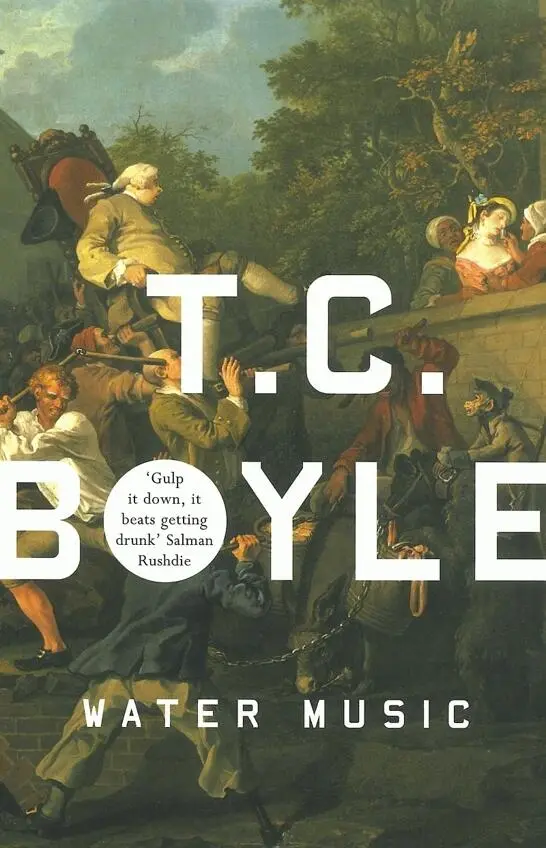
- Название:Water Music
- Автор:
- Издательство:Granta Books
- Жанр:
- Год:1983
- ISBN:9781862071551
- Рейтинг книги:3 / 5. Голосов: 1
-
Избранное:Добавить в избранное
- Отзывы:
-
Ваша оценка:
Water Music: краткое содержание, описание и аннотация
Предлагаем к чтению аннотацию, описание, краткое содержание или предисловие (зависит от того, что написал сам автор книги «Water Music»). Если вы не нашли необходимую информацию о книге — напишите в комментариях, мы постараемся отыскать её.
Water Music — читать онлайн бесплатно полную книгу (весь текст) целиком
Ниже представлен текст книги, разбитый по страницам. Система сохранения места последней прочитанной страницы, позволяет с удобством читать онлайн бесплатно книгу «Water Music», без необходимости каждый раз заново искать на чём Вы остановились. Поставьте закладку, и сможете в любой момент перейти на страницу, на которой закончили чтение.
Интервал:
Закладка:
“She wants to die,” said the man shackled to her.
After morning prayers the coffle reassembled. Nealee refused to stand and Suleiman was forced to uncoil his braided whip. She lay there, face down in the dust, and bore the first two or three strokes patiently, then rose shakily and started off. It was immediately apparent that something was wrong: she lurched forward and reeled back again, as if she were being tugged apart by some invisible force. Suleiman ordered one of his men to cut her from the tether and take up her load. The slatee then marched behind her himself, prodding her from time to time with the butt of his spear.
Just before noon there was a minor disaster. One of the singing men blundered into a hive of fierce, irascible West African bees — killer bees, as the locals called them. Through the millennia these insects had developed a swift, effective and inexorable means of dealing with the honey badgers and sweet-toothed hominids that assaulted their nests: at the slightest provocation they swarmed out en masse and stung the offender to death. Each bee was programmed to fly into a suicidal stinging frenzy at the release of an alarm chemical, which also served to direct the bee to its target. If a man was stung within a hundred yards of the nest, he could expect to be inundated by a foaming mass of insects in less than a minute. Needless to say, the encounter more often than not proved fatal.
In the case of Geo, the singing man, it wasn’t as bad as it might have been. The first sting prompted him to drop his flute and plunge headlong into a bog beside the path, where he burrowed into the muck like an amphibian. Two or three of his quick-witted companions followed suit, while the rest — free men, slaves and slatees alike — took to their heels. The bees, confused over the loss of the primary target, divided their forces in pursuit of the seventy-two secondary targets. Strategically, it was a mistake. As it turned out, no one in the party took more than fifteen or twenty stings, and some — the explorer included — escaped unscathed. But when the coffle was regrouped it was discovered that Nealee was missing. Immediately the slatees broke out the irons and shackled the slaves together, while armed guards ran off to track her down. After setting fire to the brush in order to drive off the bees, they found her beside a shallow stream, swollen with scores of beestings. She had apparently attempted to elude the insects by splashing water over herself. It hadn’t worked.
This time the whip was ineffective: she could not get up. Karfa Taura shook his head. “Strap her to the ass,” Suleiman shouted. The panniers were removed from one of the asses and Nealee was laid across the animal’s back, her hands and feet lashed together underneath. From the first the animal was intractable. It bucked and kicked until finally the straps gave way and Nealee was tossed into the bushes where she lay like a rag doll.
Over two hours had been lost. The members of the party, spooked by the wildness of the place and the hair-raising legends surrounding it, were anxious to move on. A cry went up and down the length of the coffle: “ Kang-tegi, kang-tegi .” Cut her throat, cut her throat. The sun scraped across the sky. A man stepped forward with a knife. Suleiman nodded at him, then ordered the coffle forward. Half an hour later the man rejoined the party, Nealee’s dress tied round his waist.
♦ ♦ ♦
The remainder of the journey was uneventful. The coffle proceeded in a series of forced marches, from dawn till dusk. Twenty miles a day, over mounds of splintered rock and hills haunted with shadow, through copses cluttered with fallen trees and strangling lianas, bogs that sucked the shoes from your feet, silt-clogged rivers darkened by clouds of insects and churning with fish and reptiles. It was all Mungo could do to keep up, weakened as he was by his bout with fever and starvation. He threw away his spear, his water gourd, the bone knife Aisha had given him. The straps of his sandals bit into his feet like wire and the sun crashed down on his head until all he could hear was the frenzied pshh-pshh-pshh of cymbals slashing away at the denouement of some opera or other. But he made it. First to Dindikoo, where he broke the bad news to Johnson’s three wives and eleven children, and then to Pisania, where he drifted up the front steps of Dr. Laidley’s log piazza like a ghost.
Dr. Laidley was fat and florid. He wore a dress shirt in one-hundred-tendegree heat and ninety-nine-percent humidity. With his tonsure and wire-rimmed spectacles he looked like a caricature of Ben Franklin. “Park?” he shouted, thundering across the floorboards, his pudgy hand outstretched in wonder and greeting. “Mungo Park?”
♦ ♦ ♦
Mungo was in luck. He arrived in Pisania on June 12, 1797, with one thought in mind: booking passage to England on any boat that would have him. But the monsoon season was settling in with its rot and pestilence, and he was afraid he’d have to wait it out before another boat landed on the Gambia. It could be months. He drew a bill on the African Association through Dr. Laidley, paid Karfa Taura handsomely, and settled in for a long, anticlimactic wait. But on the third day of his vigil, by purest coincidence, an American slaver sailed up the river to exchange a cargo of rum and tobacco for men, women, and children. The Charlestown was bound for South Carolina, departing on the seventeenth. Without hesitating, the explorer signed on: better to take a circuitous route home than wait out the rains in a leaky back room in Pisania. After two years on the Dark Continent, he was aching for some light.
On the morning of the seventeenth the explorer shaved, slipped into the clothes Dr. Laidley had provided him, and climbed aboard The Charlestown . The deck creaked under his feet as he set his valise down and tried to ascertain where his cabin might be located. He could see nothing. Fog hovered over the water like the underside of a dream, catching at the rigging, dissolving the quarterdeck. Vague forms glided ghostlike through the haze, mosquitoes whined. It was hot as an iron foundry. Puzzled, the explorer stood rooted to the deck and watched two figures gesticulating like Punch and Judy through a curtain of mist.
“We got to wait till the soup clears off, Cap’n,” said the shorter of the two.
“Draw the anchor, Mr. Frip. We sail immediately.”
“But—” (there was the sound of mosquito slapping and a guttural, heartfelt curse).
“But me no buts, Mister. Stay here in this fetid shithole another ten minutes and half the crew’ll be down with the shivers and the black vomit.
Haul that anchor, I say!”
The smaller figure drew off into the gloom, mumbling and swatting: “Can’t even find the fuckin’ thing in this shit. . Ouch! Sonofabitchin’ moskeeters. .”
It took two weeks to get down the river to Fort Goree, held up as they were by heavy fog, snags and contradictory winds. Four seaman, the ship’s surgeon and three slaves died of fever along the way. At Goree the Captain informed Mungo that the ship would be unavoidably detained because he was unable to obtain provisions for the crossing. “Detained?” said Mungo, his heart sinking. For two months now — lying at Kamalia, struggling through the Jallonka Wilderness — he had been sustained by visions of the eager, attentive faces ranged round the conference table in Soho Square, of Ailie in her underwear, of his book and burgeoning celebrity. He’d survived disease, humiliation, exhaustion and despair, and now he was ready to reap his reward. “For how long?” he asked.
The Captain pulled on his dogskin gloves and offered the explorer a Raleigh cigar. “There’s a relief boat due in at Goree in mid-September,” he said. “We can stock up then and be on our way.”
Читать дальшеИнтервал:
Закладка:
Похожие книги на «Water Music»
Представляем Вашему вниманию похожие книги на «Water Music» списком для выбора. Мы отобрали схожую по названию и смыслу литературу в надежде предоставить читателям больше вариантов отыскать новые, интересные, ещё непрочитанные произведения.












Обсуждение, отзывы о книге «Water Music» и просто собственные мнения читателей. Оставьте ваши комментарии, напишите, что Вы думаете о произведении, его смысле или главных героях. Укажите что конкретно понравилось, а что нет, и почему Вы так считаете.