T. Boyle - Water Music
Здесь есть возможность читать онлайн «T. Boyle - Water Music» весь текст электронной книги совершенно бесплатно (целиком полную версию без сокращений). В некоторых случаях можно слушать аудио, скачать через торрент в формате fb2 и присутствует краткое содержание. Год выпуска: 1983, ISBN: 1983, Издательство: Granta Books, Жанр: Современная проза, на английском языке. Описание произведения, (предисловие) а так же отзывы посетителей доступны на портале библиотеки ЛибКат.
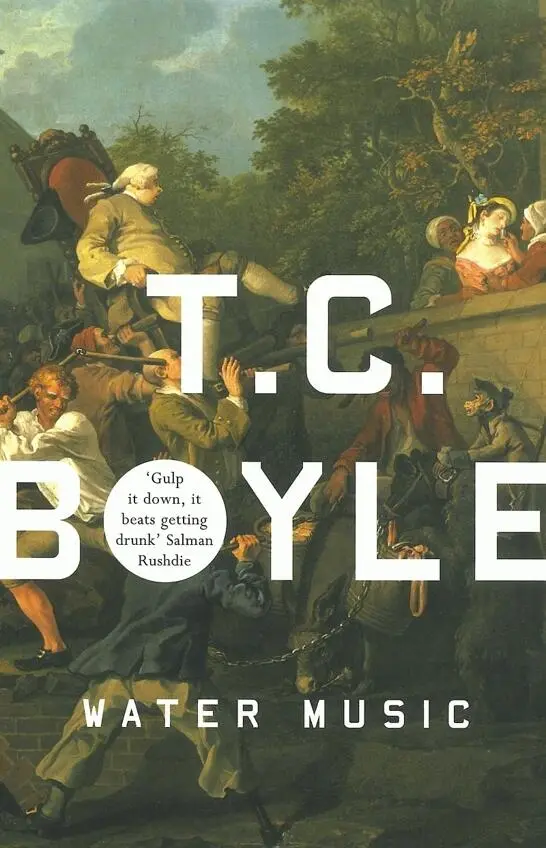
- Название:Water Music
- Автор:
- Издательство:Granta Books
- Жанр:
- Год:1983
- ISBN:9781862071551
- Рейтинг книги:3 / 5. Голосов: 1
-
Избранное:Добавить в избранное
- Отзывы:
-
Ваша оценка:
Water Music: краткое содержание, описание и аннотация
Предлагаем к чтению аннотацию, описание, краткое содержание или предисловие (зависит от того, что написал сам автор книги «Water Music»). Если вы не нашли необходимую информацию о книге — напишите в комментариях, мы постараемся отыскать её.
Water Music — читать онлайн бесплатно полную книгу (весь текст) целиком
Ниже представлен текст книги, разбитый по страницам. Система сохранения места последней прочитанной страницы, позволяет с удобством читать онлайн бесплатно книгу «Water Music», без необходимости каждый раз заново искать на чём Вы остановились. Поставьте закладку, и сможете в любой момент перейти на страницу, на которой закончили чтение.
Интервал:
Закладка:
They passed through a dark clot of vegetation that hemmed them in on all sides, then came round a bend and caught their breath — there was the Niger stretched out before them, oceanic, gray with mist. Trees stood in the water like women lifting their skirts, and the riverbank was crowded with people. Brooding over the scene were masses of shrieking, squabbling birds. Jemafoo’s face lit up. “The akeena are running!” he shouted, bounding forward like a hound on the scent.
No one even glanced up when the explorer joined the crowd on the riverbank. They were too busy hauling at ropes, collectively drawing a huge seine across the bay before them — and singing their hearts out.
“ Wo-habba-wo! ” chanted the men in a basso that shook the earth, dipping forward on the ‘‘ habba ,” leaning back into the rope on the upbeat. “ Weema-woppa, weema-woppa ,” sang the women and children, while an old man, ribby but muscular, wove a snaking melody above it with all the fire and ice of a tenor at the Royal Opera.
Mungo looked round. Madame Momadoo had joined one of the rope gangs behind her eldest son. Jemafoo stood by a mound of silver fish, each the size of a sardine, and flailed a stick at the terns and pelicans that plunged toward the seething mass and then shot off into the sky. Each villager had his task — from the old women who tended the bonfires to the boys who ran off dogs and jackals with a barrage of stones — and yet each was attuned to the other through the rhythmic insistency of the song. Order and harmony, sang the voices, cooperation and prosperity, heave and ho. The explorer stood there like a mannequin, intent on the struggle with the net, until he began to detect a change in the intensity of the music. It seemed as if the voices were about to explode, rumbling away like a stampede, when a woman’s voice rushed up the scale in a burst of Dionysian energy, searing and triumphant, the rhythm pulsing quicker now, driving toward a climax, thunderous — and suddenly Mungo was at the rope, tugging for all he was worth, oblivious to fever, hunger, sorrow, caught up in the emotional sweep of the thing.
The net was closing like a throat, squeezing off into a U, then a V, and all at once the water was alive with thrashing fish. Thousands leaped the net, hundreds of thousands more went deep, tangled in the mesh, and pounded the water to foam. Men waded in up to their waists, clubbing at the escaping fish, children scooped the stunned transgressors from the surface, the crowd pulled, and then it was over. The net was beached, colossal, a river of flesh.
Snakes and eels slithered for the water, fish flapped across the mudbank like acrobats. But for every potential escapee there was a quick scrawny Mandingo boy with a club. Thud-thud went the clubs, and a new song began, less insistent in its beat, slower-paced, methodical: a killing song. Not a fish escaped. Already the drying fires were roaring as women strung the little silver fish on lines and hung them out to toast. There was a perch in the catch that must have weighed over a hundred pounds, and a catfish-looking thing that could have swallowed it whole. Two men held up a terrapin the size of a wagon wheel, another dragged a twelve-foot python up the bank and headed off in the direction of the village. Within minutes the terrapin was shelled, dismembered and bubbling away in a pot; the perch and catfish were gutted, wrapped in leaves and tossed into a smoldering pit while a pair of marabou storks fought over the remains. Jemafoo tapped the explorer’s shoulder. “Here,” he said, offering one of the three-inch fish that flashed and writhed in his hand. ‘‘ Akeena .’’ He was grinning encouragement, having learned from experience that all distress is food-related. “Watch — like this,” he demonstrated, putting his lips to the fish’s vent and squeezing it lengthwise to draw out the roe. “Go ahead, try it.”
Birds were shrieking, a thick greasy smoke hung in the air. The voices of the chorus swelled and sank. Mungo lifted the fish to his lips, but when he tried to squeeze it he found that he didn’t have the energy. His temples were pounding, his legs gone to rubber. He sat down and dreamed of blackness.
♦ ♦ ♦
The fever came on with a vengeance. It left him enervated and delirious, and it was accompanied by an excoriating diarrhea that so debilitated him he couldn’t even muster the energy to clean himself. For two weeks he lay on a mat in the father-in-law’s hut, sweating and stinking, waking from jarring nightmares to the stark actuality of four walls on an alien planet. At intervals someone bent over him with a damp cloth, or put a wooden spoon in his mouth. An old woman offered him a potion of hammered bark: her face was Dassoud’s. Demons howled, strange melodies chanted in his ears. He saw the net that holds up the stars, dug to the center of the earth, floundered about the icy black depths of the sea. Rain hissed at the thatched roof, centipedes and crimson spiders crept over him, sucked at his organs, nested in his eyes. He screamed until he was hoarse. And then — as suddenly as it had come on — it left him. He could see and hear. He knew who he was.
The hut was crowded: children and adults, dogs, poultry, an old leper. Sheets of rain obscured the doorway, there was a smell of gutter and bilge. Jemafoo and his father-in-law were arguing.
“You throw all your burdens on me.”
“What choice do I have? Starve your daughter and grandchildren?”
“What about him?”
“You can’t turn your back on a guest.”
“I didn’t invite him. Nor you for that matter.”
The explorer stirred, raised himself to his elbows. “I’m better now,” he croaked. “Really.” He stood shakily. There was nothing left of him but eyes. “If you could just give me a bite for the road. .”
At that moment there was a cry from the far corner, an unearthly screech, a protest from another world. Madame Momadoo was surrounded by women. One of them held up a newborn infant, slick and red. It was a boy. He screeched again, a strange primal squeal compounded of terror, rage and bewilderment. But there was something else in it too: a demand.
“I can give you nothing,” the father-in-law said.
The explorer gathered up his things — the top hat stuffed with notes, his walking staff, a water gourd and battered compass — and started for the door. Jemafoo stopped him and handed him a bag of dried fish, grain and tobacco.
“Yaaaaaaaaaaaaaaaaaaaaa!” shrieked the baby, as if his teeth had been pulled.
The explorer stepped out into the rain.
♦ ♦ ♦
Half a mile up the road he began to feel dizzy, sought out shelter in a lean-to fashioned from leaves the size of overcoats, and fell asleep. When he woke, the sun was shining. He’d been told that the next town over was called Frookaboo, and that for twenty cowries you could get a Frookabooan to paddle you across the river in a dugout. So he had a choice. He could lie there in a heap of rotting leaves, or force down some dried fish and hobble up the road to Frookaboo. Indomitable, he chose to hobble.
At Frookaboo he applied to the Dooty for food, shelter and passage across the river. He was a scribe, he said, and could pay for his lodging by inditing potent and efficacious safies . Then he fell asleep. The Dooty shook him and asked him if he was a Moor. Mungo considered the question a moment, his lids at half-mast. His beard hung below his breastbone, he was dressed in a tattered toga and sandals, his skin was yellow from sun and jaundice. He squinted up at the Dooty . “ La illah el allah ,” he said, “ Mahomet rasowl Allahi .”
The explorer spent three days at Frookaboo, a guest of the Dooty . He ate well, slept in a dry hut, bowed to Mecca. The fever drew off a pace or two, and he began to regain some of his strength. He even found energy, for the first time in weeks, to take some notes. I repaid the Dooty, he wrote, by scribbling out the Lord’s Prayer for him on a bit of slate. The man was a strict Mohammedan, and thought I was writing in Arabic. I felt it expedient not to disabuse him. When I had finished, he wiped the slate clean with a wet cloth, wrung the cloth out over a cup and drank down its contents, thereby assuring himself of the maximum benefit of my words. Afterward he offered me a pipe of mutokuane and a peep beneath his wife’s veil.
Читать дальшеИнтервал:
Закладка:
Похожие книги на «Water Music»
Представляем Вашему вниманию похожие книги на «Water Music» списком для выбора. Мы отобрали схожую по названию и смыслу литературу в надежде предоставить читателям больше вариантов отыскать новые, интересные, ещё непрочитанные произведения.






Обсуждение, отзывы о книге «Water Music» и просто собственные мнения читателей. Оставьте ваши комментарии, напишите, что Вы думаете о произведении, его смысле или главных героях. Укажите что конкретно понравилось, а что нет, и почему Вы так считаете.