T. Boyle - Water Music
Здесь есть возможность читать онлайн «T. Boyle - Water Music» весь текст электронной книги совершенно бесплатно (целиком полную версию без сокращений). В некоторых случаях можно слушать аудио, скачать через торрент в формате fb2 и присутствует краткое содержание. Год выпуска: 1983, ISBN: 1983, Издательство: Granta Books, Жанр: Современная проза, на английском языке. Описание произведения, (предисловие) а так же отзывы посетителей доступны на портале библиотеки ЛибКат.
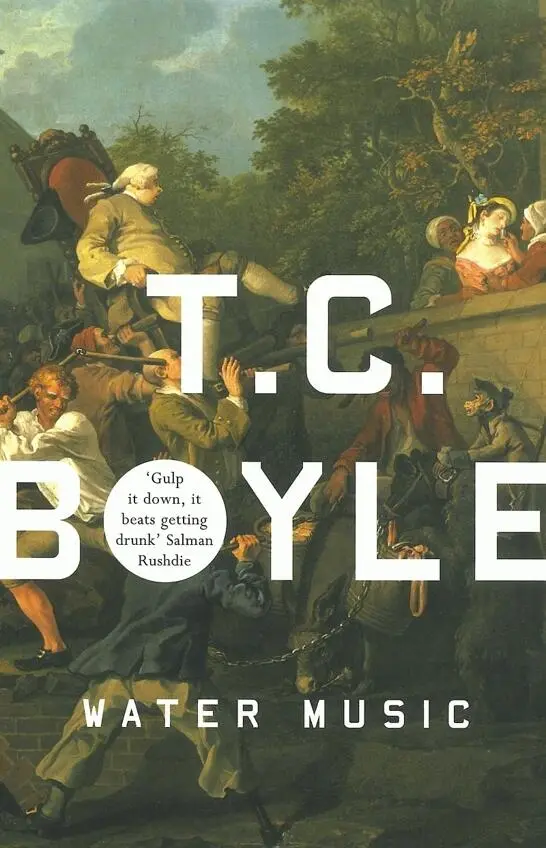
- Название:Water Music
- Автор:
- Издательство:Granta Books
- Жанр:
- Год:1983
- ISBN:9781862071551
- Рейтинг книги:3 / 5. Голосов: 1
-
Избранное:Добавить в избранное
- Отзывы:
-
Ваша оценка:
Water Music: краткое содержание, описание и аннотация
Предлагаем к чтению аннотацию, описание, краткое содержание или предисловие (зависит от того, что написал сам автор книги «Water Music»). Если вы не нашли необходимую информацию о книге — напишите в комментариях, мы постараемся отыскать её.
Water Music — читать онлайн бесплатно полную книгу (весь текст) целиком
Ниже представлен текст книги, разбитый по страницам. Система сохранения места последней прочитанной страницы, позволяет с удобством читать онлайн бесплатно книгу «Water Music», без необходимости каждый раз заново искать на чём Вы остановились. Поставьте закладку, и сможете в любой момент перейти на страницу, на которой закончили чтение.
Интервал:
Закладка:
There was a flurry of applause from the gallery.
The Lord Mayor congratulated the witness on his keen sense of civic duty.
Ned was stunned. “But that’s a lie!” he shouted. “A barefaced lie!”
The Chief Justice thumped his gavel and ordered the bailiff to restrain the prisoner. A sharp blow to the kidneys doubled Ned over, and he began to cough again. When he recovered he lifted his head and gazed steadily at Mendoza. “You were there to rob me,” he said.
At this point the prosecutor rose from his seat. “Your Honor,” he began, “I beg you to consider that at the time of his apprehension the accused was a fugitive from justice, implicated as the prime mover in the sordid Vole’s Head Tavern affair that so shocked us all a few months back.
Furthermore, I submit that it is a patent absurdity to accuse a man who left an estate valued at some sixty thousand pounds of attempting to. . rob a wretched Southwark pauper.” Here he paused gravidly. “And beyond its inherent absurdity, this wild and desperate tale constitutes a callous profanation of the memory of a great and noble Englishman who, but for the hand of that blackguard there, would be among us today to defend himself from the sting of such calumny.”
“Bravo!” called Rudolfo Binbotta.
The Chief Justice, ignoring Binbotta’s outburst, looked down at the prisoner as if he were examining a bit of offal. “I quite agree, Counselor.”The gavel came down. “Next witness!”
The next witness was Smirke. He lumbered up to the stand, all feet and thumbs, and told his tale. Ned Rise was a thief and a liar. A scoundrel who had tricked him into besmirching the good name of the Vole’s Head, and then ducked out of sight to avoid “payin’ the piper.” On the night of August eleven, Smirke testified, he had gone over to Southwark with “the majestic pugilist, ‘is late lordship and the black nigger slave to recover wot properties the prisoner ‘ad nipped from an ‘igh-placed lady and to see that ‘ee got wot was comin’ to ‘im. There I witnessed ‘im backin’ up like a cornered rat and viciously shovin’ ‘is late lordship out the window to ‘is untoimely death.”
When Ned protested, the bailiff stuffed a rag in his mouth.
Jutta Jim was called in next as a corroborative witness. Because his English fell somewhere in the range between nonexistent and prerudimentary, he conveyed his recollections by means of sign language and pantomime. While describing his performance at the Vole’s Head, for instance, he made a circle of the thumb and forefinger of his left hand, through which he repeatedly thrust the stiffened index finger of his right.
“ Mojo-jojo ,” he grinned. “Scroo.” When it came to depicting the fatal night, he crept round the courtroom with his teeth bared to indicate the stealth and savagery of the prisoner, then flopped over on his back in imitation of his dead employer. He ended the performance in tears.
The prosecutor rested his case and Neville Thorogood rose to call his first and only witness: Billy Boyles.
Boyles, the back of his head flat as a book, lurched into the courtroom from the hallway beyond. His clothes were limp and shredded, his face and scrag of a beard plastered with dirt; he stank of halfpenny gin. For a long moment he stood there in the center of the room, dazed and uncertain. All eyes were upon him. He shook his head twice, as if to clear it, took a step forward and stumbled over the court recorder. “Bailiff!” boomed the judge, “help this man to the witness stand.”
Thorogood demurred. “But Your Honor — the witness is inebriated. ”
“Nonsense.”
By this time Boyles had been helped from the floor, and was clutching at the sides of the witness stand as he dragged himself up into the box. “Are you inebriated, sir?” asked the Chief Justice.
Boyles found his seat and looked up at him. “Wot was ‘at?”
“Are you inebriated, sir?”
No response.
The Lord Mayor whispered in the ear of the Chief Justice. The Justice rephrased his question. “Drunk, sir. Are you drunk?”
This seemed to register, and Boyles’ face blanched. “Who, me? Not a bit of it. I may have had a drop or two in my day, but for a sacred event like this one I wouldn’t. .” (here he paused to fight back a belch and pound at his breastbone) “. . wouldn’t dream of it.”
The Chief Justice sat back in his chair. “The witness is yours, Counselor.”
Thorogood blew out a long exasperated breath, then turned to the witness and asked him if he knew Ned Rise to be an honest man.
“Honest?” Boyles barked. “Why he’s honest as a rogue could be wot must live by his wits.”
Someone laughed in the gallery. Boyles winked at Ned.
The counselor then asked Boyles for the particulars of the encounter in Southwark on the night of August eleven.
Boyles seemed perplexed. “August eleven? Why I can barely remember back a week — how am I supposed to know wot went on five, six months ago, eh?”
“The night of Lord Twit’s demise,” piped Thorogood.
“Ohhhhh,” said Boyles, as if this cast a whole new light on things. “That was the night, was it? August eleven? You sure?” He picked his nose thoughtfully for a moment, and then began his story. “Well, I tells you. I was present for the whole thing and I says that Neddy Rise is innocent as a babby.” (This prompted a protest from the gallery, to which Boyles responded with an obscene gesture.) “You see they got me drunk,” he continued, “and forced me to find out Neddy’s lodgin’s for ‘em, though Neddy was dead and drownded five months before. So we goes up to his lodgin’s and waits for him, me and Twit and the rest. . and the rest. .”
“Yes,” shrilled Thorogood, “go on.”
But Boyles could not go on. His head had come to rest on the rail before him and he had begun to breathe through his nose with a low racheting sound. The Chief Justice ordered the bailiff to shake him, but it was no use: he was out cold. “Remove the witness!” boomed the judge. And then: “Have you any more witnesses to call, Mr. Thorogood?”
“No, your honor,” whined Ned’s counselor, “but—”
“Mr. Prosecutor — you may address the jury.”
In his summation, the prosecutor drew on the Classics, Shakespeare and the Bible. He quoted poetry, marshaled evidence, spoke of sin and corruption, the sad state of London’s streets, of inbreeding and the criminal mentality. He spoke glowingly of torture and the gallows, of the deterrent effect of public execution. Ned Rise, he asserted, was a fiend and a libertine. A Jack the Ripper, an Ethan Allen, a Robespierre. He was filth, vermin, disease. To stamp him out would be patriotic, Christian — as close as the English public could come to asserting their identification with Jesus of Nazareth and their loathing for Satan and his vile minions on earth. “I implore you,” he concluded, “no — I command you in the name of King George and the Lord in Heaven to eliminate this cancerous growth, this bubo, this Ned Rise, before he swells up to consume us all!”
The prosecutor was bathed in sweat. His final words rang out like the trumpets of the archangels warming up for Judgment Day. The gallery burst into spontaneous applause.
And then it was Ned’s turn. The rag was removed from his mouth, and he prepared to make his final plea to the jury. (At this point in the history of English jurisprudence, counsel for the defense was prohibited from addressing the jury — that privilege was reserved for the defendant alone. Often as not the defendant was half-starved, ignorant, intimidated by the proceedings, incapable of weighing evidence or of reasoning clearly. But that was his lookout.)
Ned took a deep breath, turned to face the jury, and gave it his best shot. “Gentlemen of the jury,” he began, “there are two sides to every story, and I beg you now to take heed of mine. First, everything you have heard here today is a lie.” There were boos and catcalls from the gallery; the judge rapped for order. “All I wanted was to live decent. I put aside a few pounds so I could be married and open a tavern or some other respectable business. I worked hard and saved my money. But these men came in the dead of night to beat and rob me — Smirke, Mendoza, and yes, Lord Twit, God rest his soul.”
Читать дальшеИнтервал:
Закладка:
Похожие книги на «Water Music»
Представляем Вашему вниманию похожие книги на «Water Music» списком для выбора. Мы отобрали схожую по названию и смыслу литературу в надежде предоставить читателям больше вариантов отыскать новые, интересные, ещё непрочитанные произведения.









Обсуждение, отзывы о книге «Water Music» и просто собственные мнения читателей. Оставьте ваши комментарии, напишите, что Вы думаете о произведении, его смысле или главных героях. Укажите что конкретно понравилось, а что нет, и почему Вы так считаете.