T. Boyle - Water Music
Здесь есть возможность читать онлайн «T. Boyle - Water Music» весь текст электронной книги совершенно бесплатно (целиком полную версию без сокращений). В некоторых случаях можно слушать аудио, скачать через торрент в формате fb2 и присутствует краткое содержание. Год выпуска: 1983, ISBN: 1983, Издательство: Granta Books, Жанр: Современная проза, на английском языке. Описание произведения, (предисловие) а так же отзывы посетителей доступны на портале библиотеки ЛибКат.
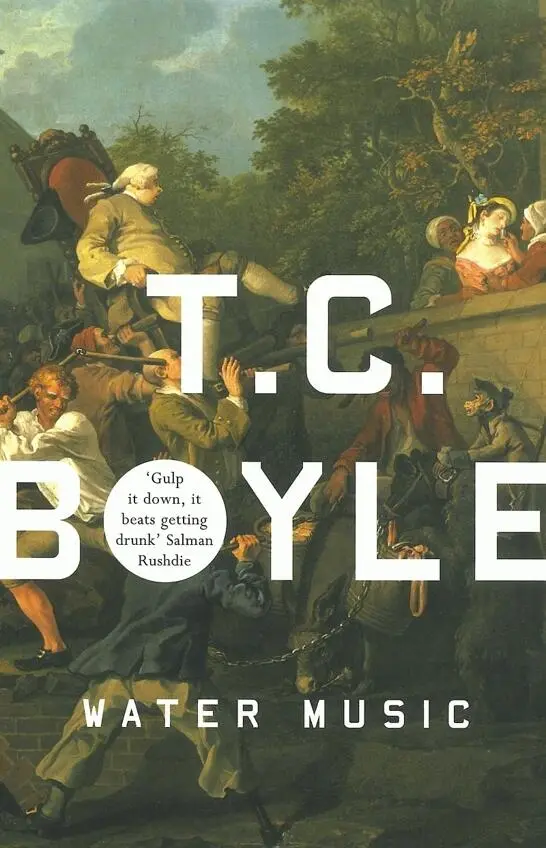
- Название:Water Music
- Автор:
- Издательство:Granta Books
- Жанр:
- Год:1983
- ISBN:9781862071551
- Рейтинг книги:3 / 5. Голосов: 1
-
Избранное:Добавить в избранное
- Отзывы:
-
Ваша оценка:
Water Music: краткое содержание, описание и аннотация
Предлагаем к чтению аннотацию, описание, краткое содержание или предисловие (зависит от того, что написал сам автор книги «Water Music»). Если вы не нашли необходимую информацию о книге — напишите в комментариях, мы постараемся отыскать её.
Water Music — читать онлайн бесплатно полную книгу (весь текст) целиком
Ниже представлен текст книги, разбитый по страницам. Система сохранения места последней прочитанной страницы, позволяет с удобством читать онлайн бесплатно книгу «Water Music», без необходимости каждый раз заново искать на чём Вы остановились. Поставьте закладку, и сможете в любой момент перейти на страницу, на которой закончили чтение.
Интервал:
Закладка:
“Infamy!” shouted Sir Joseph Banks.
“It’s a lie!” shrieked the Countess Binbotta.
Ned held up his shackled hands for silence. “Where would the likes of me get the near five hundred pounds that was stole from me that night?
Simple. It was I, who by the sweat of my brow, bottled — er, imported — the renowned caviar, Chichikov’s Choice—”
There was an angry rumble at the mention of the brand name; Ned began to feel he’d made a mistake, but blundered on nonetheless.
“Chichikov’s Choice, which I sold at a sacrifice so the good people of London could enjoy the finest—”
“Frog’s eggs and shoe blacking!” shouted an angry juror.
“Poison!” shouted another.
“String him up!”
The bailiff had to restrain one of the jurors, red in the face, who was attempting to climb over the rail and assault the prisoner. The gallery was in riot, Ned ducking shoes and bits of rotten fruit, the Chief Justice and Lord Mayor pounding the table with their gavels. “Order!” called the clerk. “Order!”
When the courtroom had settled down, the Chief Justice glared angrily at Ned. “Bailiff,” he roared, “the prisoner is inciting to riot. Muffle him.” The rag was reinserted in Ned’s mouth and the Chief Justice charged the jury to deliberate and pronounce their verdict.
The foreman rose. He was a rangy, dyspeptic-looking fellow whose face was creased with scowl lines. “There is no need for deliberation, your honor. Our decision is unanimous. We find the defendant guilty as charged.” He made as if to sit, but then thought better of it. “And if I may say so, Your Honor, I think hangin’s too good for him.”
The Chief Justice looked down the row of his colleagues — the sheriffs, the alderman, the Lord Mayor — while the court held its breath. Then, with a grim terrible look, he reached beneath the table, produced the black cap and set it atop his wig. “Ned Rise,” he called in a voice that would wake the dead. “Face the court and hear our doom.” He paused to blow his nose mightily. “After weighing the evidence we find you guilty as charged and sentence you to hang by the neck until you are dead, dead, dead.”
As the Chief Justice delivered the sentence, the bailiff slipped a string about the prisoner’s thumb and pulled it tight to illustrate his words. Ned was dazed. He looked round him and saw that the entire courtroom was on its feet, people were applauding and whistling, razzing and jeering — Fanny was nowhere to be seen. The bailiff took him by the arm and led him across the room toward the door that communicated with the prison. Through all the noise of the crowd one sound rang in his ears, filled his being, made his flesh crawl as if all the corpses in the world had risen up to rake their nails across a monstrous blackboard: “Eeeeeee!” it grated. “Eeeeeee! Eeeeeeeeeeeee!”
♦ HEGIRA ♦
The loss of Johnson hit the explorer like a hammerblow. If before the situation was grim, now it was desperate. Not only was he half-naked, starved, febrile, nauseated, penniless and lost, he suddenly found himself on his own in an alien and hostile environment — without guide, companion or fellow sufferer. Life with the Moors was a lark by comparison.
As he watched Johnson’s brow sink into the muck, he lost control of himself, carrying on like a Greek housewife at the funeral of her eldest son, or a federalist, forced by luck of the draw to inscribe his name last on a historic and revolutionary document. Purely and simply, he gave way to despair. Sat down in the water and began tearing at his hair, wailing, sobbing and moaning, gnashing his teeth, rending his skin, flailing at the water with his useless knife and cursing, blaspheming, crying out against the senseless mechanism of the universe and the black arbitrary heart that oversees it. This went on for ten minutes or so, until he felt a hand on his arm. It was the refugee. Behind, up to their knees in water, stood the little man’s wife and stunted children, their faces stung with anxiety. “Come on,” the man said. “There’s nothing you can do here — except maybe attract another crocodile.”
The man’s name was Jemafoo Momadoo. Like many of the Mandingoes of the region he was a Moslem, having converted to Mohammedanism under pressure from the Moors. He bowed to Mecca twice a day, abstained from pork and named his first son Ismail — but he was no fanatic. Until the deluge he had been a tenant farmer in the village of Sooha, scraping away at the dusty soil from dawn till dusk, yanking at the desiccated yellow teats of his goats, boiling the meat from the bones of snakes, toads and rats. A week of steady rain flooded the fields around Sooha to a depth of three and a half feet. He and his wife and their wisps of children were asleep in their cane hut when the Niger swept down on them, seething and booming. The flood waters took his goats, two sons, his hut, tools and meager stock of dried legumes and rice. In return it gave him the bloated carcasses of two hartebeests and a sitatunga.
He led the explorer back up the rise to where the pot was once again simmering over the fire. The clearing was so green it ached. “Would you like a cup of broth?” he asked.
♦ ♦ ♦
Mungo accompanied the Momadoos to the village of Song, where Jemafoo’s father-in-law was the Dooty . It was a two-day trek. Jemafoo was hoping to participate in the reduction of his father-in-law’s larder, while Mungo, still reeling under the shock of Johnson’s sudden demise and shaken with the onset of fever, welcomed the opportunity to travel anywhere, so long as it was in the right direction. (He had discovered, much to his dismay, that the failed attempt to cross the Toolumbo had resulted in his landing on the far side of the Niger, twenty miles downriver from the point at which he’d started . The discovery came as no surprise, actually — it was just another link in a concatenation of major setbacks and bitter disappointments that had begun with the disappearance of his seatrunk ten minutes after landing at Goree, and that had continued unabated ever since.)
The Momadoos, en famille , trooped into Song just after dawn, the explorer bringing up the rear. Cook fires smoldered under the light drizzle, dogs yapped, guinea hens pecked in the dirt. There was no one to be seen. Madame Momadoo, eight-and-a-half months pregnant and a native of the village, was puzzled. She peered into this hut or that, called out a time or two, and then turned to her husband and shrugged her shoulders. But then she caught her breath and stood stock-still, listening. Her broad face broke into a grin. “ Mola lave akombo ,” she said. “They’re singing. Listen.”
The sound was faint and distant, a static in the air, a hum of the sort that announces a massing of insects — or a gathering of armies. The explorer strained his ears: it seemed to be coming from the direction of the river. He started toward it automatically, without thinking, almost as if he were under a spell. Human voices, raised in song. How long had it been? Bass and contralto, counterpoint, soaring sopranos — the sweep of voices took him back to the cavernous cathedrals of Edinburgh and the simple oak-beamed chapel of his boyhood at Fowlshiels. He found himself returning Madame Momadoo’s grin.
The muddy path wound through a series of vegetable plots already burgeoning with yellow gourds, incipient watermelons, yams, cassavas, Indian corn and peanuts, then dipped down a short incline to follow an earthen levee across what appeared to be a flooded rice paddy. The children scampered on ahead, thin as featherless birds, while Madame Momadoo hurried after them, her great belly jogging in time to the flash of her elbows. Mungo picked his way along carefully, quizzing Jemafoo about the local power structure, agricultural techniques, initiation rites. The music swelled in his ears.
Читать дальшеИнтервал:
Закладка:
Похожие книги на «Water Music»
Представляем Вашему вниманию похожие книги на «Water Music» списком для выбора. Мы отобрали схожую по названию и смыслу литературу в надежде предоставить читателям больше вариантов отыскать новые, интересные, ещё непрочитанные произведения.











Обсуждение, отзывы о книге «Water Music» и просто собственные мнения читателей. Оставьте ваши комментарии, напишите, что Вы думаете о произведении, его смысле или главных героях. Укажите что конкретно понравилось, а что нет, и почему Вы так считаете.