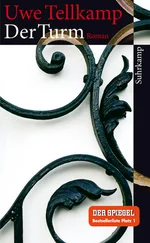
Uwe Tellkamp - The Tower
Здесь есть возможность читать онлайн «Uwe Tellkamp - The Tower» весь текст электронной книги совершенно бесплатно (целиком полную версию без сокращений). В некоторых случаях можно слушать аудио, скачать через торрент в формате fb2 и присутствует краткое содержание. Год выпуска: 2014, Издательство: Penguin, Жанр: Современная проза, на английском языке. Описание произведения, (предисловие) а так же отзывы посетителей доступны на портале библиотеки ЛибКат.

- Название:The Tower
- Автор:
- Издательство:Penguin
- Жанр:
- Год:2014
- ISBN:нет данных
- Рейтинг книги:5 / 5. Голосов: 1
-
Избранное:Добавить в избранное
- Отзывы:
-
Ваша оценка:
The Tower: краткое содержание, описание и аннотация
Предлагаем к чтению аннотацию, описание, краткое содержание или предисловие (зависит от того, что написал сам автор книги «The Tower»). Если вы не нашли необходимую информацию о книге — напишите в комментариях, мы постараемся отыскать её.
The Tower — читать онлайн бесплатно полную книгу (весь текст) целиком
Ниже представлен текст книги, разбитый по страницам. Система сохранения места последней прочитанной страницы, позволяет с удобством читать онлайн бесплатно книгу «The Tower», без необходимости каждый раз заново искать на чём Вы остановились. Поставьте закладку, и сможете в любой момент перейти на страницу, на которой закончили чтение.
Интервал:
Закладка:
Christian was taken into a shed. The air in the room and the corridor smelt musty. There were eighteen beds in the room, six bunks with three beds each. The guard showed Christian his locker and ordered him to stand there. The guard went out, Christian stared out of the window through which dusty light came. The window was barred, you could see one of the watchtowers and a strip of gravel with the dogs, of which two had now woken up. Only now did Christian understand what had happened to him and that this was his foreseeable future: Schwedt an der Oder Military Prison, one year, one irreplaceable year of his life. And that Here, Here you stand was burrowing itself deep into him, like a screw, he needed to distract himself and started to count: with the years of service that he still had to complete he would be discharged in the autumn of 1989, five years in the National People’s Army and he’d no idea what would happen after that, perhaps Meno would help him. He couldn’t stay standing but already the guard was back ordering him to do just that.
‘We’ll see to it that you’re re-educated.’
The daily routine began with being woken at four in the morning. The prisoners jumped out of their beds, where they’d been sleeping in cotton vests, the genital area naked. Morning exercises and washing. In Christian’s company there were forty-seven military prisoners sharing one washroom with ten water pipes. The water points had no taps, the taps were kept by Staff Sergeant Gottschlich and had to be screwed onto the pipes. They were usually issued.
After breakfast there was either training in the facility (drill training, putting on and taking off protective clothing, instruction in fire protection, march with extra-full pack, assault course) or work. For the disciplinary units — soldiers who had not been through a military court — work was mostly in the cellars of the sheds. Christian and Pancake were serving a sentence handed down by the court and were driven out to the Combine every day. There they sandpapered doors, repaired or made pallets, smoothed the edges of plastic furniture or screwed screws into screw-holes. Work lasted eight hours, after that they were taken back to the facility for training. After cleaning the room and their section, 8 p.m. lights out. There were no doors on the toilets, everyone could watch you doing your business.
‘So you don’t do something stupid like committing suicide,’ Staff Sergeant Gottschlich said. Hanging from the ceiling of the company corridor was a grotesquely bizarre object: a toy train made by earlier prisoners out of scraps of plastic from the Petrochemical Combine for the company commander’s fortieth birthday. The train had thirty-six goods wagons in different colours. Because the wagons were so brightly coloured it was called the ‘Orient Express’. There were coloured cards in the wagons and names on the coloured cards. The position of the name indicated the level of fulfilment of targets. It was an advantage to have your name in one of the first ten wagons. If you were in the middle, there were drills . One of these was to be woken at midnight and spend two hours standing in full rig. If your name was in the last or next-to-last wagon (Staff Sergeant Gottschlich wasn’t entirely consistent in that) for more than a week, you were sent for a spell in the U-boat , where you also ended up for recalcitrance, insubordination, failure to accept one’s errors, uncooperative attitude, doing something stupid. Doing something stupid could be not to sit absolutely motionless, but ready to learn during political education or on Thursdays during the communal viewing of Karl-Eduard von Schnitzler’s Black Channel on TV2.
The official name for the U-boat was Detention. Detentions were announced at roll call. Before Christian went to the U-boat he had to go and see the doctor ‘to determine suitability for detention’. The doctor was a young but weary man in a white coat but with no stethoscope. He asked Christian whether he was taking any medicine or had any illnesses.
‘Acne vulgaris,’ Christian said.
‘That blooms even in the dark.’ The doctor put a weary scribble on the detention-suitability-assessment form.
The U-boat was dark, since there were no windows, and Christian spent a long time there, a week, he guessed. During that time he had felt his way round every nook and cranny of the cell. The bucket beside the table for him to relieve himself had an enamel lid with two wire guide brackets; Christian learnt to use his sense of touch like a blind man, the writing on the lid was slightly raised and said ‘Servus’. The blankets smelt of Spee washing powder and — it took him a while to work this out — of the lamas in Dresden Zoo, of lamas in the rain to be more precise. For a long time in the even longer darkness of the cell Christian could not get rid of the idea that he had reached the innermost point of the system. He was in the GDR, the country had fortified frontiers and a wall. He was in the National People’s Army, which had barracks walls and guarded entrances. And in Schwedt Military Prison he was stuck in the U-boat, behind walls with no windows. So now he was entirely there, now he must have arrived. But more than that he must, Christian thought, be himself. He must be naked, his self laid bare, and he thought that he must now have the great thoughts and insights he’d dreamt of at home and at school. He sat naked on the floor but the only thought he had was that if you sat naked on stones for a while you got cold. That you were hungry and thirsty, that you can count your pulse, that in darkness you also get tired, that for a while you can hear nothing but dead silence and that then your ear starts to produce its own sounds, that your eye is constantly trying to light little cigarette-lighter flames, here and there and there, and that you go mad in the darkness, however many poems you know, novels you’ve read, films you’ve seen and memories you have.
Now, Christian thought, I really am Nemo. No one .
On a hot day in July, Christian, Pancake and twenty-eight other prisoners were sent to Effects. They were being transferred, they were told, to the Orient, as the chemical area round Leuna, Schkopau and Bitterfeld was known because of the colourful effusions from the factories. The chemical industry brought bread, prosperity and beauty and for it they needed workers. Handcuffed, they followed the Friendship oil pipeline that went from the town on the Oder, whose high-rise buildings were bright in the distance, to the Orient of the chemical industry in its main area, Samarkand, in the south-west of the Republic.
61. Carbide Island
Apart from crows, there were no birds there. As the summer twilight began to fall in the garden of Caravel the yearning, melodious lament of the blackbird could be heard; here, on Carbide Island there were no bird calls apart from the ugly, coarse croaking of huge flocks of crows that seemed to feel at home on the foam-washed banks of the Saale, the bend of which could be seen from the window, and gathered every evening in the pale skeletons of trees for sleep and for the stories of the day, the poet’s ‘day that has been today’ … They chattered and cawed and fished around in the scum for edible matter, which was presumably washed up in sufficient quantities, and sometimes, when the lights went out in the cells on Carbide Island, they seemed to be laughing, giving voice to their gratingly repulsive mockery. Like a cloak of invisibility, the colour of their plumage, that shining coal-black, blended with that of the river, which flowed sluggishly and, almost every evening now, in August, illuminated by an iron-red sun, through the landscape of the chemical industry over which, fixed to the platforms at the top of the furnaces, the flag of Samarkand fluttered: a yellow flag, the yellow of the quarantine flag for ships, with a black retort on it. Christian and the others had been sent from Schwedt to Camp II, which took up a separate corridor on the fifth floor of the prison. On the corridor wall, beside the table for the guard on duty, was a ‘daily schedule of work’, abbreviated to DSW. It was similar to the one in Camp I: the early shift was woken at four (though here it was by the rising and falling wail of a siren, as if an alert for an impending air raid), followed by morning exercises and washing. Here the taps over the basins were fixed, but there wasn’t always water — when Samarkand was ‘on a lift’, as they put it, when all the machines, filtering installations, cooling systems, works conduits were demanding water, it was a dribble that came out of the washroom taps. Also it wasn’t drinking water that came out of the pipes but a liquid that was sometimes rusty, more often as yellow as soup, and smelt of floorcloths and rotten eggs. People said the smell came from carbide, from ‘the other side’, from across the Saale on the bank of which, connected to the prison by a bridge that looked as if it were coral-encrusted, there was a carbide factory. From the bridge, which the company approached at an easy march, it looked like an old steam locomotive that was bending down for a drink from the Saale. Pouring out of a cyclopean chimney were clouds of light-grey smoke that, below the clouds, mingled with the discharges from the coking plant, the chlorine works, the power stations lower down the Saale, creating a dark, unmoving swirl that widened out at the top like a flower head.
Читать дальшеИнтервал:
Закладка:
Похожие книги на «The Tower»
Представляем Вашему вниманию похожие книги на «The Tower» списком для выбора. Мы отобрали схожую по названию и смыслу литературу в надежде предоставить читателям больше вариантов отыскать новые, интересные, ещё непрочитанные произведения.










Обсуждение, отзывы о книге «The Tower» и просто собственные мнения читателей. Оставьте ваши комментарии, напишите, что Вы думаете о произведении, его смысле или главных героях. Укажите что конкретно понравилось, а что нет, и почему Вы так считаете.