Jonathan Levi - Septimania
Здесь есть возможность читать онлайн «Jonathan Levi - Septimania» весь текст электронной книги совершенно бесплатно (целиком полную версию без сокращений). В некоторых случаях можно слушать аудио, скачать через торрент в формате fb2 и присутствует краткое содержание. Год выпуска: 2016, Издательство: The Overlook Press, Жанр: Современная проза, на английском языке. Описание произведения, (предисловие) а так же отзывы посетителей доступны на портале библиотеки ЛибКат.
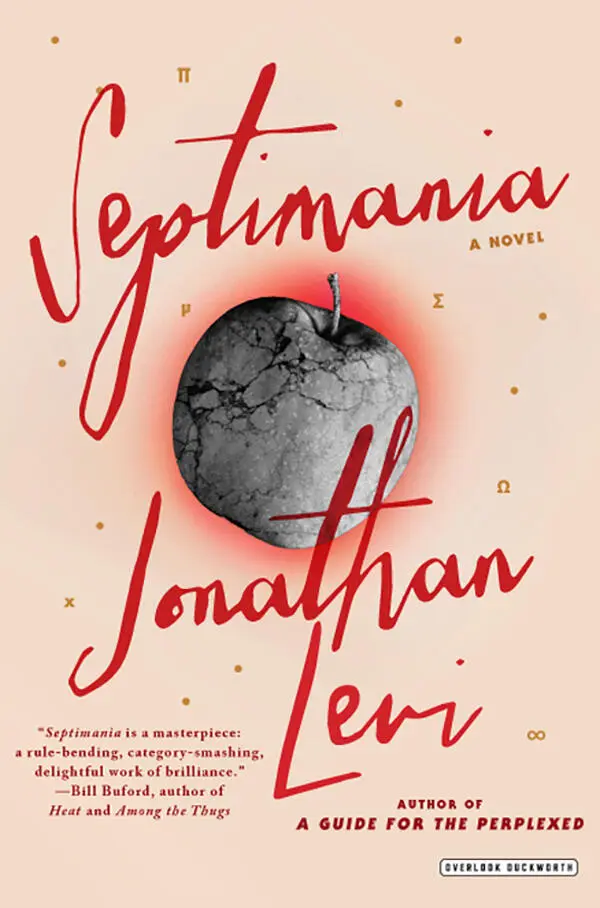
- Название:Septimania
- Автор:
- Издательство:The Overlook Press
- Жанр:
- Год:2016
- ISBN:нет данных
- Рейтинг книги:4 / 5. Голосов: 1
-
Избранное:Добавить в избранное
- Отзывы:
-
Ваша оценка:
Septimania: краткое содержание, описание и аннотация
Предлагаем к чтению аннотацию, описание, краткое содержание или предисловие (зависит от того, что написал сам автор книги «Septimania»). Если вы не нашли необходимую информацию о книге — напишите в комментариях, мы постараемся отыскать её.
Over the next fifty years, Malory’s search for Louiza leads to encounters with Pope John Paul II, a band of lost Romanians, a magical Bernini statue, Haroun al Rashid of Arabian Nights fame, an elephant that changes color, a shadowy U.S. spy agency and one of the 9/11 bombers, an appleseed from the original Tree of Knowledge, and the secret history of Isaac Newton and his discovery of a Grand Unified Theory that explains everything. It is the quest of a Candide for love and knowledge, and the ultimate discovery that they may be unified after all.
Septimania — читать онлайн бесплатно полную книгу (весь текст) целиком
Ниже представлен текст книги, разбитый по страницам. Система сохранения места последней прочитанной страницы, позволяет с удобством читать онлайн бесплатно книгу «Septimania», без необходимости каждый раз заново искать на чём Вы остановились. Поставьте закладку, и сможете в любой момент перейти на страницу, на которой закончили чтение.
Интервал:
Закладка:
There were many things that Louiza wanted to say to Malory.
Not about the cottage, which was boring and, in any case, she couldn’t understand. Not about the Cottagemates either, or the change in the seasons along the river, or even the change in her own season.
She wanted to tell him about the problems. Not the solutions, the problems.
She had begun to feel, particularly in the past few months as her own secret had grown inside her, that she was seeing something, becoming aware, recognizing a pattern in the problems they were bringing her in the mornings, the problems that were left for her on the kitchen table.
They were all problems about origins: equations about sources, about where things came from. Louiza knew, of course, from a life in the countryside of East Anglia, about chickens and eggs, about the grunts of sows birthing in straw and muck, about lambs born in forgotten ditches and discovered only after the thaw in the recovered memory of lone sheep. She knew that the movement inside her was generated by something more biological than a chance meeting one spring afternoon in the organ loft of a village church. She even knew something about the various theories of the origins of the universe, about the physical forces unleashed by the Big Bang. And her father had an Anglican word to explain all origins.
What she wanted to tell Malory was more elemental than God.
“I saw—” she began.
Malory stopped just outside the door of the church on the piazza of Santa Maria sopra Minerva as Louiza’s contraction dug into the back of his neck and an exposed piece of his left wrist. He wanted to tell Louiza that it would be all right, that she was going to be fine, that he was with her, that he would stay with her, that he would never leave her again. But half his body was resetting its muscles after the run down the nave of the church into the piazza, and the other half was wincing at the pain in his own neck and wrist. What little attention he had left was surprised by the statue of the elephant carrying the obelisk in the center of the piazza. Malory could have sworn that the night before, when he had knocked on the door of the Dominican monastery, the elephant had been painted an enamel midnight blue, as rich as the ceiling of the nave of Santa Maria sopra Minerva. But now — there was no question, even though he was half-starved of oxygen — the elephant was the crimson of the cardinals whom Fra Mario believed forse oggi would choose a new pope.
“I thought—” Malory began.
“Make no mistake, Malory,” Tibor said. “There is a war going on.”
“War?” Malory asked.
“Three hundred and something years ago, Fra Domenico Paglia, the Grand Poo-Bah of Santa Maria sopra Minerva, found an Egyptian obelisk buried in his blessed cloister, a scrap from the time of the Romans. So, Fra Domenico decided to erect this puli in front of the piazza and held a competition to design an all-purpose obelisk holder. One of the finalists was Gian Lorenzo Bernini, Mister Baroque, the drinking buddy of four or five popes and a couple of dozen cardinals. The other — surprise, surprise — was Fra Domenico himself. Bernini won, of course. Fra D. was an amateur who only had time for a bust or two when he wasn’t condemning heretics. But that didn’t stop him from showing Bernini who’s boss. He offered Bernini some divinely received structural advice, how the weight of the obelisk would fracture the thirteenth and fourteenth lumbar vertebrae of the elephant. Bernini knew Fra Domenico was weak on the anatomy of pachyderms. But he also knew that the Dominicans were the Hounds of God and would bite hard if he didn’t lend at least one ear to this inquisitorial engineer.
“So, Bernini put a little stone box beneath the elephant’s gut, to make Fra Domenico happy. And then Bernini led his elephant into the middle of the piazza. Now, a lesser artist might have faced the elephant’s trunk towards the church and another might have faced him away, as if pulling the weight of the cathedral towards Heaven or the Tevere, whichever came first. But Bernini was a genius. He parallel-parked Dumbo with his left flank against the church and his head facing the lobby of the Hotel Minerva. And then he lifted the tail of his beast ever so daintily to the port side, so he could aim his fragrant marble farts through the window of the study of the Dominican friar.”
Louiza’s contraction subsided, her grip on Malory’s neck and wrist loosened. She giggled.
“I like your girlfriend,” Tibor said.
Malory smiled down at Louiza, trembling and chapped, her hair, damp from exertion, pasted to the whiteness of her cheek, but smiling up at him all the same.
“Showtime, kids!” Tibor squeezed Malory’s shoulder and set off at a jog towards an alley at the far corner of the piazza. With the new-found strength of an elephant with an obelisk on its back, Malory lifted Louiza once again and ran. From Piazza Minerva, Malory followed Tibor down the narrow Via dei Cestari, past the windows of the liturgical boutiques, where ecclesiastical dandies ran up diocesan expense accounts with accessories for their altars and sacristies. Malory pressed Louiza’s face into his chest away from some of the more explicit artifacts — the portraits of Jesus straight off the covers of romance novels and body-building mags, the altar cloths woven with raised scarlet threads as if freshly washed in the blood of the lamb, the crowns of thorns, the boxes of 14-karat nails.
At Largo Argentina, Tibor stopped the cars and motorini for Malory to ford the rush hour traffic and then raced ahead down a narrow vicolo to the massive door of the Palazzo Caetani on the Via delle Botteghe Oscure. Caetani, Palazzo Caetani — Malory knew the name. When the vicar mentioned something about an inheritance, Malory’s inheritance, he’d named property in Rome. A villa, or was it a palazzo? It couldn’t possibly be something this cold and massive, with an entryway ten, twenty, maybe thirty feet high, the name Caetani etched in testamentary capitals above the door. But the name Caetani, Palazzo Caetani troubled Malory’s memory as he hefted Louiza around the side of the building and followed Tibor down a narrow slalom of Cinquecentos and Citroens. He knew the name.
“Malory?” It was Louiza struggling to say something against his chest.
“Yes?” Malory said, pausing halfway down the alley, where a drainpipe bled a green stain of neglect on the side of the palazzo. “Tibor, wait!” he called, and crunched his ear down towards Louiza’s mouth. “What is it, Louiza?”
“Biscuit,” Louiza said.
“Biscuit?” Malory leaned in closer, wondering what he had heard.
“Biscuit,” Louiza repeated. But before Malory could ask whether she was really hungry and he should stop at a café on the way to the hospital and was this really wise, Louiza screamed and writhed in another contraction. Malory held onto her as she opened and closed and squirmed and changed shape and form like — which one of the Greek water gods was it, Malory tried to remember, in which one of the Greek myths?
And in his own struggle to remember, another memory shot its way to the surface of Malory’s sweating brain. Biscuit. Biscuit tin. Antonella’s biscuit tin. Caetani. Palazzo Caetani and Antonella’s biscuit tin and the small black-and-white television set in the Maths Faculty on Selwyn Road and the voice of Anna Ford.
“Aldo Moro.” But now it was the voice of Tibor, who had run back from the bottom of the alley and stood with Malory. “This was where they found him. Like I said, there’s a war going on.”
Malory remembered the TV footage he’d watched with the sobbing Antonella — the crowd in the alley, the Palazzo Caetani, of course. And the cherry Renault 4, boot open, the assassinated Prime Minister curled up in his own fetal drama.
Читать дальшеИнтервал:
Закладка:
Похожие книги на «Septimania»
Представляем Вашему вниманию похожие книги на «Septimania» списком для выбора. Мы отобрали схожую по названию и смыслу литературу в надежде предоставить читателям больше вариантов отыскать новые, интересные, ещё непрочитанные произведения.









Обсуждение, отзывы о книге «Septimania» и просто собственные мнения читателей. Оставьте ваши комментарии, напишите, что Вы думаете о произведении, его смысле или главных героях. Укажите что конкретно понравилось, а что нет, и почему Вы так считаете.