Jonathan Levi - Septimania
Здесь есть возможность читать онлайн «Jonathan Levi - Septimania» весь текст электронной книги совершенно бесплатно (целиком полную версию без сокращений). В некоторых случаях можно слушать аудио, скачать через торрент в формате fb2 и присутствует краткое содержание. Год выпуска: 2016, Издательство: The Overlook Press, Жанр: Современная проза, на английском языке. Описание произведения, (предисловие) а так же отзывы посетителей доступны на портале библиотеки ЛибКат.
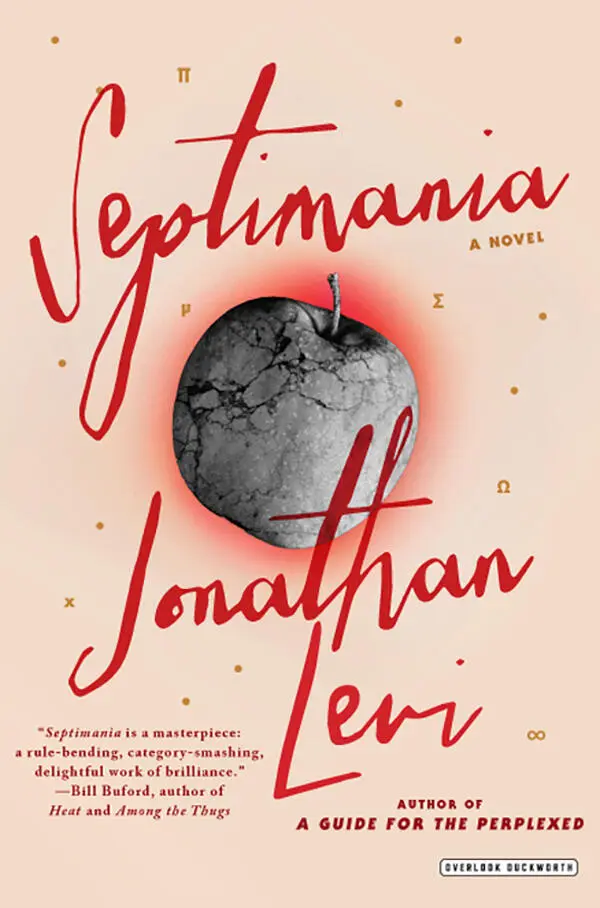
- Название:Septimania
- Автор:
- Издательство:The Overlook Press
- Жанр:
- Год:2016
- ISBN:нет данных
- Рейтинг книги:4 / 5. Голосов: 1
-
Избранное:Добавить в избранное
- Отзывы:
-
Ваша оценка:
Septimania: краткое содержание, описание и аннотация
Предлагаем к чтению аннотацию, описание, краткое содержание или предисловие (зависит от того, что написал сам автор книги «Septimania»). Если вы не нашли необходимую информацию о книге — напишите в комментариях, мы постараемся отыскать её.
Over the next fifty years, Malory’s search for Louiza leads to encounters with Pope John Paul II, a band of lost Romanians, a magical Bernini statue, Haroun al Rashid of Arabian Nights fame, an elephant that changes color, a shadowy U.S. spy agency and one of the 9/11 bombers, an appleseed from the original Tree of Knowledge, and the secret history of Isaac Newton and his discovery of a Grand Unified Theory that explains everything. It is the quest of a Candide for love and knowledge, and the ultimate discovery that they may be unified after all.
Septimania — читать онлайн бесплатно полную книгу (весь текст) целиком
Ниже представлен текст книги, разбитый по страницам. Система сохранения места последней прочитанной страницы, позволяет с удобством читать онлайн бесплатно книгу «Septimania», без необходимости каждый раз заново искать на чём Вы остановились. Поставьте закладку, и сможете в любой момент перейти на страницу, на которой закончили чтение.
Интервал:
Закладка:
“One moment,” Malory shook himself loose and turned back to Louiza’s door. This time it was Tibor who stopped him with a gentle palm to the shoulder.
“Go,” Tibor said.
“Let me speak with the doctor.” Malory eased Tibor’s hand away and stepped towards the door. Tibor wouldn’t be budged.
“I’ll wait here and look after your Louiza. Come later, when you’re finished with your business.” The palm again on Malory’s shoulder. Comfort and assurance. “We will celebrate.”
“We must hurry,” Settimio said, his childlike eyes icing into something barely warmer than insistence. “The Driver will take you. I will follow.”
“The Driver? Where?” Malory said again. “I really have only five minutes. Ten minutes maximum.” But Malory felt his feet begin to jog down the corridor, down the staircase with a sense of urgency, the two Italians at his elbows, the confidence of Tibor behind him. Louiza was in good hands — a doctor, a hospital, a new Rumanian friend who owed Malory his life. Perhaps the bank was closing. Perhaps there were papers that he needed to sign by the end of the day. Malory’s Cambridge had effectively been sealed by the death of Mrs. Emery and the dismissal from Trinity College. Whatever Settimio was leading him to in Rome was, of necessity, the key to new beginnings with Louiza and their new baby. Louiza would understand. He would hurry. Determination, Malory whispered to himself. Courage.
At the entrance to the hospital, the tall man helped Malory straddle the passenger seat of a Vespa. Settimio turned to another motorino by the fountain.
“I’m sorry,” Malory said. “You must tell me where we’re going. What is so important at this very moment?”
“All shall be clear,” Settimio said, as he steadied Malory’s elbow on the narrow cushion behind the Driver. “Prepare yourself”—and Settimio started up his own Vespa—“prepare yourself to become a king.”
King? King! Had he heard Settimio correctly? He wanted to shout, Wait! Or, What! But the Vespa took off beneath him, over the bridge and onto the Lungotevere, leaving all courage and most of his breath behind. King? Organ tuner, yes. Possible father, possibly. But King? Hadn’t he told this man, this Settimio that he only had a few minutes to spare? What had induced him to take Settimio’s hand, to follow these men and leave Louiza when she was on the verge of giving birth? What had persuaded him to climb onto the Driver’s Vespa? What did Malory know of Vespas, how to stop a Vespa, how to jump off a Vespa? What did Malory know of the streets of Rome? What could Malory know about the one-way systems of the future that, in any case, would do little to assuage the panic of any hapless passenger on the back of a motorino speeding down the narrow cobblestones of the Lungaretta, veering off to the right just before the peeling, neglected mosaics of Santa Maria in Trastevere, past the pasticcerie of the Via del Moro and the smells of lunches just finished and the sounds of dishes drying almost drowned out by the unmuffled hum and denatured smell of the engine? How could Malory know that Settimio, riding ahead of them on an identical machine, was no lunatic but merely serving the function of regal processions in centuries past, going back to the times of Renaissance princes, medieval warlords, Roman emperors, and consuls before them, who first built the streets leading from the Tevere to higher ground, who haggled and bartered and even killed in order to out-dazzle their neighbors with the splendor of the processions that brought them from this place to that. How was Malory to know that Settimio and the Driver and their matched Vespas were the economical evolution of the equine consorts of yore? Indeed, at the speed of the Vespas, which slalomed past the mothers with prams and grandmothers with canes and dodged the traffic spewing from the tunnel beneath the Gianicolo like stuntmen, at such a speed, how was Malory to identify this breakneck, hair-raising, flesh-crawling dash as anything other than the final lap of the race of his own life? How could he have possibly thought that these men, these Italians who had introduced themselves into Malory’s universe only a few minutes before and then motorinoed him off in the opposite direction from where he wanted to be, were leading him to the modest bank account that he hoped might finance his new beginnings? He had whispered prayers over the past few months, usually upon waking and again at that hopeful moment of dusk when just one more ray of sunshine might bring Louiza’s bright face into his vision before darkness fell — prayers that his quest for his Louiza might quickly be done so that he might embark on the project of the rest of unconscious mankind: life.
Life. Malory wanted life, a life, with the love of a real woman. He had never suspected it would require a gruesome death at the intersection of a speeding Vespa and a piece of Renaissance masonry. Malory saw nothing of St. Peter’s Dome, as the Driver turned the Vespa into the great piazza, nothing of the massive saints waving their stony salutes from atop Bernini’s arcade, nothing of the long avenue of the Via della Conciliazione stretching down to his left. But he knew enough to pray. Malory prayed as they sped past the harlequinade of the Swiss Guard, through the portcullised arch of the Papal Palace. Malory prayed with the last breath in the bellows of his lungs, merely to live. And with that prayer, the Vespa came to a halt at a small wooden door where, already parked and groomed, Settimio stood, ready to escort him inside the Vatican.
“Bloody hell!” said Malory, who had been known to swear on very few occasions.
“ Mio Principe ,” said Settimio, steadying Malory’s elbow as he unwrapped his thighs from the clammy vinyl of the Vespa. The Driver opened the jump box of the motorino and withdrew a small whisk broom and gave Malory a quick brush to remove the most obvious layer of dust. “I’m afraid we haven’t time for much more,” Settimio added. “But you shouldn’t worry, my lord. They don’t stand on ceremony.”
“Who don’t?” was the question Malory thought to ask, but only much later. Two Swiss Guards presented themselves to Malory with the same hand to the heart and bend to the knee with which Settimio and the Driver had greeted him.
“No need for concern,” Settimio said. “I shall accompany as far as possible.”
“Where?” Malory asked. But as his escort moved forward and Malory walked with Settimio half a step back and to the starboard side, Malory’s wit and geography guessed he was somewhere between St. Peter’s and the museums in the few acres of the Vatican City. The corridors down which he trotted within his peculiar committee were lined with plaques and bas-reliefs of crossed-keys and pontifical hats and the kind of adornments that he reckoned stood in for the family snaps and framed posters of Hay Wains in the households of normal families.
Another rank of the Swiss Guards appeared at the base of a corniced staircase of foot-polished marble, silent, still, eyes forward, except for a single Alpine novice who seemed as curious about Malory as Malory was about the procession and its destination.
“Settimio?” Malory asked.
“You look splendid, mio Principe .” Settimio’s answer — although not to any questions at the top of Malory’s mind — cauterized Malory’s anxiety. He would be fine. Louiza would be fine. Settimio — Malory turned and smiled at Settimio. Settimio he could trust. This must be one of the governmental buildings, he thought. What had Antonella said about the Vatican bank? Perhaps this is Immigration and I’m entitled to a Vatican passport as part of my inheritance, which would be cool, but why the rush? And maybe, Malory thought, part of my grandmother’s will provides for servants, and these men, Settimio and this Driver, are my employees. And yet, in that case, shouldn’t I be the one giving them orders, not vice versa? Shouldn’t I be the one telling them to take me back to Louiza, perhaps with a Swiss Guard or two to help me question the red-haired American obstetrician, or whoever he was?
Читать дальшеИнтервал:
Закладка:
Похожие книги на «Septimania»
Представляем Вашему вниманию похожие книги на «Septimania» списком для выбора. Мы отобрали схожую по названию и смыслу литературу в надежде предоставить читателям больше вариантов отыскать новые, интересные, ещё непрочитанные произведения.








Обсуждение, отзывы о книге «Septimania» и просто собственные мнения читателей. Оставьте ваши комментарии, напишите, что Вы думаете о произведении, его смысле или главных героях. Укажите что конкретно понравилось, а что нет, и почему Вы так считаете.