Jonathan Levi - Septimania
Здесь есть возможность читать онлайн «Jonathan Levi - Septimania» весь текст электронной книги совершенно бесплатно (целиком полную версию без сокращений). В некоторых случаях можно слушать аудио, скачать через торрент в формате fb2 и присутствует краткое содержание. Год выпуска: 2016, Издательство: The Overlook Press, Жанр: Современная проза, на английском языке. Описание произведения, (предисловие) а так же отзывы посетителей доступны на портале библиотеки ЛибКат.
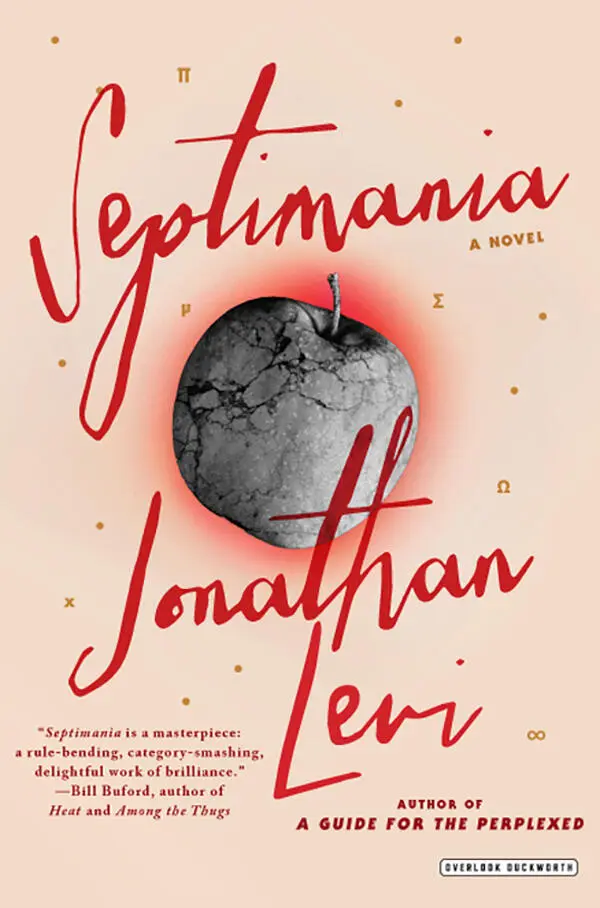
- Название:Septimania
- Автор:
- Издательство:The Overlook Press
- Жанр:
- Год:2016
- ISBN:нет данных
- Рейтинг книги:4 / 5. Голосов: 1
-
Избранное:Добавить в избранное
- Отзывы:
-
Ваша оценка:
Septimania: краткое содержание, описание и аннотация
Предлагаем к чтению аннотацию, описание, краткое содержание или предисловие (зависит от того, что написал сам автор книги «Septimania»). Если вы не нашли необходимую информацию о книге — напишите в комментариях, мы постараемся отыскать её.
Over the next fifty years, Malory’s search for Louiza leads to encounters with Pope John Paul II, a band of lost Romanians, a magical Bernini statue, Haroun al Rashid of Arabian Nights fame, an elephant that changes color, a shadowy U.S. spy agency and one of the 9/11 bombers, an appleseed from the original Tree of Knowledge, and the secret history of Isaac Newton and his discovery of a Grand Unified Theory that explains everything. It is the quest of a Candide for love and knowledge, and the ultimate discovery that they may be unified after all.
Septimania — читать онлайн бесплатно полную книгу (весь текст) целиком
Ниже представлен текст книги, разбитый по страницам. Система сохранения места последней прочитанной страницы, позволяет с удобством читать онлайн бесплатно книгу «Septimania», без необходимости каждый раз заново искать на чём Вы остановились. Поставьте закладку, и сможете в любой момент перейти на страницу, на которой закончили чтение.
Интервал:
Закладка:
“Louiza wants a biscuit,” Malory said. Louiza’s body slowly relaxed, and the moisture from the latest contraction left a stain against Malory’s corduroy lapel.
“And I want a coffee,” Tibor said, “and half a bottle of grappa. But there isn’t time.” And Tibor put a large paw on Malory’s shoulder and propelled him forward, down the alley.
“Biscuit later, Louiza,” Malory murmured. He felt her nod, or at least felt her nose bury itself between two buttons of his shirt until it pressed its wet, friendly intimacy into his chest.
She wanted desperately to talk to Malory, to tell him about the problems. But she couldn’t, weak with the pain and the effort and needing sleep and a biscuit, maybe two, and some tea, and a way to ease this thing, this problem out of her womb and into this world. But what world? The world in her vision was Malory’s damp shirt, the walls of Renaissance palazzi as Malory carried her through the streets of Rome, the occasional bit of sky. Broken columns, amalgamated brick and stone of crumbling houses, a square block of roof, and then a sky that opened up as Malory carried her towards the river, figured more as variables in an equation than as points on a guided tour of Rome. They were all part of another problem of origins, like the problems they had brought her in the cottage. If she could only solve this problem, Louiza thought, then maybe, just maybe, the pain would go away.
There would be time, she was sure of it. There would be time to take pencil and paper and sort it all out. As blurred and bumpy as the journey was, Louiza felt a comfort in Malory’s arms. She was rescued. Malory had come and rescued her, even if she had been the one who had traveled — she still couldn’t remember how — across the Channel and half of Europe to find him in Rome. He was with her now, carrying her past elephants and down alleys, carrying her and their child. Had she told him? Of all the many questions, the one that had an answer was whose child she was carrying. It was Malory’s, could only be Malory’s. They would be together, the three of them, she and Malory and the child, bound in that indelible equation i = u.
But where in that equation was there space for the baby? Louiza raised her face towards Malory, Malory of the determined eyes, Malory of the unfailing plod and steady breath, who was trotting after Tibor, following him past the buzz of motorcycles and the rush of water mixed with the diesel of autobuses. The equation was perfect with Louiza and Malory, but with Malory and Louiza alone. Louiza = Malory, Malory = Louiza. Maybe that’s why this baby inside her was causing such pain, up, down, inside and out. It didn’t fit. The baby didn’t fit in the equation.
There was another equation that troubled Malory.
October minus March equals seven. Seven, not nine. Not the nine months of human gestation, but the seven months since he had made love to Louiza in the organ loft of St. George, Whistler Abbey, which, although they seemed like an eternity to Malory, didn’t add up. Wasn’t twenty-eight weeks much too early? Was Louiza’s baby premature? Or worst of all, had some other organ tuner climbed into Louiza’s loft two months before him?
“There it is,” Tibor shouted at Malory as they shuffled across the Lungotevere through the fallen leaves of the plane trees. Malory saw an island in the middle of the river, a fortress of an island, a stone boat floating, against the rules of all physics, in the middle of the river.
“What is it?” Malory puffed after.
“L’Isola Tiberina. The island of the Tiber!” Tibor shouted into Malory’s uncomprehending face. “The best goddamned place to have a child on Earth. Follow me!”
“Ah,” Malory said. And armed with little more knowledge than before, Malory struggled over a stone bridge to the Isola Tiberina following Tibor as he turned right beneath an Art Nouveau awning: Ospedale Fatebenefratelli.
“ Buona sera .” A nun nodded at him. “ Sua moglie? ” Malory was on the verge of stopping and asking which way it was to the maternity ward, when he saw the sign Maternità and turned left.
“Malory!” Tibor shouted at him from the opposite direction. “Forget the signs, this is Italy.” At a slightly slower pace, Malory carried Louiza into one courtyard, full of visitors squatting on plastic benches or stretched out on old newspapers along the wall. They jogged around a makeshift bar of charcoal burner and clothesline holding pages of the day’s L’Osservatore Romano , through another arcade and into a second courtyard that turned back in the direction of the bridge. Malory looked hopefully to the signs on the left-hand staircases, but most of them were either unintelligible or prefixed with pessimistic onco ’s and cardio ’s.
“I told you,” Tibor said, running for a staircase in a far corner, “no signs! This way.” Malory followed Tibor up a staircase one flight, then two.
“Almost there, Louiza,” he whispered her name, setting his courage to the verge of overheating with the thought that he, Malory, was on the cusp of fatherhood.
“Malory,” Louiza said, “you’ll stay with me, won’t you? You’ll stay?” She had forgotten about the equations, forgotten about the problems. The contractions had focused her mind on this miraculous man who was carrying her — was he really big enough to do that? — carrying her in his arms.
And Malory — Malory didn’t know what the rules were, barely knew where they were, but he pulled Louiza tight, his cheek pressed to hers, her breath hot and wet in his ear. And if it were possible, he felt the Pip in the Kit Bag pull her in even tighter as he floated, yes floated with the long-sought Louiza in his arms down the hallways of the Ospedale Fatebenefratelli.
“ Fututi pizda matii! ” Tibor shouted for the fifth time that morning. “ Eccoci qua! Here we are!” Tibor stopped at a door much like the others. A variety of nurse-like nuns or nun-like nurses kept a steady flow down the slow lanes of the corridors as Malory tried to catch his breath. And with that announcement, Tibor turned the handle and pushed the door wide open.
Breathless as he was, Malory stopped breathing for more than a moment at the radiance that embraced the three of them. Even Louiza raised her face towards the glow that came from inside. The room that opened up to them was at the forward-most point of the Ospedale Fatebenefratelli, the prow of the ship. It was a triangular room of sunlight and marble; an altarpiece window on starboard and another on portside made the room seem like it was carving a wake of light through the Tiber towards the Ponte Garibaldi and, in the far distance, the dome of St. Peter’s. And the sun from the windows made it nearly impossible to see the few contents of the room — an armchair, a low table, a pair of beds.
A nun appeared from behind the door.
“We’ve been expecting you, my dear.” An English accent. The sister guided Malory to the bed on the left. She pulled down the covers and smiled. Malory, in his exhaustion, accepted both accent and invitation as he would a pair of scones and a cup of tea. He met the sister’s smile and set Louiza gently on sun-warmed sheets.
“Don’t go,” she whispered through the sweat and the matted hair.
“No one’s going anywhere,” the sister said, easing Louiza’s grip from Malory’s neck. “We’re just going to clean you up and help you into something more comfortable. You’ll want to look your best to greet your new baby, won’t you?”
In the Roman sunlight, filtered only by the umbrella pines outside the window and a bit of curtainy lace, Louiza was as angelic as any of the creatures he had seen dancing in the dust of the organ loft that afternoon back in March. Some might say Louiza needed a serious wash-up after her cross-continental hegira . But to Malory, there was no more best than how she looked.
Читать дальшеИнтервал:
Закладка:
Похожие книги на «Septimania»
Представляем Вашему вниманию похожие книги на «Septimania» списком для выбора. Мы отобрали схожую по названию и смыслу литературу в надежде предоставить читателям больше вариантов отыскать новые, интересные, ещё непрочитанные произведения.











Обсуждение, отзывы о книге «Septimania» и просто собственные мнения читателей. Оставьте ваши комментарии, напишите, что Вы думаете о произведении, его смысле или главных героях. Укажите что конкретно понравилось, а что нет, и почему Вы так считаете.